

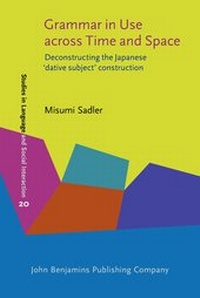
Grammar in Use across Time and Space
Deconstructing the Japanese 'dative subject' construction
Published on 6. November 2007
Book
Hardback
212 pages
978-90-272-2630-3 (ISBN)
Description
This monograph contains the first systematic investigation of the Japanese 'dative subject' construction across time and space. It demonstrates that, in order to capture what speakers/writers know about how to put an utterance or a clause together, it is necessary to pay attention to what they do in actual language use and in different discourse types. The work also shows the importance of diachronic perspectives to help us better understand the ways in which a particular grammatical structure is represented synchronically. By utilizing modern Japanese conversation, contemporary Japanese novels, and a pre-modern and modern Japanese literature corpus, the study highlights the role of 'dative subjects' at the semantic and discourse-pragmatic levels. Specifically, it demonstrates that what has been considered to be a most 'grammatical' aspect of Japanese actually turns out to be rather pragmatically oriented.
Reviews / Votes
This monograph is the first systematic investigation of the 'dative subject' construction in Japanese across time and space. [...] Misumi Sadler's monograph provides fascinating new perspectives on the Japanese dative subject construction across space and time. This is certainly a significant contribution in the area of historical pragmatics as well as Japanese linguistics. -- Minako Nakayasu, Hamamatsu University School of Medicine, Japan, in the Journal of Historical Pragmatics, Vol. 11:2 (2010)More details
Series
Language
English
Place of publication
Amsterdam
Netherlands
Target group
Professional and scholarly
Dimensions
Height: 245 mm
Width: 164 mm
Weight
560 gr
ISBN-13
978-90-272-2630-3 (9789027226303)
Copyright in bibliographic data and cover images is held by Nielsen Book Services Limited or by the publishers or by their respective licensors: all rights reserved.
Schweitzer Classification
Other editions
Additional editions
Misumi Sadler
Grammar in Use across Time and Space
Deconstructing the Japanese 'dative subject' construction
E-Book
11/2007
1st Edition
John Benjamins Publishing Company
€130.99
Available for download
Person
Content
1. List of tables; 2. List of figures; 3. Acknowledgments; 4. Chapter 1. Introduction; 5. 1.1. Overview; 6. 1.2. Previous approaches; 7. 1.3. Theoretical approach; 8. 1.4. Goals; 9. 1.5. Organization; 10. Chapter 2. Data and methodology; 11. 2.1. Introduction; 12. 2.2. Spoken versus written; 13. 2.3. Modern Japanese discourse data; 14. 2.4. Criteria for selecting the dative subject construction in discourse; 15. 2.5. Examples of coding clauses; 16. 2.6 Summary; 17. Chapter 3. The dative subject construction in naturally occurring conversation; 18. 3.1. Introduction; 19. 3.2. Overall distribution; 20. 3.3. Clauses with or without overt core argument NPs; 21. 3.4. Clauses with no overt core argument NPs; 22. 3.5. Clauses with one overt core argument NP; 23. 3.6. Marking of NPs; 24. 3.7. The characteristics of "dative subjects" in naturally occurring conversation; 25. 3.8 Summary; 26. Chapter 4. The dative subject construction in contemporary Japanese novels; 27. 4.1. Introduction; 28. 4.2. Overall distribution; 29. 4.3. Clauses with or without overt core argument NPs; 30. 4.4. Clauses with one overt core argument NP; 31. 4.5. Clauses with no overt core argument NPs; 32. 4.6. Marking of NPs; 33. 4.7. The characteristics of "dative subjects" in contemporary Japanese novels; 34. 4.8 Summary; 35. Chapter 5. "Dative subjects" across time: An examination of pre-modern and modern Japanese texts; 36. 5.1. Introduction; 37. 5.2. The history of the Japanese language: The divergence and convergence of spoken and written Japanese; 38. 5.3. Data; 39. 5.4. Ni-marked NP1s in pre-modern and modern Japanese texts; 40. 5.5 Summary; 41. Chapter 6. Conclusion; 42. 6.1. Introduction; 43. 6.2. Summary; 44. 6.3. The semantic and pragmatic enrichment of ni-marked NP1s; 45. 6.4. Implications; 46. 6.5. Suggestions for further studies; 47. Appendix A: List of abbreviations; 48. Appendix B: Transcription symbols; 49. References; 50. Author index; 51. Subject index