

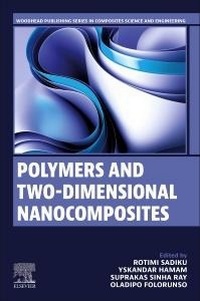
Polymers and Two-Dimensional Nanocomposites
Published on 26. November 2024
Book
Paperback/Softback
716 pages
978-0-443-14131-7 (ISBN)
Description
Polymers and Two-Dimensional Nanocomposites provides a detailed review of recent progress in this important research field. The chapters cover new developments in synthesis methods, fabrication techniques, sample preparation methods, surface modification, characterization, methods of enhancing the properties of these materials and industrial applications in energy, environmental, oil and gas, sensors, corrosion, biomedical and structural applications.
The book provides a valuable reference resource for academic and industrial researchers, materials scientists and engineers working in the fields of polymer science and engineering, polymer composites and nanocomposites.
The book provides a valuable reference resource for academic and industrial researchers, materials scientists and engineers working in the fields of polymer science and engineering, polymer composites and nanocomposites.
More details
Series
Language
English
Place of publication
United States
Publishing group
Elsevier - Health Sciences Division
Target group
Professional and scholarly
Product notice
Paperback (trade)
Unsewn / adhesive bound
Dimensions
Height: 229 mm
Width: 155 mm
Thickness: 34 mm
Weight
1125 gr
ISBN-13
978-0-443-14131-7 (9780443141317)
Copyright in bibliographic data and cover images is held by Nielsen Book Services Limited or by the publishers or by their respective licensors: all rights reserved.
Schweitzer Classification
Other editions
Additional editions
Rotimi Sadiku | Yskandar Hamam | Suprakas Sinha Ray
Polymers and Two-Dimensional Nanocomposites
E-Book
11/2024
Elsevier
€275.00
Available for download
Persons
Prof. Rotimi Sadiku is currently an Emeritus Professor at the Tshwane University of Technology, Pretoria, South Africa.
Professor Emmanuel Rotimi Sadiku started his career as early as in 1976 as assistant Supervisor at the Zaria Industries Limited Nigeria and later received the Nigeria Government Scholarship to pursue a BSc [Hons.] (1980) degree at the University of Strathclyde, Glasgow, Scotland, UK. During this journey, he received numerous awards as best student and then, received the Nigeria government scholarship to pursue his PHD (1986) in Polymer Science at University of Strathclyde. He did a 11/2 years postdoctoral fellowship at the CNR/University of Genova, Italy (1989/90) After receiving postdoctoral fellowship award (Swedish Institute Research Fellowship) he joined (1990) the Department of Polymer Technology, Royal Institute of Technology, Stockholm, Sweden. He did spend 1/2 year at the Faculty of Physics, Freiburg University as Visiting Scientist. In 1999, he later received South African Research Foundation (NRF) Fellowship award to join University of Stellenbosch, Institute for Polymer Science.
Prof. Yskandar Hamam received his bachelor's degree in electrical engineering from the American University of Beirut, in 1966, and then went on to achieve his M.Sc. and Ph.D. degrees from the University of Manchester (UMIST) in 1970 and 1972. From 1966 to 1968, he worked as an engineer on various projects in Beirut. He became an Adjunct Professor with the Universidade Federal Rio de Janeiro, from 1972 to 1973 and then became an Assistant Professor with the American University, from 1973 to 1976. From 1977 to 1978 he worked as a researcher with Union Power Companies, in Charleroi, Belgium. In 1979 to 1991, he became Head of the Department of Continuing Education, Ecole Superieure d'Ingenieurs Electrotechniqueet Electronique (ESIEE), Noisy-le-Grand, France, where he later became Dean of Faculty, from 1991 to 1996. He has been Head of the Computer Control Laboratory, Noisyle-Grand, since 1996. He has co-authored four books, 25 book chapters and has authored or co-authored more than 100 articles in peer-reviewed journals and conference proceedings. He is currently Scientific Director of the French South African Institute of Technology (F'SATI), at Tshwane University of Technology, South Africa, and is an Emeritus Professor with ESIEE. Professor Suprakas Sinha Ray is a Chief Research Scientist and Manager of the Centre for Nanostructures and Advanced Materials, and Director of the DSTI-CSIR Nanotechnology Innovation Centre, Council for Scientific and Industrial Research, Pretoria, South Africa. He received his PhD degree in Physical Chemistry at the University of Calcutta, India, in 2001, and was a recipient of the ''Sir P. C Ray Research Award'' for the best PhD work. Prof. Ray's current research focuses on the applications of advanced nanostructured & polymeric materials. He is one of the most active and highly cited authors (h-index of 99) in the field of polymer nanocomposite materials, and he has recently been ranked by Thomson Reuters among the Top 1% most impactful and influential scientists and among the top 50 high-impact chemists.
He has delivered more than 77 plenary/keynote/invited presentations at international conferences and has organised or co-organised several events. He authored 16 books, co-authored 13 edited books, wrote 65 book chapters on various aspects of polymer-based nano-structured materials and their applications, and published 687 articles in high-impact international journals. His work also includes 14 articles in peer-reviewed international conference proceedings and 30 articles in national and international conference proceedings. Additionally, he holds nine patents (registered or pending) and has developed 13 new technologies, which he has shared with colleagues, collaborators, and industry partners. His team has commercialised several products and supported SMMEs. Over the past 19 years, he has mentored 27 postdoctoral fellows and supervised 48 PhD and 17 Master's students. In 2016, he was honored with South Africa's most prestigious NSTF Award.
Oladipo FOLORUNSO obtained his bachelor and master's degree in electrical engineering from the Federal University of Technology, Akure, and the University of Benin in Nigeria.He is currently pursuing his Doctoral degree in Electrical Engineering at Tshwane University of Technology, Republic of South Africa. His research interests include polymer nanocomposites for energy storage applications.
Professor Emmanuel Rotimi Sadiku started his career as early as in 1976 as assistant Supervisor at the Zaria Industries Limited Nigeria and later received the Nigeria Government Scholarship to pursue a BSc [Hons.] (1980) degree at the University of Strathclyde, Glasgow, Scotland, UK. During this journey, he received numerous awards as best student and then, received the Nigeria government scholarship to pursue his PHD (1986) in Polymer Science at University of Strathclyde. He did a 11/2 years postdoctoral fellowship at the CNR/University of Genova, Italy (1989/90) After receiving postdoctoral fellowship award (Swedish Institute Research Fellowship) he joined (1990) the Department of Polymer Technology, Royal Institute of Technology, Stockholm, Sweden. He did spend 1/2 year at the Faculty of Physics, Freiburg University as Visiting Scientist. In 1999, he later received South African Research Foundation (NRF) Fellowship award to join University of Stellenbosch, Institute for Polymer Science.
Prof. Yskandar Hamam received his bachelor's degree in electrical engineering from the American University of Beirut, in 1966, and then went on to achieve his M.Sc. and Ph.D. degrees from the University of Manchester (UMIST) in 1970 and 1972. From 1966 to 1968, he worked as an engineer on various projects in Beirut. He became an Adjunct Professor with the Universidade Federal Rio de Janeiro, from 1972 to 1973 and then became an Assistant Professor with the American University, from 1973 to 1976. From 1977 to 1978 he worked as a researcher with Union Power Companies, in Charleroi, Belgium. In 1979 to 1991, he became Head of the Department of Continuing Education, Ecole Superieure d'Ingenieurs Electrotechniqueet Electronique (ESIEE), Noisy-le-Grand, France, where he later became Dean of Faculty, from 1991 to 1996. He has been Head of the Computer Control Laboratory, Noisyle-Grand, since 1996. He has co-authored four books, 25 book chapters and has authored or co-authored more than 100 articles in peer-reviewed journals and conference proceedings. He is currently Scientific Director of the French South African Institute of Technology (F'SATI), at Tshwane University of Technology, South Africa, and is an Emeritus Professor with ESIEE. Professor Suprakas Sinha Ray is a Chief Research Scientist and Manager of the Centre for Nanostructures and Advanced Materials, and Director of the DSTI-CSIR Nanotechnology Innovation Centre, Council for Scientific and Industrial Research, Pretoria, South Africa. He received his PhD degree in Physical Chemistry at the University of Calcutta, India, in 2001, and was a recipient of the ''Sir P. C Ray Research Award'' for the best PhD work. Prof. Ray's current research focuses on the applications of advanced nanostructured & polymeric materials. He is one of the most active and highly cited authors (h-index of 99) in the field of polymer nanocomposite materials, and he has recently been ranked by Thomson Reuters among the Top 1% most impactful and influential scientists and among the top 50 high-impact chemists.
He has delivered more than 77 plenary/keynote/invited presentations at international conferences and has organised or co-organised several events. He authored 16 books, co-authored 13 edited books, wrote 65 book chapters on various aspects of polymer-based nano-structured materials and their applications, and published 687 articles in high-impact international journals. His work also includes 14 articles in peer-reviewed international conference proceedings and 30 articles in national and international conference proceedings. Additionally, he holds nine patents (registered or pending) and has developed 13 new technologies, which he has shared with colleagues, collaborators, and industry partners. His team has commercialised several products and supported SMMEs. Over the past 19 years, he has mentored 27 postdoctoral fellows and supervised 48 PhD and 17 Master's students. In 2016, he was honored with South Africa's most prestigious NSTF Award.
Oladipo FOLORUNSO obtained his bachelor and master's degree in electrical engineering from the Federal University of Technology, Akure, and the University of Benin in Nigeria.He is currently pursuing his Doctoral degree in Electrical Engineering at Tshwane University of Technology, Republic of South Africa. His research interests include polymer nanocomposites for energy storage applications.
Editor
Tshwane University of Technology, Department of Chemical, Metallurgical and Materials Engineering, South Africa
Tshwane University of Technology, South Africa.Emeritus Professor at EISEE Paris, France and Tshwane University of Technology, South Africa
Centre for Nanostructures and Advanced Materials, DSTI-CSIR Nanotechnology Innovation Centre, Council for Scientific and Industrial Research, Pretoria, South Africa
Tshwane University of Technology, Republic of South Africa
Content
1. Two-dimensional nanofillers
2. General overview of polymers and two-dimensional nanofiller-based nanocomposites
3. Bottom-up and top-down fabrication processes of polymer and two-dimensional nanocomposites
4. Borophene: synthesis methods, applications, challenges, and future prospects
5. Proper samples preparation methods for SEM, TEM, TGA, XRD, and DSC: techniques, operations, and recommendation
6. Surface modification of two-dimensional materials: techniques and applications
7. Characterization of polymer and two-dimensional nanocomposites: A molecular dynamics approach
8. Enhancing the mechanical and electrical properties of polymers using graphene
9. Enhancing the electromagnetic, piezoresistive and electrical properties of polymers using MXene
10. Thermal, thermomechanical and rheology properties of polymer nanocomposite
11. Thermal and electrical conductivity of polymer and polymer nanocomposite
12. Investigating the optical properties of polymer nanocomposites: synthesis, challenges, and recommendations
13. Recent development in polymer nanocomposites for energy storage applications especially supercapacitors
14. Fuel cell-based polymer based two-dimensional nanocomposites: synthesis, challenges, and prospects
15. Li ion batteries and polymer nanocomposite
16. Conductive polymers: Effective materials for heavy metal ions removal (Water treatment).
17. Polymer nanocomposites in the oil and gas and defence industry
18. Polymer and graphene sensors
19. Polymer nanocomposite field effect transistors
20. Recent development in polymer nanocomposites for corrosion treatment
21. Structural applications of polymer and two-dimensional nanocomposites: A critical review
22. Recent development in polymer nanocomposites for biomedical and antibacterial applications
23. Future of applications of polymer based two-dimensional nanocomposites
2. General overview of polymers and two-dimensional nanofiller-based nanocomposites
3. Bottom-up and top-down fabrication processes of polymer and two-dimensional nanocomposites
4. Borophene: synthesis methods, applications, challenges, and future prospects
5. Proper samples preparation methods for SEM, TEM, TGA, XRD, and DSC: techniques, operations, and recommendation
6. Surface modification of two-dimensional materials: techniques and applications
7. Characterization of polymer and two-dimensional nanocomposites: A molecular dynamics approach
8. Enhancing the mechanical and electrical properties of polymers using graphene
9. Enhancing the electromagnetic, piezoresistive and electrical properties of polymers using MXene
10. Thermal, thermomechanical and rheology properties of polymer nanocomposite
11. Thermal and electrical conductivity of polymer and polymer nanocomposite
12. Investigating the optical properties of polymer nanocomposites: synthesis, challenges, and recommendations
13. Recent development in polymer nanocomposites for energy storage applications especially supercapacitors
14. Fuel cell-based polymer based two-dimensional nanocomposites: synthesis, challenges, and prospects
15. Li ion batteries and polymer nanocomposite
16. Conductive polymers: Effective materials for heavy metal ions removal (Water treatment).
17. Polymer nanocomposites in the oil and gas and defence industry
18. Polymer and graphene sensors
19. Polymer nanocomposite field effect transistors
20. Recent development in polymer nanocomposites for corrosion treatment
21. Structural applications of polymer and two-dimensional nanocomposites: A critical review
22. Recent development in polymer nanocomposites for biomedical and antibacterial applications
23. Future of applications of polymer based two-dimensional nanocomposites