

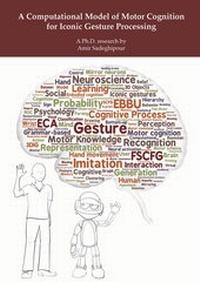
A computational model of motor cognition for iconic gesture processing
1st Edition
Published on 19. March 2015
Book
298 pages
978-3-8440-3451-6 (ISBN)
Description
In this PhD thesis, I propose a computational cognitive model for processing iconic gestures performed with hands and arms. Among different social behaviors, investigating gestures has gained special attention during the last decades. In the field of human-computer interaction, advances in motion tracking systems have opened the gateway to the broader application of gesture-based user interfaces. Virtual humanoid agents are been increasingly used in human-computer interaction as user friendly interfaces that allow for intuitive and natural face-to-face communication.
Against this background, I propose a model that endows artificial humanoid agents with the ability to gesture. This capacity includes, for instance, fast and reliable recognition of highly diverse gesture performances, the ability to learn how to perform gestures through imitation, and to establish gestural alignment during interaction with human users. To this end, I propose a cognitive model of the human sensorimotor system based on neuroscience and psychological empirical evidence, and couched in current cognitive theories. To implement information processing within this cognitive model, I propose two computational approaches with complementary strengths and weaknesses: (1) Empirical Bayesian Belief Update (EBBU) features the fast, incremental and cognitively plausible recognition of gestures during interaction with humans. (2) Feature-based Stochastic Context-Free Grammar (FSCFG) learns discriminative or descriptive grammar models of gesture performances.
Against this background, I propose a model that endows artificial humanoid agents with the ability to gesture. This capacity includes, for instance, fast and reliable recognition of highly diverse gesture performances, the ability to learn how to perform gestures through imitation, and to establish gestural alignment during interaction with human users. To this end, I propose a cognitive model of the human sensorimotor system based on neuroscience and psychological empirical evidence, and couched in current cognitive theories. To implement information processing within this cognitive model, I propose two computational approaches with complementary strengths and weaknesses: (1) Empirical Bayesian Belief Update (EBBU) features the fast, incremental and cognitively plausible recognition of gestures during interaction with humans. (2) Feature-based Stochastic Context-Free Grammar (FSCFG) learns discriminative or descriptive grammar models of gesture performances.
More details
Series
Thesis
Doctoral thesis
2014
Universität Bielefeld
Language
English
Place of publication
Aachen
Germany
Target group
Professional and scholarly
Product notice
Unsewn / adhesive bound
Illustrations
75
75 farbige Abbildungen
85
Dimensions
Height: 24 cm
Width: 17 cm
Weight
444 gr
ISBN-13
978-3-8440-3451-6 (9783844034516)
Schweitzer Classification