

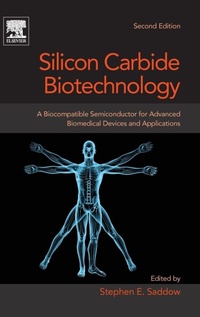
Silicon Carbide Biotechnology
A Biocompatible Semiconductor for Advanced Biomedical Devices and Applications
2nd Edition
Published on 1. March 2016
Book
Hardback
378 pages
978-0-12-802993-0 (ISBN)
Description
Silicon Carbide Biotechnology: A Biocompatible Semiconductor for Advanced Biomedical Devices and Applications, Second Edition, provides the latest information on this wide-band-gap semiconductor material that the body does not reject as a foreign (i.e., not organic) material and its potential to further advance biomedical applications.
SiC devices offer high power densities and low energy losses, enabling lighter, more compact, and higher efficiency products for biocompatible and long-term in vivo applications, including heart stent coatings, bone implant scaffolds, neurological implants and sensors, glucose sensors, brain-machine-interface devices, smart bone implants, and organ implants.
This book provides the materials and biomedical engineering communities with a seminal reference book on SiC for developing technology, and is a resource for practitioners eager to identify and implement advanced engineering solutions to their everyday medical problems for which they currently lack long-term, cost-effective solutions.
SiC devices offer high power densities and low energy losses, enabling lighter, more compact, and higher efficiency products for biocompatible and long-term in vivo applications, including heart stent coatings, bone implant scaffolds, neurological implants and sensors, glucose sensors, brain-machine-interface devices, smart bone implants, and organ implants.
This book provides the materials and biomedical engineering communities with a seminal reference book on SiC for developing technology, and is a resource for practitioners eager to identify and implement advanced engineering solutions to their everyday medical problems for which they currently lack long-term, cost-effective solutions.
More details
Edition
2nd edition
Language
English
Place of publication
United States
Target group
Professional and scholarly
Biomedical and materials engineers and scientists, device professionals and related specialists searching for a robust biomedical option for implantation with semiconductor effects.
Product notice
Laminated cover
Dimensions
Height: 234 mm
Width: 156 mm
Thickness: 22 mm
Weight
709 gr
ISBN-13
978-0-12-802993-0 (9780128029930)
Copyright in bibliographic data and cover images is held by Nielsen Book Services Limited or by the publishers or by their respective licensors: all rights reserved.
Schweitzer Classification
Other editions
Additional editions
Stephen E. Saddow
Silicon Carbide Biotechnology
A Biocompatible Semiconductor for Advanced Biomedical Devices and Applications
E-Book
03/2016
2nd Edition
Elsevier
€143.00
Available for download
Previous edition
Stephen Saddow
Silicon Carbide Biotechnology
A Biocompatible Semiconductor for Advanced Biomedical Devices and Applications
Book
01/2012
Elsevier
€179.81
Withdrawn from sale
Person
Dr. Stephen E. Saddow is currently a Professor of Electrical Engineering and Medical Engineering, both departments in the College of Engineering at the University of South Florida (USF), Tampa. In 2020, he was appointed as a visiting researcher in the Molecular Imaging Branch, National Cancer Institute, Bethesda, MD to facilitate the development of SiC-based nanoparticles to treat deep tissue cancer using near-infrared photoimmunotherapy (NIR-PIT). He is also a visiting scientist in the Elettra synchrotron light source in Trieste, Italy (BEAR beamline). He was elected Fellow of the AIMBE and is a senior member of both the IEEE and National Academy of Inventors. His group has demonstrated the compatibility of SiC and graphene to numerous cell lines in vitro and to the central nervous system of wild-type mice to cubic SiC (3C-SiC) in vivo. Studies include the MRI compatibility of 3C-SiC for neural probe applications as well as the ability to noninvasively detect changes in patient glucose levels without the need of needles that require frequent swap-out. The hemocompatibility of 3C-SiC has been established leading to the demonstration that 3C-SiC passed all phases of ISO-10993 testing, which is necessary to secure FDA approval for human clinical trials. He holds several patents relating to SiC biomedical devices, such as implantable glucose sensors and neural implants. He has more than 150 publications on SiC materials and devices and has edited two books on this topic: 'Silicon Carbide Biotechnology: A Biocompatible Semiconductor for Advanced Biomedical Devices and Applications' (Elsevier, 2012) and 'Silicon Carbide Biotechnology: A Biocompatible Semiconductor for Advanced Biomedical Devices and Applications, Second Edition' (Elsevier, 2016). His research interests include the development of advanced biomedical devices for human healthcare applications where he works at the nexus of material and biological science to engineer long-term, in vivo medical devices based on silicon carbide and its derivatives.
Content
1. Silicon Carbide for Biomedical Applications: An Update2. The Cytotoxicity of 3C-SiC and a-SiC Investigated through Strict Adherence to ISO 109933. Study of the Hemocompatiblity of SiC: 3C-S-C and a-SiC Films4. Graphene Functionalization for Biosensor Applications5. SIC Bio-sensing and Electrochemical Sensing State of the Art and Perspective6. SiC RF Antennas for in-vivo Glucose Monitoring and WiFi Applications7. Solving Reliability and Stability Issues in Implantable Neural Interfaces with 3C-SiC8. Amorphous SiC for Neural Interface Applications9. SiC Nanowire Based Transistors for Electrical DNA Detection10. Silicon Carbide Based Nanowires for Biomedical Applications