

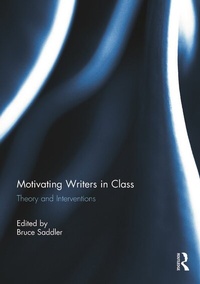
Motivating Writers in Class
Theory and Interventions
1st Edition
Published on 20. November 2013
Book
Hardback
134 pages
978-0-415-72638-2 (ISBN)
Description
Writing is a very complex process that is difficult to teach, learn, and research. Although many students struggle with writing, composing often presents major challenges for students with disabilities. One area of written expression that presents particular difficulties for students with disabilities is motivation.
Motivation is a key aspect of written expression that helps all writers complete difficult composing tasks. However, students with disabilities may have more negative motivational patterns and may also be less positive about writing and their ability as writers than their normally achieving peers.
Logically, this means that effective writing intervention efforts must not only address how to write but must also articulate methods to increase students' motivation to write. This book, written for teachers, scholars, and researchers, focuses on the essential issue of helping students learn how to want to write. Each contributing author presents an important theoretical or pedagogical element of writing motivation, for example:
The historical beginnings of research in this area
Conceptual and methodological advances in the field of motivation to write
Developmental trajectories of writing motivation in typical and atypical populations
The effect of playful writing tasks on the development of writing ability as well as on motivation to write
The impact of writing prompts on motivation
How reading motivation relates and supports writing motivation
This book was originally published as a special issue of Reading and Writing Quarterly.
Motivation is a key aspect of written expression that helps all writers complete difficult composing tasks. However, students with disabilities may have more negative motivational patterns and may also be less positive about writing and their ability as writers than their normally achieving peers.
Logically, this means that effective writing intervention efforts must not only address how to write but must also articulate methods to increase students' motivation to write. This book, written for teachers, scholars, and researchers, focuses on the essential issue of helping students learn how to want to write. Each contributing author presents an important theoretical or pedagogical element of writing motivation, for example:
The historical beginnings of research in this area
Conceptual and methodological advances in the field of motivation to write
Developmental trajectories of writing motivation in typical and atypical populations
The effect of playful writing tasks on the development of writing ability as well as on motivation to write
The impact of writing prompts on motivation
How reading motivation relates and supports writing motivation
This book was originally published as a special issue of Reading and Writing Quarterly.
More details
Language
English
Place of publication
London
United Kingdom
Publishing group
Taylor & Francis Ltd
Target group
College/higher education
Illustrations
1 s/w Abbildung, 1 s/w Zeichnung
1 Line drawings, black and white; 1 Illustrations, black and white
Dimensions
Height: 246 mm
Width: 174 mm
Weight
408 gr
ISBN-13
978-0-415-72638-2 (9780415726382)
Copyright in bibliographic data and cover images is held by Nielsen Book Services Limited or by the publishers or by their respective licensors: all rights reserved.
Schweitzer Classification
Other editions
Additional editions
E-Book
04/2023
1st Edition
Routledge
€69.99
Available for download
E-Book
04/2023
1st Edition
Routledge
€69.99
Available for download
Book
07/2015
1st Edition
Routledge
€69.00
Shipment within 10-20 days
Person
Bruce Saddler is Assistant Professor in the Special Education program at the University of Albany, USA. His research interests include writing disabilities, self-monitoring, and self-regulation.
Content
Motivating Writers: Theory and Interventions Bruce Saddler 1. Motivation Research in Writing: Theoretical and Empirical Considerations Gary A. Troia, Rebecca K. Shankland, and Kimberly A. Wolbers 2. Teaching Elementary School Students to Play With Meanings and Genre Pietro Boscolo, Carmen Gelati, and Nicoletta Galvan 3. Are Attitudes Toward Writing and Reading Separable Constructs? A Study With Primary Grade Children Steve Graham, Virginia Berninger, and Robert Abbott 4. Avoiding the Struggle: Instruction That Supports Students' Motivation in Reading and Writing About Content Material Linda H. Mason, Hedda Meadan, Laura R. Hedin, and Anne Mong Cramer 5. State Writing Assessment: Inclusion of Motivational Factors in Writing Tasks Natalie G. Olinghouse, Jinjie Zheng, and Larissa Morlock