

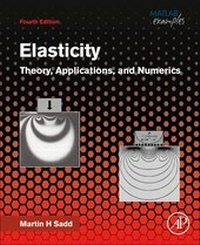
Elasticity
Theory, Applications, and Numerics
4th Edition
Published on 25. March 2020
Book
Paperback/Softback
624 pages
978-0-12-815987-3 (ISBN)
Description
Elasticity: Theory, Applications, and Numerics, Fourth Edition, continues its market-leading tradition of concisely presenting and developing the linear theory of elasticity, moving from solution methodologies, formulations, and strategies into applications of contemporary interest, such as fracture mechanics, anisotropic and composite materials, micromechanics, nonhomogeneous graded materials, and computational methods.
Developed for a one- or two-semester graduate elasticity course, this new edition has been revised with new worked examples and exercises, and new or expanded coverage of areas such as treatment of large deformations, fracture mechanics, strain gradient and surface elasticity theory, and tensor analysis. Using MATLAB software, numerical activities in the text are integrated with analytical problem solutions. Online ancillary support materials for instructors include a solutions manual, image bank, and a set of PowerPoint lecture slides.
Developed for a one- or two-semester graduate elasticity course, this new edition has been revised with new worked examples and exercises, and new or expanded coverage of areas such as treatment of large deformations, fracture mechanics, strain gradient and surface elasticity theory, and tensor analysis. Using MATLAB software, numerical activities in the text are integrated with analytical problem solutions. Online ancillary support materials for instructors include a solutions manual, image bank, and a set of PowerPoint lecture slides.
More details
Edition
4th edition
Language
English
Place of publication
San Diego
United States
Publishing group
Elsevier Science Publishing Co Inc
Target group
College/higher education
Graduate students in mechanical, civil, aerospace and materials engineering; R&D engineers in structural and mechanical design
Dimensions
Height: 235 mm
Width: 191 mm
Weight
1250 gr
ISBN-13
978-0-12-815987-3 (9780128159873)
Copyright in bibliographic data and cover images is held by Nielsen Book Services Limited or by the publishers or by their respective licensors: all rights reserved.
Schweitzer Classification
Other editions
New editions
Book
05/2025
5th Edition
Academic Press
€123.50
Shipment within 15-20 days
Additional editions
E-Book
03/2020
4th Edition
Academic Press
€88.95
Available for download
Previous edition
Book
03/2014
3rd Edition
Academic Press
€116.36
Article exhausted; check for reprint
Person
Martin H. Sadd is Professor Emeritus of Mechanical Engineering at the University of Rhode Island. He received his Ph.D. in mechanics from the Illinois Institute of Technology and began his academic career at Mississippi State University. In 1979 he joined the faculty at Rhode Island and served as department chair from 1991 to 2000. Professor Sadd's teaching background is in the area of solid mechanics with emphasis in elasticity, continuum mechanics, wave propagation, and computational methods. He has taught elasticity at two academic institutions, in several industries, and at a government laboratory. Professor Sadd's research has been in computational modeling of materials under static and dynamic loading conditions using finite, boundary, and discrete element methods. Much of his work has involved micromechanical modeling of geomaterials including granular soil, rock, and concretes. He has authored more than 75 publications and has given numerous presentations at national and international meetings.
Content
Part 1: Foundations and elementary applications1. Mathematical Preliminaries2. Deformation: Displacements and Strains3. Stress and Equilibrium4. Material Behavior - Linear Elastic Solids5. Formulation and Solution Strategies6. Strain Energy and Related Principles7. Two-Dimensional Formulation8. Two-Dimensional Problem Solution9. Extension, Torsion, and Flexure of Elastic Cylinders
Part 2: Advanced applications10. Complex Variable Methods11. Anisotropic Elasticity12. Thermoelasticity13. Displacement Potentials and Stress Functions: Applications to Three-Dimensional Problems14. Nonhomogeneous Elasticity15. Micromechanics Applications16. Numerical Finite and Boundary Element Methods
Part 2: Advanced applications10. Complex Variable Methods11. Anisotropic Elasticity12. Thermoelasticity13. Displacement Potentials and Stress Functions: Applications to Three-Dimensional Problems14. Nonhomogeneous Elasticity15. Micromechanics Applications16. Numerical Finite and Boundary Element Methods