

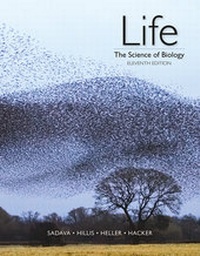
Life: The Science of Biology
11th Edition
Published on 1. December 2016
Book
Hardback
1268 pages
978-1-319-12657-5 (ISBN)
Description
Life is the most balanced experiment-based introductory biology textbook on the market, and the 10th edition has been revised to further align it with modern teaching of biology.
More details
Edition
11st ed. 2017
Language
English
Place of publication
New York
United Kingdom
Publishing group
Macmillan Learning
Target group
College/higher education
Edition type
Revised edition
Illustrations
1268 p.
Dimensions
Height: 23.5 cm
Width: 15.5 cm
ISBN-13
978-1-319-12657-5 (9781319126575)
DOI
10.26778/978-1-319-19000-2
Schweitzer Classification
Other editions
New editions
David Hillis | Heller H. Craig | Hacker Sally
Life: The Science of Biology Digital Update
Book
03/2023
12th Edition
W.H.Freeman & Co Ltd
€94.50
Available immediately
David Hillis | H. Craig Heller | Sally D. Hacker
Life: The Science of Biology
Book
03/2020
12th Edition
W.H.Freeman & Co Ltd
€74.89
Article exhausted; check for reprint
Previous edition
David M. Hillis | David E. Sadava | H. Craig Heller
Life: The Science of Biology
Book
12/2016
11th Edition
W.H.Freeman & Co Ltd
€190.45
Article exhausted; check for reprint
Persons
David E. Sadava is the Pritzker Family Foundation Professor of Biology, Emeritus, at the Keck Science Center of Claremont McKenna, Pitzer, and Scripps, three of The Claremont Colleges. In addition, he is Adjunct Professor of Cancer Cell Biology at the City of Hope Medical Center. Twice winner of the Huntoon Award for superior teaching, Dr. Sadava has taught courses on introductory biology, biotechnology, biochemistry, cell biology, molecular biology, plant biology, and cancer biology. In addition to Life: The Science of Biology, he is the author or coauthor of books on cell biology and on plants, genes, and crop biotechnology. His research has resulted in many papers coauthored with his students, on topics ranging from plant biochemistry to pharmacology of narcotic analgesics to human genetic diseases.
David M. Hillis is the Alfred W. Roark Centennial Professor in Integrative Biology at the University of Texas at Austin, where he also has directed the Center for Computational Biology and Bioinformatics and the School of Biological Sciences. Dr. Hillis has taught courses in introductory biology, genetics, evolution, systematics, and biodiversity. He has been elected to the National Academy of Sciences and the American Academy of Arts and Sciences, awarded a John D. and Catherine T. MacArthur Fellowship, and has served as President of the Society for the Study of Evolution and of the Society of Systematic Biologists.
H. Craig Heller is the Lorry I. Lokey/Business Wire Professor in Biological Sciences and Human Biology at Stanford University. He has taught in the core biology courses at Stanford since 1972 and served as Director of the Program in Human Biology, Chairman of the Biolo-gical Sciences Department, and Associate Dean of Research. Dr. Heller is a fellow of the American Association for the Advancement of Science and a recipient of the Walter J. Gores Award for excellence in teaching and the Kenneth Cuthberson Award for Exceptional Service to Stanford University
David M. Hillis is the Alfred W. Roark Centennial Professor in Integrative Biology at the University of Texas at Austin, where he also has directed the Center for Computational Biology and Bioinformatics and the School of Biological Sciences. Dr. Hillis has taught courses in introductory biology, genetics, evolution, systematics, and biodiversity. He has been elected to the National Academy of Sciences and the American Academy of Arts and Sciences, awarded a John D. and Catherine T. MacArthur Fellowship, and has served as President of the Society for the Study of Evolution and of the Society of Systematic Biologists.
H. Craig Heller is the Lorry I. Lokey/Business Wire Professor in Biological Sciences and Human Biology at Stanford University. He has taught in the core biology courses at Stanford since 1972 and served as Director of the Program in Human Biology, Chairman of the Biolo-gical Sciences Department, and Associate Dean of Research. Dr. Heller is a fellow of the American Association for the Advancement of Science and a recipient of the Walter J. Gores Award for excellence in teaching and the Kenneth Cuthberson Award for Exceptional Service to Stanford University
Content
Part ONE The Science of Life and Its Chemical Basis.- Part TWO Cells.- Part THREE Cells and Energy.- Part FOUR Genes and Heredity.- Part FIVE Genomes.- Part SIX The Patterns and Processes of Evolution.- Part SEVEN The Evolution of Diversity.- Part EIGHT Flowering Plants: Form and Function.- Part NINE Animals: Form and Function.- Part TEN Ecology