

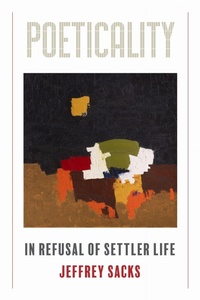
Poeticality
In Refusal of Settler Life
Published on 23. January 2026
Book
Hardback
336 pages
978-1-5315-1232-3 (ISBN)
Description
"Will you not memorize a little poetry to halt the slaughter?" the Palestinian poet Mahmoud Darwish wrote. Darwish's poetic statement points to world-evacuating and genocidal violences - in a triangulation of Palestine, Iraq, and the American settler state - as his language recalls us to a sonority in utterance and acts of refusal in collective form. Through readings of Arabic and Arab poetry, art, translation, and philosophy, Jeffrey Sacks illumines an indetermined, non-accumulative, non-propertied manner of lingual doing - across post-Ottoman topographies and states, and in excess of any single language - where language is a practice in sociality, the social is indistinct from the ontological, and being is a poetic mode - what this book calls "poeticality."
Poeticality studies the Lebanese-American poet and painter Etel Adnan, the Iraqi poet and translator Khalid al-Ma?ali, philosophers in the Arabic peripatetic tradition, and writings of Karl Marx, Paul Celan, Walter Benjamin, and others, to demonstrate a sense of form wholly other than what is advanced in self-determined social existence, linguistic self-understanding, and philosophical self-representation - a manner of address and a social pose, which Sacks summarizes under the heading "settler life."
Settler life - a form of life, a practice of reading, and an asymmetric distribution of social destruction - asserts itself as a generalized and regulating attack upon Black and Indigenous life, and upon all forms of non-white, non-Christian, non-heteronormative existence. "Everything is in the language we use," the Oglala Lakota poet Layli Long Soldier has written. This book - learning from Long Soldier's observation and with Darwish's sense of the poetic - affirms the demand for Indigenous sovereignty, in Palestine, in Turtle Island, and elsewhere, a demand which, through the collective acts occasioned in it, decomposes and deposes all sovereign forms and all stately legalities, in refusal of settler life.
Poeticality studies the Lebanese-American poet and painter Etel Adnan, the Iraqi poet and translator Khalid al-Ma?ali, philosophers in the Arabic peripatetic tradition, and writings of Karl Marx, Paul Celan, Walter Benjamin, and others, to demonstrate a sense of form wholly other than what is advanced in self-determined social existence, linguistic self-understanding, and philosophical self-representation - a manner of address and a social pose, which Sacks summarizes under the heading "settler life."
Settler life - a form of life, a practice of reading, and an asymmetric distribution of social destruction - asserts itself as a generalized and regulating attack upon Black and Indigenous life, and upon all forms of non-white, non-Christian, non-heteronormative existence. "Everything is in the language we use," the Oglala Lakota poet Layli Long Soldier has written. This book - learning from Long Soldier's observation and with Darwish's sense of the poetic - affirms the demand for Indigenous sovereignty, in Palestine, in Turtle Island, and elsewhere, a demand which, through the collective acts occasioned in it, decomposes and deposes all sovereign forms and all stately legalities, in refusal of settler life.
Reviews / Votes
"Jeffrey Sacks writes with such fluent intensity, with an erudition so broad and so focused, that he reveals a mode of reading that seizes the time and is unheld by it, that defends the land and is unbound to it, thereby discerning and advancing a specific poetics of Palestinian insurgency that is and bears a planetary gift that genocidal settlement can't steal - the great goodness of life. There is no right to refuse such beautiful and terrible refusal." - Fred Moten, New York University"It is not only that Sacks shows settler life to exceed the settler's life in the colony. It is not only that he tracks settler life's linguistic and philosophical practices, sustained by social and juridical forms, and pressed-out at the world in the manner of a counterinsurgent attack. By attuning the reader to an 'anontological form' emerging from Arab and Arabic ways of doing language, possessing neither property nor self, Sacks also gathers poetic withdrawals from settler life. The result is an opening - a struggle, a reanimated tradition - that refuses division and mastery." - Samera Esmeir, University of California, Berkeley
More details
Edition
New edition
Language
English
Place of publication
New York
United States
Target group
Professional and scholarly
College/higher education
Edition type
New edition
Product notice
Cloth over boards
Illustrations
16 color and 3 b/w illustrations
Dimensions
Height: 229 mm
Width: 152 mm
Thickness: 25 mm
Weight
739 gr
ISBN-13
978-1-5315-1232-3 (9781531512323)
Copyright in bibliographic data and cover images is held by Nielsen Book Services Limited or by the publishers or by their respective licensors: all rights reserved.
Schweitzer Classification
Person
Jeffrey Sacks is Associate Professor of Arabic and Comparative Literature at the University of California, Riverside. He is the author of Iterations of Loss: Mutilation and Aesthetic Form, al-Shidyaq to Darwish (Fordham, 2015), which won the Harry Levin Prize First Book Prize from the ACLA, and translator of Mahmoud Darwish's Why Did You leave the Horse Alone? (Archipelago, 2006).
Content
<Acknowledgments xi
Preface xv
Introduction:
Poeticality 1
1 Settler Life 19
Reading Life, 21
Property, 27
Pacification, 38
Translation, 48
Politick Societies, 53
2 Anontological Form 66
Patience, 68
Mere Being, 73
Demonstration, 83
Insubstantiality, 92
Common Things, 97
Necessity, 101
Generosity, 112
3 Insurgence: A Poetics of Things 118
Reverberation, 121
Inessential Gathering, 130
Language, 140
Poetic Being, 148
Insurgent Life, 165
Notes 175
Works Cited 247
Index 273
Plates follow page 92
Preface xv
Introduction:
Poeticality 1
1 Settler Life 19
Reading Life, 21
Property, 27
Pacification, 38
Translation, 48
Politick Societies, 53
2 Anontological Form 66
Patience, 68
Mere Being, 73
Demonstration, 83
Insubstantiality, 92
Common Things, 97
Necessity, 101
Generosity, 112
3 Insurgence: A Poetics of Things 118
Reverberation, 121
Inessential Gathering, 130
Language, 140
Poetic Being, 148
Insurgent Life, 165
Notes 175
Works Cited 247
Index 273
Plates follow page 92