

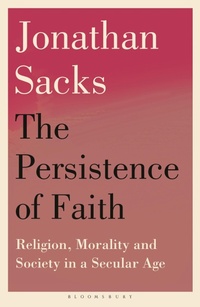
The Persistence of Faith
Religion, Morality and Society in a Secular Age
Published on 8. May 2025
Book
Paperback/Softback
144 pages
978-1-3994-2079-2 (ISBN)
Description
Confidence in a faith is a subtle quality and lack of it shows in many ways, some contradictory. Dr Sacks has that confidence and the quiet charisma to communicate it.
Sacks argues that faiths must remain open to criticism, keep alive their separate communities and still contribute far more to national debates on moral issues. They must also learn to get along better. His thesis is that we still live under a Biblical canopy and that a cohesive morality needs the uniting bonds of faith.
The subject of this book - religions and ethics - is good ground for him to build on: The Jewish contribution to ethics is distinctly rational and has a long and illustrious tradition. Moral philosophy is after all a Jewish preoccupation.
In recent years, he writes, religion has taken us unawares. The rise of the Moral Majority in the USA, the Islamic Revolution, the growth of religious parties in Israel, the power of Catholicism in Poland and the African continent all run contrary to the basic thesis that modernity and secularization went hand in hand and could almost be regarded as synonyms. Instead, and against all prediction, religion has resurfaced in the public domain.
In this book, Sacks argues the case for a broadly based return to tradition within the context of religious pluralism and tolerance. Religious values remain a strong force within our culture to be renewed. For our society to be viable indeed they must be renewed.
Sacks argues that faiths must remain open to criticism, keep alive their separate communities and still contribute far more to national debates on moral issues. They must also learn to get along better. His thesis is that we still live under a Biblical canopy and that a cohesive morality needs the uniting bonds of faith.
The subject of this book - religions and ethics - is good ground for him to build on: The Jewish contribution to ethics is distinctly rational and has a long and illustrious tradition. Moral philosophy is after all a Jewish preoccupation.
In recent years, he writes, religion has taken us unawares. The rise of the Moral Majority in the USA, the Islamic Revolution, the growth of religious parties in Israel, the power of Catholicism in Poland and the African continent all run contrary to the basic thesis that modernity and secularization went hand in hand and could almost be regarded as synonyms. Instead, and against all prediction, religion has resurfaced in the public domain.
In this book, Sacks argues the case for a broadly based return to tradition within the context of religious pluralism and tolerance. Religious values remain a strong force within our culture to be renewed. For our society to be viable indeed they must be renewed.
Reviews / Votes
These paperback editions of his timeless works celebrate his legacy for today. With stunning new covers and forewords by brilliant writers from around the world, they are perfect for anyone wishing to reacquaint themselves with Rabbi Sacks' writing, and for introducing a new generation to his evergreen wisdom. * Jewish News *More details
Language
English
Place of publication
London
United Kingdom
Publishing group
Bloomsbury Publishing PLC
Dimensions
Height: 130 mm
Width: 198 mm
Thickness: 12 mm
Weight
110 gr
ISBN-13
978-1-3994-2079-2 (9781399420792)
Copyright in bibliographic data and cover images is held by Nielsen Book Services Limited or by the publishers or by their respective licensors: all rights reserved.
Schweitzer Classification
Other editions
Additional editions
E-Book
07/2025
1st Edition
Bloomsbury Continuum
€12.49
Available for download
E-Book
07/2025
1st Edition
Bloomsbury Continuum
€12.49
Available for download
Person
Rabbi Lord Jonathan Sacks was Chief Rabbi of the United Hebrew Congregations of Britain and the Commonwealth. He was the author of numerous books, including Celebrating Life, From Optimism to Hope, The Persistence of Faith and The Dignity of Difference, for which he won a Grawemeyer Award in Religion.
Content
Preface
Introduction
1 The Environment of Faith
2 Demoralisation
3 The Fragile Family
4 Paradoxes of Pluralism
5 Fundamentalism
6 A Community of Communities
7 Afterword
Further Reading
Introduction
1 The Environment of Faith
2 Demoralisation
3 The Fragile Family
4 Paradoxes of Pluralism
5 Fundamentalism
6 A Community of Communities
7 Afterword
Further Reading