

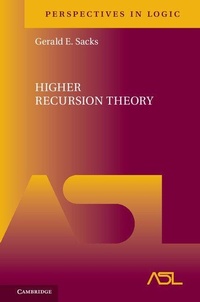
Higher Recursion Theory
Published on 2. March 2017
Book
Hardback
362 pages
978-1-107-16843-5 (ISBN)
Description
Since their inception, the Perspectives in Logic and Lecture Notes in Logic series have published seminal works by leading logicians. Many of the original books in the series have been unavailable for years, but they are now in print once again. This volume, the second publication in the Perspectives in Logic series, is an almost self-contained introduction to higher recursion theory, in which the reader is only assumed to know the basics of classical recursion theory. The book is divided into four parts: hyperarithmetic sets, metarecursion, ?-recursion, and E-recursion. This text is essential reading for all researchers in the field.
More details
Series
Language
English
Place of publication
Cambridge
United Kingdom
Target group
Professional and scholarly
Dimensions
Height: 240 mm
Width: 161 mm
Thickness: 26 mm
Weight
774 gr
ISBN-13
978-1-107-16843-5 (9781107168435)
Copyright in bibliographic data and cover images is held by Nielsen Book Services Limited or by the publishers or by their respective licensors: all rights reserved.
Schweitzer Classification
Other editions
Additional editions
Gerald E. Sacks
Higher Recursion Theory
E-Book
03/2017
Cambridge University Press
€133.99
Available for download
Person
Gerald E. Sacks works in the Department of Mathematics at Harvard University, Massachusetts and at the Massachusetts Institute of Technology.
Content
Part I. Hyperarithmetic Sets: 1. Constructive ordinals and \prod_1^1 sets; 2. The hyperarithmetic hierarchy; 3. \Sigma_1^1 predicates of reals; 4. Measure and forcing; Part II. Metarecursion: 5. Metarecursive enumerability; 6. Hyperregularity and priority; Part III. ?-Recursion: 7. Admissibility and regularity; 8. Priority arguments; 9. Splitting, density and beyond; Part IV. E-Recursion: 10. E-closed structures; 11. Forcing computations to converge; 12. Selection and k-sections; 13. E-recursively enumerable degrees; Bibliography; Subject index.