

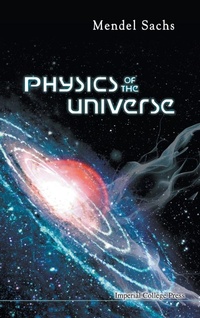
Physics Of The Universe
Published on 18. March 2010
Book
Hardback
148 pages
978-1-84816-532-8 (ISBN)
Description
This book presents a new approach to the subject of cosmology. It fully exploits Einstein's theory of general relativity. It is found that the most general formal expression of the theory replaces the (10-component) tensor formalism with a (16-component) quaternion formalism. This leads to a unified field theory, where one field incorporates gravitation and electromagnetism. The theory predicts an oscillating universe cosmology with a spiral configuration. Dark matter is explained in terms of a sea of particle-antiparticle pairs, each in a particular (derived) ground state. This leads to an explanation for the separation between matter and antimatter in the universe. There is a brief discussion of black holes and pulsars. The final chapter delves into philosophical considerations such as the different types of 'truth', positivism versus realism and a discussion of the role of the Mach principle in physics and cosmology.
More details
Language
English
Place of publication
London
United Kingdom
Target group
College/higher education
Academics, physicists and graduates interested in cosmology and theory of general relativity.
Dimensions
Height: 235 mm
Width: 157 mm
Thickness: 13 mm
Weight
375 gr
ISBN-13
978-1-84816-532-8 (9781848165328)
Copyright in bibliographic data and cover images is held by Nielsen Book Services Limited or by the publishers or by their respective licensors: all rights reserved.
Schweitzer Classification
Person
Content
Physics of the Universe; The Language of Cosmology: The Mathematical Basis of General Relativity; A Unified Field Theory in General Relativity: Extension from the Tensor to the Quaternion Language; An Oscillating, Spiral Universe Cosmology; Dark Matter; Concluding Remarks: Black Holes, Pulsars, On the Human Race and Cosmology; Philosophical Considerations: On Truth, Positivism versus Realism: Subjectivity versus Objectivity; On Mach's Influence in Physics and Cosmology.