

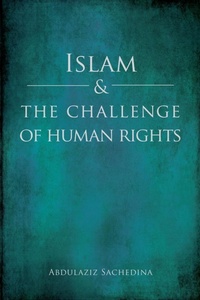
Islam and the Challenge of Human Rights
Published on 3. April 2014
Book
Paperback/Softback
272 pages
978-0-19-934717-9 (ISBN)
Description
In 1948, the General Assembly of the United Nations adopted and proclaimed the International Declaration of Human Rights, a document designed to hold both individuals and nations accountable for their treatment of fellow human beings, regardless of religious or cultural affiliations. Since then, the compatibility of Islam and human rights has emerged as a particularly thorny issue of international concern, and has been addressed by Muslim rulers, conservatives, and extremists, as well as Western analysts and policymakers; all have commonly agreed that Islamic theology and human rights cannot coexist.
Abdulaziz Sachedina rejects this informal consensus, arguing instead for the essential compatibility of Islam and human rights. He offers a balanced and incisive critique of Western experts who have ignored or underplayed the importance of religion to the development of human rights, contending that any theory of universal rights necessarily emerges out of particular cultural contexts. At the same time, he re-examines the juridical and theological traditions that form the basis of conservative Muslim objections to human rights, arguing that Islam, like any culture, is open to development and change. Finally, and most importantly, Sachedina articulates a fresh position that argues for a correspondence between Islam and secular notions of human rights.
Abdulaziz Sachedina rejects this informal consensus, arguing instead for the essential compatibility of Islam and human rights. He offers a balanced and incisive critique of Western experts who have ignored or underplayed the importance of religion to the development of human rights, contending that any theory of universal rights necessarily emerges out of particular cultural contexts. At the same time, he re-examines the juridical and theological traditions that form the basis of conservative Muslim objections to human rights, arguing that Islam, like any culture, is open to development and change. Finally, and most importantly, Sachedina articulates a fresh position that argues for a correspondence between Islam and secular notions of human rights.
Reviews / Votes
Islam and the Challenge of Human Rights is a reverent, insightful, and truly critical work by Abdulaziz Sachedina, who is the leading Islamic theorist writing in English today. This book is must reading for Muslims who want to be full participants in western moral and political discourse, for Jews and Christians who want voices from the third great monotheistic religion of revelation to become part of their dialogical interaction, and even for secular people who want to engage religious voices in moral and political discourse that is truly inclusive. * David Novak, J. Richard and Dorothy Shiff Professor of Jewish Studies, University of Toronto *More details
Language
English
Place of publication
New York
United States
Target group
College/higher education
Professional and scholarly
Dimensions
Height: 234 mm
Width: 156 mm
Thickness: 16 mm
Weight
458 gr
ISBN-13
978-0-19-934717-9 (9780199347179)
Copyright in bibliographic data and cover images is held by Nielsen Book Services Limited or by the publishers or by their respective licensors: all rights reserved.
Schweitzer Classification
Other editions
Additional editions
Abdulaziz Sachedina
Islam and the Challenge of Human Rights
Book
11/2009
Oxford University Press Inc
€81.40
Shipment within 15-20 days
Abdulaziz Sachedina
Islam and the Challenge of Human Rights
E-Book
11/2009
OUP eBook
€18.99
Available for download
Abdulaziz Sachedina
Islam and the Challenge of Human Rights
E-Book
11/2009
1st Edition
OUP eBook
€23.99
Available for download
Person
Abdulaziz Sachedina is Professor and Endowed IIIT Chair in Islamic Studies at George Mason University.
Content
Contents ; Chapter 1: Clash of Universalism: Secular and Religious in Human Rights ; Chapter 2: The Nature of Islamic Ethical-Juridical Discourse ; Chapter 3: Natural Law and Knowledge of Ethical Necessity ; Chapter 4: The Dignity and Capacities of Women as Equal Bearers of Human Rights ; Chapter 5: Individial and Society: Claims and Responsibilities ; Chapter 6: Freedom of Religion and Conscience: The Foundation of Pluralistic World Order ; Notes ; Select Bibliography ; Index