

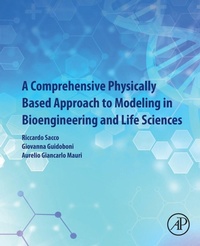
A Comprehensive Physically Based Approach to Modeling in Bioengineering and Life Sciences
Published on 19. July 2019
Book
Paperback/Softback
854 pages
978-0-12-812518-2 (ISBN)
Description
A Comprehensive Physically Based Approach to Modeling in Bioengineering and Life Sciences provides a systematic methodology to the formulation of problems in biomedical engineering and the life sciences through the adoption of mathematical models based on physical principles, such as the conservation of mass, electric charge, momentum, and energy. It then teaches how to translate the mathematical formulation into a numerical algorithm that is implementable on a computer. The book employs computational models as synthesized tools for the investigation, quantification, verification, and comparison of different conjectures or scenarios of the behavior of a given compartment of the human body under physiological and pathological conditions.
Reviews / Votes
"When this reviewer opted to receive and review this text, it was hoped that it would present as a complementary text to those of Drs. Carson and Cobelli [Modelling Methodology for Physiology and Medicine (2013) and Introduction to Modeling in Physiology and Medicine, 2nd ed. (2019)].?This was not to be the case. While this text is touted as being for "Biomedical engineers, life sciences researchers, as well as undergraduate and graduate students in Biomedical Engineering, Electrical Engineering, Mathematics, Biology, and Medicine? (Academic Press website), this reviewer suggests that the text be mainly considered as a reference text, to be used primarily by those with an adequate mathematical and MATLAB background." --IEEEMore details
Language
English
Place of publication
San Diego
United States
Publishing group
Elsevier Science Publishing Co Inc
Target group
Professional and scholarly
Biomedical engineers, life sciences researchers, as well as undergraduate and graduate students in Biomedical Engineering, Electrical Engineering, Mathematics, Biology and Medicine.
Product notice
Paperback (trade)
Dimensions
Height: 236 mm
Width: 189 mm
Thickness: 45 mm
Weight
1687 gr
ISBN-13
978-0-12-812518-2 (9780128125182)
Copyright in bibliographic data and cover images is held by Nielsen Book Services Limited or by the publishers or by their respective licensors: all rights reserved.
Schweitzer Classification
Other editions
Additional editions
Riccardo Sacco | Giovanna Guidoboni | Aurelio Giancarlo Mauri
A Comprehensive Physically Based Approach to Modeling in Bioengineering and Life Sciences
E-Book
07/2019
Academic Press
€175.00
Available for download
Persons
Riccardo Sacco, PhD, is an applied mathematician whose research and teaching activities span a wide variety of topics, including computational biology, semiconductor device modeling and simulation, computational fluid mechanics, and finite element analysis. Dr. Sacco has been appointed as a member of the Editorial Board of the "Journal of Coupled Systems and Multiscale Dynamics? and of the "Journal of Modeling for Ophthalmology.? In a joint partnership with Prof. Guidoboni and Prof. Harris, Dr. Sacco has promoted a series of international workshops, congresses, and doctoral courses with the twofold purpose of disseminating the use of mathematical and numerical methods in the study and clinical treatment of ophthalmological diseases and of fostering and favoring the interaction among students, scientists, and researchers in the fields of applied sciences and life sciences. Giovanna Guidoboni, PhD, is an applied mathematician with expertise in mathematical and computational modeling of complex fluid flows arising in engineering and biomedical applications. Dr. Guidoboni has promoted the development of interdisciplinary approaches in physiology and ophthalmology at the international level. She co-founded a new peer-reviewed scientific journal titled "Journal for Modeling in Ophthalmology,? for which she currently serves as co-Chief Editor and Managing Editor, and a new series of interdisciplinary congresses and doctoral courses creating a forum where ophthalmologists, physiologists, mathematicians, engineers, physicists, and biologists can discuss new ideas on how to address outstanding challenges in ophthalmology. Aurelio Giancarlo Mauri, MSc, is a Senior Member of the Technical Staff of Micron Technology, where he currently works in the numerical simulation group appointed for the physical modeling of electronic devices. He is the main author of FEMOS-MP (Finite Element Method Oriented Simulator for Multiphysics Problems), a C++ platform for the simulation of complex multiphysics systems including thermomechanical effects, chemical reactions and kinetics, semiconductors, and nonconventional materials in the continuum framework and using atomistic kinetic Monte Carlo methods. Currently, he also holds a lecturer fellowship at Politecnico di Milano for the courses "Numerical Analysis? and "Computational Modeling for Electronics and Biomathematics.?
Author
Associate Professor, Department of Mathematics, Politecnico di Milano, Italy
Professor of Electrical Engineering and Computer Science, University of Missouri, Professor of Mathematics, University of Missouri, Adjunct Professor of Mathematical Sciences, Indiana University Purdue University Indianapolis, Adjunct Professor of Ophthalmology, Indiana University School of Medicine
Lecturer, Politecnico di Milano, Italy
Content
Part I. Mathematical, Computational, and Physical Foundations1. Elements of Mathematical Modeling2. Elements of Mathematical Methods3. Elements of computational methods4. Elements of Physics
Part II. Balance Laws5. The Rational Continuum Mechanics Approach to Matter in Motion6. Balance laws in integral form7. Balance laws in local form8. Continuum Approach for Multicomponent Mixtures
Part III. Constitutive Relations9. Preliminary Considerations on Constitutive Modeling10. Constitutive Relations for Fluids11. Constitutive Relations for Solids12. Constitutive Relations for Multicomponent Mixtures13. Constitutive Relations in Electromagnetism and Ion Electrodynamics
Part IV. Model Reduction of System Complexity14. Reduction of the Maxwell Partial Differential System15. Electric Analogy to Fluid Flow
Part V. Mathematical Models of Basic Biological Units and Complex Systems16. Cellular Components and Functions: A Brief Overview17. Mathematical Modeling of Cellular Electric Activity18. Mathematical Modeling of Electric Propagation Along Nerve Fibers19. Differential Models in Cellular Functions
Part VI. Advanced Mathematical and Computational Methods20. Functional Spaces and Functional Inequalities21. Functional Iterations for Nonlinear Coupled Systems of Partial Differential Equations22. Time Semidiscretization and Weak Formulations for Initial Value/Boundary Value Problems of Advection-Diffusion-Reaction Type23. Finite Element Approximations of Boundary Value Problems of Advection-Diffusion-Reaction Type24. Finite Element Approximations of Initial Value/Boundary Value Problems of Advection-Diffusion-Reaction Type25. Finite Element Approximation of a Unified Model for Linear Elastic Materials
Part VII. Simulation Examples and Clinical Applications26. Ion Dynamics in Cellular Membranes27. Interaction Between Hemodynamics and Biomechanics in Ocular Perfusion
Part VIII. Examples, Exercises, and Projects28. Coding of Examples Using Matlab Scripts29. Matlab Functions for Algorithm Implementation30. Homework: Exercises and Projects
Appendix A. Elements of Differential Geometry and Balance Laws in Curvilinear Coordinates
Part II. Balance Laws5. The Rational Continuum Mechanics Approach to Matter in Motion6. Balance laws in integral form7. Balance laws in local form8. Continuum Approach for Multicomponent Mixtures
Part III. Constitutive Relations9. Preliminary Considerations on Constitutive Modeling10. Constitutive Relations for Fluids11. Constitutive Relations for Solids12. Constitutive Relations for Multicomponent Mixtures13. Constitutive Relations in Electromagnetism and Ion Electrodynamics
Part IV. Model Reduction of System Complexity14. Reduction of the Maxwell Partial Differential System15. Electric Analogy to Fluid Flow
Part V. Mathematical Models of Basic Biological Units and Complex Systems16. Cellular Components and Functions: A Brief Overview17. Mathematical Modeling of Cellular Electric Activity18. Mathematical Modeling of Electric Propagation Along Nerve Fibers19. Differential Models in Cellular Functions
Part VI. Advanced Mathematical and Computational Methods20. Functional Spaces and Functional Inequalities21. Functional Iterations for Nonlinear Coupled Systems of Partial Differential Equations22. Time Semidiscretization and Weak Formulations for Initial Value/Boundary Value Problems of Advection-Diffusion-Reaction Type23. Finite Element Approximations of Boundary Value Problems of Advection-Diffusion-Reaction Type24. Finite Element Approximations of Initial Value/Boundary Value Problems of Advection-Diffusion-Reaction Type25. Finite Element Approximation of a Unified Model for Linear Elastic Materials
Part VII. Simulation Examples and Clinical Applications26. Ion Dynamics in Cellular Membranes27. Interaction Between Hemodynamics and Biomechanics in Ocular Perfusion
Part VIII. Examples, Exercises, and Projects28. Coding of Examples Using Matlab Scripts29. Matlab Functions for Algorithm Implementation30. Homework: Exercises and Projects
Appendix A. Elements of Differential Geometry and Balance Laws in Curvilinear Coordinates