

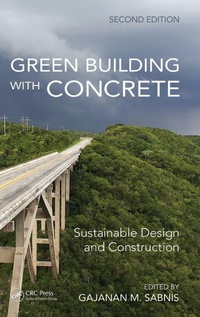
Green Building with Concrete
Sustainable Design and Construction, Second Edition
2nd Edition
Published on 16. June 2015
Book
Hardback
460 pages
978-1-4987-0410-6 (ISBN)
Description
Illustrates the Global Relevance of Sustainability
Applicable to roads, bridges, and other elements of the infrastructure, Green Building with Concrete: Sustainable Design and Construction, Second Edition provides an overview of all available information on the role of concrete in green building. A handbook offering viewpoints from worldwide experts on the global nature of the sustainability movement, it highlights research on economic analysis, in particular the International Organization for Standardization, Environmental Management-Life Cycle Assessment-Principles and Framework application of life cycle costing, to provide a full picture of the economic benefits of concrete in green building.
Outlines the Variety of Ways That Concrete Is Easily and Affordably Reused
With an emphasis on environmental impact and occupational and consumer health and safety, the text clearly outlines how to make the most of concrete in sustainable design. It explores the benefits of thermal mass, increased water supply, and improving water quality; reducing urban heat island effects; reducing construction waste; and the use of supplementary cementitious materials. The authors include an in-depth evaluation of carbon dioxide (CO2) and other emissions associated with the manufacture of cement. They also highlight the attributes that concrete has to offer the green building movement and the effect that emerging life cycle analysis has on concrete's role in this important revolution in the building industry. Readers gain a better understanding of how concrete can contribute to sustainable construction, Leadership in Energy and Environmental Design (LEED), and the green building movement overall.
Green Building with Concrete: Sustainable Design and Construction, Second Edition presents the most recent information about concrete's role in the green building movement, state-of-the-art methodologies, and best practices, and provides readers with diverse viewpoints on global sustainability.
Applicable to roads, bridges, and other elements of the infrastructure, Green Building with Concrete: Sustainable Design and Construction, Second Edition provides an overview of all available information on the role of concrete in green building. A handbook offering viewpoints from worldwide experts on the global nature of the sustainability movement, it highlights research on economic analysis, in particular the International Organization for Standardization, Environmental Management-Life Cycle Assessment-Principles and Framework application of life cycle costing, to provide a full picture of the economic benefits of concrete in green building.
Outlines the Variety of Ways That Concrete Is Easily and Affordably Reused
With an emphasis on environmental impact and occupational and consumer health and safety, the text clearly outlines how to make the most of concrete in sustainable design. It explores the benefits of thermal mass, increased water supply, and improving water quality; reducing urban heat island effects; reducing construction waste; and the use of supplementary cementitious materials. The authors include an in-depth evaluation of carbon dioxide (CO2) and other emissions associated with the manufacture of cement. They also highlight the attributes that concrete has to offer the green building movement and the effect that emerging life cycle analysis has on concrete's role in this important revolution in the building industry. Readers gain a better understanding of how concrete can contribute to sustainable construction, Leadership in Energy and Environmental Design (LEED), and the green building movement overall.
Green Building with Concrete: Sustainable Design and Construction, Second Edition presents the most recent information about concrete's role in the green building movement, state-of-the-art methodologies, and best practices, and provides readers with diverse viewpoints on global sustainability.
Reviews / Votes
"... a valuable contribution to the area of sustainability practices in building design, concrete use, cement manufacturing and use, industrial by-product utilization. ... a very good explanation of the concept of sustainable concrete through the use of industrial by-products that have characteristics rendering them suitable for use in concrete, cement, or construction applications."-Aaron Fuller, Department of Firing Systems, Institute of Combustion and Power Plant Technology, University of Stuttgart, Stuttgart, Germany
"The rich experience and the extensive research that has gone into the discussion about materials being considered for Reinforced Concrete as well as Coating the Green Buildings, will help the industry in creating awareness about the necessity of Greener Planet."
-Akshit Dhawan, Akshit Dhawan, A.M. ASCE, India
"... provides a very good introduction to the Trendy topic of green construction with emphasis on reinforced concrete. Its contributors include a wide cross section of highly respected International experts in the field who have presented comprehensive insight into a number of important topics. ... reads as a very good technical Reference, as well as a suitable text in green construction. This is certainly a keystone book for any modern technical library in building construction.
-Dwayne Anthony Thurton, M.Eng, BSCE, P.Eng
"This book is a must have for practicing engineers who want to design sustainable concrete sturctures."
-Laurence Burley, Jr.
"For those interested in learning more about designing sustainable concrete structures will find valuable information in this book. It provides a good overview of various factors to consider in green concrete buildings. This book is a good reference to have.
-Sandeep P. Mathur, P.E., SECB, LEED AP, F.ASCE, Gerdau Long Steel North America
More details
Edition
2nd edition
Language
English
Place of publication
Bosa Roca
United States
Publishing group
Taylor & Francis Inc
Target group
College/higher education
Professional and scholarly
Academic and Professional Practice & Development
Illustrations
208 s/w Abbildungen, 39 s/w Tabellen
39 Tables, black and white; 208 Illustrations, black and white
Dimensions
Height: 240 mm
Width: 161 mm
Thickness: 29 mm
Weight
851 gr
ISBN-13
978-1-4987-0410-6 (9781498704106)
Copyright in bibliographic data and cover images is held by Nielsen Book Services Limited or by the publishers or by their respective licensors: all rights reserved.
Schweitzer Classification
Other editions
Additional editions
E-Book
06/2015
2nd Edition
CRC Press
€225.99
Available for download
E-Book
06/2015
2nd Edition
CRC Press
€225.99
Available for download
Previous edition
Book
10/2011
1st Edition
CRC Press
€131.44
Article exhausted; check for reprint
Person
Gajanan M. Sabnis, PhD, PE, is an international consultant and advisor to companies in the US and in India. He is an emeritus professor at Howard University in Washington, District of Columbia. With his diverse cultural background and experience in the United States and India, he spends considerable time in India to assist on infrastructure projects there. Dr. Sabnis is a strong proponent of sustainability in civil engineering. He participated in the initial development of the policy on sustainability in the American Society of Civil Engineers and has built his own home as an experiment following the principles of sustainable construction.
Content
Introduction. Sustainability in the Cement Industries and Chemical Admixtures. The Principles of Sustainable Building Design. Sustainability through Thermal Mass of Concrete. Concrete Pavements and Sustainability. Roller-Compacted Concrete Pavements. Pervious Concrete for Sustainable Development. Heat Island Effects. Future Sustainable City: The Case of Masdar City. Sustainability and Rehabilitation of Concrete Structures. Global Sustainability and Concrete. Sustainable Concrete with Industrial and Postconsumer By-Product Materials. Sustainability of Steel Reinforcement. Coatings for Creating Green Infrastructure. Materials' Specifications: The Missing Link to Sustainability Planning.