

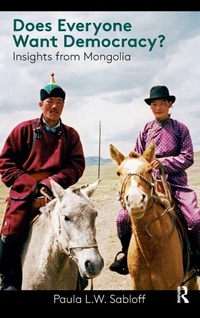
Does Everyone Want Democracy?
Insights from Mongolia
1st Edition
Published on 30. April 2013
Book
Hardback
282 pages
978-1-59874-565-8 (ISBN)
Description
Do all people desire democracy? For at least a century, the idea that democracy is a universal good has been an article of faith for American policy makers. Paula Sabloff challenges this conventional wisdom about who wants democracy and why. Arguing that certain universal human aspirations exist, she shows how local realities are highly particularistic and explains that culture, history, and values are critical to the study of political systems. Her fascinating study of Mongolia-feudal until it became the first country to follow Russia into communism and now struggling with post-socialist democratization-is a model for investigating how everyday people around the world actually think about and implement democracy on their own terms.
Reviews / Votes
"This fascinating study of Mongolia...is a model for investigating how everyday people around the world actually think about and implement democracy on their own terms."-Julian Dierkes, University of British Columbia "The evolution of democratic institutions in the Republic of Mongolia during the two decades since the 1990 collapse of communism serves as the subject of this fascinating case study of local attitudes toward democracy. Written by veteran observer of postsocialist Mongolian society Sabloff (anthropology, Santa Fe Institute) and informed by many candid interviews with diverse citizens across Mongolia, this book succeeds in demonstrating that attitudes toward democracy are complex. Democratic aspirations not only take form from universal human emotions but also are molded by historical and environmental influences specific to Mongolia itself, or shared specifically with neighboring countries and other postsocialist societies. Mongolian values with respect to forms of governance subsumed under the word "democracy" cannot be properly understood without careful consideration of the unique blend of historical, environmental, and social ingredients that underpin modern Mongolian society. Grounded in general principles as well as realities specific to Mongolia, Sabloff's findings have implications for policy makers interested in the spread of democracy to more countries around the globe. While serving as a model for other local studies of democratization, this book is indispensable for anyone hoping to acquire an understanding of Mongolia today and tomorrow. Summing Up: Essential. All levels/libraries." -CHOICEMore details
Language
English
Place of publication
Walnut Creek
United States
Illustrations
illustrations
Dimensions
Height: 235 mm
Width: 157 mm
Thickness: 20 mm
Weight
566 gr
ISBN-13
978-1-59874-565-8 (9781598745658)
Copyright in bibliographic data and cover images is held by Nielsen Book Services Limited or by the publishers or by their respective licensors: all rights reserved.
Schweitzer Classification
Other editions
Additional editions
E-Book
06/2016
Routledge
€53.99
Available for download
E-Book
06/2016
Routledge
€53.99
Available for download
Book
09/2014
1st Edition
Left Coast Press Inc
€54.50
Shipment within 3-4 weeks
Person
Paula L. W. Sabloff is a professor at the Santa Fe Institute, USA. She is a political anthropologist who has conducted research in Mexico, the United States, and Mongolia, and taught at the University of Pittsburgh and the University of Pennsylvania. She curated the exhibition "Modern Mongolia: Reclaiming Genghis Khan" at the National Museum of Natural History (Smithsonian Institution) and is editor of several books, including Higher Education in the Post-Communist World (1998), Modern Mongolia (2001), and Mapping Mongolia (2011).
Content
Chapter 1 Introduction; Chapter 2 Democracy Means Independence and Freedom; Chapter 3 Democracy Means Human Rights; Chapter 4 Democracy Brings Political Freedom; Chapter 5 Democracy Brings Economic Freedom; Chapter 6 A Democratic Government Is Responsible to Its Citizens; Chapter 7 Citizens' Rights or Civic Duty: Citizens' Relationship to Democratic Governance; Chapter 8 Conclusion: Shared Experiences, Shared Ideas;