


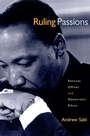
Ruling Passions
Political Offices and Democratic Ethics
Published on 24. February 2002
Book
Paperback/Softback
368 pages
978-0-691-08831-0 (ISBN)
Description
How should politicians act? When should they try to lead public opinion and when should they follow it? Should politicians see themselves as experts, whose opinions have greater authority than other people's, or as participants in a common dialogue with ordinary citizens? When do virtues like toleration and willingness to compromise deteriorate into moral weakness? In this innovative work, Andrew Sabl answers these questions by exploring what a democratic polity needs from its leaders. He concludes that there are systematic, principled reasons for the holders of divergent political offices or roles to act differently. Sabl argues that the morally committed civil rights activist, the elected representative pursuing legislative results, and the grassroots organizer determined to empower ordinary citizens all have crucial democratic functions. But they are different functions, calling for different practices and different qualities of political character. To make this case, he draws on political theory, moral philosophy, leadership studies, and biographical examples ranging from Everett Dirksen to Ella Baker, Frances Willard to Stokely Carmichael, Martin Luther King Jr. to Joe McCarthy.
Ruling Passions asks democratic theorists to pay more attention to the "governing pluralism" that characterizes a diverse, complex democracy. It challenges moral philosophy to adapt its prescriptions to the real requirements of democratic life, to pay more attention to the virtues of political compromise and the varieties of human character. And it calls on all democratic citizens to appreciate "democratic constancy": the limited yet serious standard of ethical character to which imperfect democratic citizens may rightly hold their leaders--and themselves.
Ruling Passions asks democratic theorists to pay more attention to the "governing pluralism" that characterizes a diverse, complex democracy. It challenges moral philosophy to adapt its prescriptions to the real requirements of democratic life, to pay more attention to the virtues of political compromise and the varieties of human character. And it calls on all democratic citizens to appreciate "democratic constancy": the limited yet serious standard of ethical character to which imperfect democratic citizens may rightly hold their leaders--and themselves.
Reviews / Votes
"This book is an extraordinary achievement. It is brilliantly conceived and executed, closely argued and erudite, sensitive to textual and political nuance and lucid even at its most inventive and sophisticated. . . . Particular discussions of thinkers, actors and issues are as original as the architecture of the work as a whole. Thus one learns something significant not only about Rousseau, Tocqueville, Madison, Frances Williard, Martin Luther King, Saul Alinsky, and Everett Dirksen, but about larger issues such as what Sabl calls democratic constancy, philosophy and politics, theory and institutions. Many of the book's formulations are memorable, almost all are provocative in ways that stimulate reflection. There is much to argue with in this book, but every argument is one worth having."-Peter Euben, author of Corrupting Youth and The Tragedy of Political Theory "This is a significant, highly original, and interesting contribution to our understanding of political ethics. The author displays a mastery of a large theoretical literature, which he brings to bear in a restrained way to shed light on the ethical obligations of politicians."-Joseph Bessette, Alice Tweed Tuohy Professor of Government and Ethics, Claremont-McKenna CollegeMore details
Language
English
Place of publication
New Jersey
United States
Target group
Professional and scholarly
College/higher education
Product notice
Paperback (trade)
Dimensions
Height: 229 mm
Width: 152 mm
Thickness: 22 mm
Weight
597 gr
ISBN-13
978-0-691-08831-0 (9780691088310)
Copyright in bibliographic data and cover images is held by Nielsen Book Services Limited or by the publishers or by their respective licensors: all rights reserved.
Schweitzer Classification
Other editions
Additional editions
E-Book
02/2009
1st Edition
Princeton University Press
from
€154.95
Available for download
Person
Andrew Sabl is Assistant Professor of Policy Studies at UCLA.
Content
Preface and Acknowledgments xi Introduction 1 Part One: Theory 17 Chapter One Political Offices: Universalism, Partiality, and Compromise 19 Chapter Two Political Office and the Theory of Democratic Constancy 55 Chapter Three Office and the Democratic Order: Alternative Views 96 Part Two: Applications 135 Chapter Four The Senator and the Politics of Fame 143 Chapter Five The Moral Activist and the Politics of Public Opinion 201 Chapter Six The Organizer and the Politics of Personal Association 248 Conclusion Governing Pluralism, Office Diversity, and Democratic Ethics 299 References 327 Index 341