

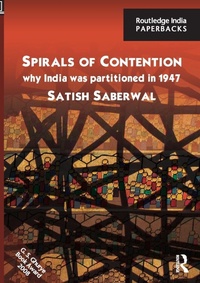
Spirals of Contention
Why India was Partitioned in 1947
1st Edition
Published on 18. April 2013
Book
Paperback/Softback
240 pages
978-0-415-84196-2 (ISBN)
Description
This study examines the social and psychological processes that led to the Partition of the Indian subcontinent in 1947. It recognizes the long-term continuities in the idiom of conflict (as well as cooperation), and shows that, by 1900, the conflicts and animosities were gathering a self-aggravating momentum. The book moves back and forth between evidence and general, or theoretical, understanding.
Separateness between Hindus and Muslims grew reciprocally, with hardening religious identities and the growing frequency of incidents of conflict. These skirmishes had several dimensions: symbolic (desecrating places of worship), societal (conversions), and physical (violence against women). As mutual trust declined, a quarter century of negotiations under diverse auspices failed to yield an agreement, and even the framework of the Partition in 1947 was imposed by the colonial rulers.
A theoretically informed study, this book takes a comparative stance along several axes. Recognizing long-term continuities in the idiom of conflict (as well as of cooperation), it will be of interest to students of conflicts, Partitions, history, sociology, and South Asian studies.
Separateness between Hindus and Muslims grew reciprocally, with hardening religious identities and the growing frequency of incidents of conflict. These skirmishes had several dimensions: symbolic (desecrating places of worship), societal (conversions), and physical (violence against women). As mutual trust declined, a quarter century of negotiations under diverse auspices failed to yield an agreement, and even the framework of the Partition in 1947 was imposed by the colonial rulers.
A theoretically informed study, this book takes a comparative stance along several axes. Recognizing long-term continuities in the idiom of conflict (as well as of cooperation), it will be of interest to students of conflicts, Partitions, history, sociology, and South Asian studies.
Reviews / Votes
His last and arguably most important book...- T. N. Madan, Honorary Professor, Institute of Economic Growth, University of Delhi
More details
Language
English
Place of publication
London
United Kingdom
Publishing group
Taylor & Francis Ltd
Target group
College/higher education
Dimensions
Height: 210 mm
Width: 148 mm
Thickness: 13 mm
Weight
319 gr
ISBN-13
978-0-415-84196-2 (9780415841962)
Copyright in bibliographic data and cover images is held by Nielsen Book Services Limited or by the publishers or by their respective licensors: all rights reserved.
Schweitzer Classification
Other editions
Additional editions

E-Book
04/2012
1st Edition
American Book Store
€37.99
Available for download

E-Book
04/2012
1st Edition
American Book Store
€37.99
Available for download

Book
12/2007
1st Edition
Routledge India
€206.00
Shipment within 15-20 days
Person
Satish Saberwal was formerly Professor of Sociology, Centre for Historical Studies, Jawaharlal Nehru University, New Delhi.
Content
Preface. Acknowledgements. Introduction. 1. Medieval Legacy 2. Facing the Future 1 3. Facing the Future 2 4. Nineteenth Century Anxieties 5. Parallel Processes 6. Drifting Apart. Concluding Review. Bibliography. About the Author. Index