

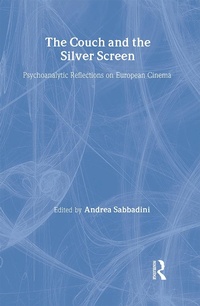
The Couch and the Silver Screen
Psychoanalytic Reflections on European Cinema
Published on 29. May 2003
Book
Hardback
278 pages
978-1-58391-951-4 (ISBN)
Description
The Couch and the Silver Screen is a collection of original contributions which explore European cinema from psychoanalytic perspectives. Both classic and contemporary films are presented and analysed by a variety of authors, including leading cinema historians and theorists, psychoanalysts with a specific expertise in the interpretation of films, as well as the filmmakers themselves. This composite approach offers a fascinating insight into the world of cinema.
The Couch and the Silver Screen is illustrated with stills throughout and Andrea Sabbadini's introduction provides a theoretical and historical context for the current state of psychoanalytic studies of films. The book is organised into four clear sections - Set and Stage, Working Through Trauma, Horror Perspectives and Documenting Internal Worlds - which form the basis for engaging chapters including:
easily readable and jargon-free film reviews.
essays on specific subjects such as perspectives on the horror film genre and adolescent development.
transcripts of live debates among film directors including Bernardo Bertolucci, actors, critics and psychoanalysts discussing films.
The cultural richness of the material presented, combined with the originality of multidisciplinary dialogues on European cinema, makes this book appealing not only to film buffs, but also to professionals, academics and students interested in the application of psychoanalytic ideas to the arts.
The Couch and the Silver Screen is illustrated with stills throughout and Andrea Sabbadini's introduction provides a theoretical and historical context for the current state of psychoanalytic studies of films. The book is organised into four clear sections - Set and Stage, Working Through Trauma, Horror Perspectives and Documenting Internal Worlds - which form the basis for engaging chapters including:
easily readable and jargon-free film reviews.
essays on specific subjects such as perspectives on the horror film genre and adolescent development.
transcripts of live debates among film directors including Bernardo Bertolucci, actors, critics and psychoanalysts discussing films.
The cultural richness of the material presented, combined with the originality of multidisciplinary dialogues on European cinema, makes this book appealing not only to film buffs, but also to professionals, academics and students interested in the application of psychoanalytic ideas to the arts.
Reviews / Votes
'In these days, when psychoanalysis is looking for ways to integrate itself back into the world - into cultural, political, intellectual, and emotional life - a book like this is to be cherished ... It is a gold mine for anyone interested in movies, in psychoanalysis, or in the reciprocity between them' - Anita Weinreb Katz, Journal of the American Psychoanalytic Association, 53(2): 673-679; 2005."This is a book which will fascinate all cinema lovers and take its place among the many valuable writings on applied psychoanalysis in Europe" - Serge Firsch, The International Journal of Psychoanalysis 'In these days, when psychoanalysis is looking for ways to integrate itself back into the world - into cultural, political, intellectual, and emotional life - a book like this is to be cherished ... It is a gold mine for anyone interested in movies, in psychoanalysis, or in the reciprocity between them' - Anita Weinreb Katz, Journal of the American Psychoanalytic Association, 53(2): 673-679; 2005.
"This is a book which will fascinate all cinema lovers and take its place among the many valuable writings on applied psychoanalysis in Europe" - Serge Firsch, The International Journal of Psychoanalysis
More details
Series
Language
English
Place of publication
London
United Kingdom
Publishing group
Taylor & Francis Ltd
Target group
College/higher education
Professional and scholarly
Dimensions
Height: 239 mm
Width: 163 mm
Thickness: 23 mm
Weight
542 gr
ISBN-13
978-1-58391-951-4 (9781583919514)
Copyright in bibliographic data and cover images is held by Nielsen Book Services Limited or by the publishers or by their respective licensors: all rights reserved.
Schweitzer Classification
Other editions
Additional editions
E-Book
07/2005
Routledge
€49.99
Available for download
E-Book
07/2005
Routledge
€49.99
Available for download
Book
05/2003
Brunner-Routledge
€57.50
Shipment within 3-4 weeks
Person
Andrea Sabbadini is a psychoanalyst in private practice in London and a lecturer at UCL. He is founding editor of Psychoanalysis and History and book review editor of The International Journal of Psychoanalysis. He chairs the European Psychoanalytic Film Festival and a series of film events at the ICA.
Content
Mulvey, Foreword. Sabbadini, Introduction. Part I: Set and Stage.Bertolucci, Shaw, Mawson, The Inner and Outer Worlds of the Filmmaker's Temporary Social Structure. Christie, Stevenson, Taylor Robinson, One in the Eye From Sam - Samuel Beckett's Film (1964) and his Contribution to our Vision in Theatre, Cinema and Psychoanalysis. Part II: Working Through Trauma.Moretti, Golinelli, Bolognini, Sabbadini, Sons and Fathers: A Room of their Own - Nanni Moretti's The Son's Room (2001). Sekoff, Witness and Persecution in two Short Films: Miguel Sapochnik's The Dreamer (2001) and Lindy Heymann's Kissing Buba (2001). Annegret Mahler-Bungers, A Post-postmodern Walkyrie - Psychoanalytic Considerations on Tom Tykwer's Run, Lola, Run (1999). Pedron de Martin, Thomas Vinterberg's Festen (1998) - An Attempt to Avoid Madness Through Denunciation. Diamond, Itsvan Szabo's Sunshine (1999) - The Cinematic Representation of Historical and Familial Trauma. Part III: Horror Perspectives. Schneider, Notes on the Relevance of Psychoanalytic Theory to Euro-horror Cinema. Campbell, Dario Argento's Phenomena (1985) - A Psychoanalytic Perspective on the 'Horror Film' Genre and Adolescent Development. Aubry, Freedom Through Re-introjection: A Kleinian Perspective on Dominik Moll's Harry: He's Here to Help (2000). Grant, Cinema, Horror and the Abominations of Hell - Carl-Theodor Dreyer's Vampyr (1931) and Lucio Fulci's The Beyond (1981). Part IV: Documenting Internal Worlds. Apted, Taylor Robinson, Narratives and Documentaries - An Encounter with Michael Apted and his Films. Cowie, The Cinematic Dream-work of Ingmar Bergman's Wild Strawberries (1957). Filipovic, Film as an Abreaction of Totalitarianism - Vinko Bre an's Marshal Tito's Spirit (2000). Berman, Rosenheimer, Aviad, Documentary Directors and their Protagonists: A Transferential / Countertransferential Relationship? Timna Rosenheimer's Fortuna (2000) and Michal Aviad's Ever Shot Anyone? (1995). Brody, Brearley, Filming Psychoanalysis: Feature or Documentary? Two Contributions.