

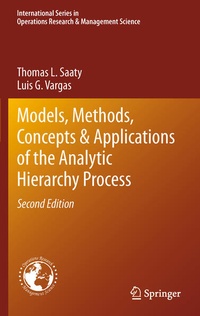
Models, Methods, Concepts & Applications of the Analytic Hierarchy Process
2nd Edition
Published on 12. April 2012
Book
Hardback
XIV, 346 pages
978-1-4614-3596-9 (ISBN)
Description
The Analytic Hierarchy Process (AHP) is a prominent and powerful tool for making decisions in situations involving multiple objectives. Models, Methods, Concepts and Applications of the Analytic Hierarchy Process, 2nd Edition applies the AHP in order to solve problems focused on the following three themes: economics, the social sciences, and the linking of measurement with human values. For economists, the AHP offers a substantially different approach to dealing with economic problems through ratio scales. Psychologists and political scientists can use the methodology to quantify and derive measurements for intangibles. Meanwhile researchers in the physical and engineering sciences can apply the AHP methods to help resolve the conflicts between hard measurement data and human values. Throughout the book, each of these topics is explored utilizing real life models and examples, relevant to problems in today's society.This new edition has been updated and includes five new chapters that includes discussions of the following:- The eigenvector and why it is necessary- A summary of ongoing research in the Middle East that brings together Israeli and Palestinian scholars to develop concessions from both parties- A look at the Medicare Crisis and how AHP can be used to understand the problems and help develop ideas to solve them.
More details
Series
Edition
2nd ed. 2012
Language
English
Place of publication
New York
United States
Target group
Professional and scholarly
Research
Edition type
Revised edition
Illustrations
XIV, 346 p.
Dimensions
Height: 241 mm
Width: 160 mm
Thickness: 23 mm
Weight
705 gr
ISBN-13
978-1-4614-3596-9 (9781461435969)
DOI
10.1007/978-1-4614-3597-6
Schweitzer Classification
Other editions
Additional editions
Thomas L. Saaty | Luis G. Vargas
Models, Methods, Concepts & Applications of the Analytic Hierarchy Process
Book
05/2014
2nd Edition
Springer
€246.09
Shipment within 15-20 days
Thomas L. Saaty | Luis G. Vargas
Models, Methods, Concepts & Applications of the Analytic Hierarchy Process
E-Book
04/2012
2nd Edition
Springer
€234.33
Available for download
Previous edition
Thomas L. Saaty | Luis G. Vargas
Models, Methods, Concepts & Applications of the Analytic Hierarchy Process
Book
10/2012
Springer
€128.39
Shipment within 7-9 days
Persons
Thomas L. Saaty (1926 - 2017) was a Distinguished University Professor at the University of Pittsburgh (USA), where he taught in the Joseph M. Katz Graduate School of Business. Prior to coming to the University of Pittsburgh, Saaty was a professor at the Wharton School, University of Pennsylvania (USA) for 10 years. Before that he was working at the Arms Control and Disarmament Agency at the U.S. State Department. He was the architect of the Analytic Hierarchy Process (AHP) and its generalization to complex decisions with dependence and feedback, the Analytic Network Process (ANP).
Luis G. Vargas is a Professor of Business Analytics and Operations at the Joseph M. Katz Graduate School of Business of the University of Pittsburgh (USA). His research focuses on decision theory, practical applications of the Analytic Hierarchy Process (AHP), artificial intelligence in manufacturing, the use of artificial intelligence techniques for scheduling, measurement of resource utilization, group decision making, Bayesian networks, and forecasting.
H. J. Zoffer served as dean of the Joseph M. Katz Graduate School of Business of the University of Pittsburgh (USA) from 1968 to 1996, following a career in teaching and university administration. He is the author of a number of articles and books on such subjects as individual and group decision-making under risk, the social responsibility of business, continuing education for managers, business ethics, corporate risk analysis, accounting education, and improving institutional credibility.
Amos Guiora is Professor of Law at the S.J. Quinney College of Law, University of Utah. He teaches Criminal Procedure, International Law, Global Perspectives on Counterterrorism and Religion and Terrorism, incorporating innovative scenario-based instruction to address national and international security issues and dilemmas. He has publishedextensively on issues related to national security, limits of interrogation, religion and terrorism, the limits of power, multiculturalism and human rights. His latest book: The Crime of Complicity: The Bystander in the Holocaust, directly contributed to legislation ratified by the Utah Legislature in 2021 that criminalizes bystanders who do not intervene on behalf of children and vulnerable adults. The legislation, introduced by Rep. Brian King and sponsored by Sen. Kurt Bramble, enjoyed overwhelming bipartisan support.
Content
How to Make a Decision.- The Seven Pillars of the Analytic Hierarchy Process.- Architectural Design.- Why is the Principal Eigenvector Necessary?.- Designing a Mousetrap.- Designing the Best Catamaran.- The Selection of a Bridge.- Measuring Dependence Between Activities: Input Output Application to the Sudan.- Technological Choice in Less Developed Countries.- Market Attractiveness of Developing Countries.- An Analytic Hierarchy Process Based Approach to the Design and Evaluation of a Marketing Driven Business and Corporate Strategy.- New Product Pricing Strategy.- Incorporating Expert Judgement in Economic Forecasts: The Case of the U.S. Economy in 1992.- A New Macroeconomic Forecasting and Policy Evaluation Method.- A New Approach to the Middle East Conflict: The Analytic Hierarchy Process.- Legalization of Euthanasia.- How Should Congress Address the Medicare Crisis?.- Ethics in International Business.- Abortion and the States: How Will the Supreme Court Rule on the Upcoming Pennsylvania Abortion Issue?.- The Benefits and Costs of Authorizing Riverboat Gambling.- To Drill or Not to Drill: A Synthesis of Expert Judgements.- Modeling the Graduate Business School Admissions Process.- Infertility Decision Making.- Deciding Between Angioplasty and Coronary Artery Bypass Surgery.