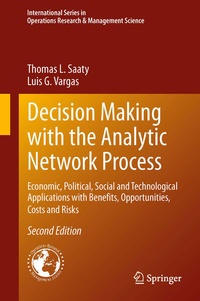
The Analytic Network Process (ANP), developed by Thomas Saaty in his work on multicriteria decision making, applies network structures with dependence and feedback to complex decision making. This new edition of
Decision Making with the Analytic Network Process
is a selection of the latest applications of ANP to economic, social and political decisions, and also to technological design. The ANP is a methodological tool that is helpful to organize knowledge and thinking, elicit judgments registered in both in memory and in feelings, quantify the judgments and derive priorities from them, and finally synthesize these diverse priorities into a single mathematically and logically justifiable overall outcome. In the process of deriving this outcome, the ANP also allows for the representation and synthesis of diverse opinions in the midst of discussion and debate.
The book focuses on the application of the ANP in three different areas: economics, the social sciences and the linking of measurement with human values. Economists can use the ANP for an alternate approach for dealing with economic problems than the usual mathematical models on which economics bases its quantitative thinking. For psychologists, sociologists and political scientists, the ANP offers the methodology they have sought for some time to quantify and derive measurements for intangibles. Finally the book applies the ANP to provide people in the physical and engineering sciences with a quantitative method to link hard measurement to human values. In such a process, one is able to interpret the true meaning of measurements made on a uniform scale using a unit.
Series
Edition
Language
Place of publication
Target group
Professional and scholarly
Research
Edition type
Illustrations
Dimensions
Height: 241 mm
Width: 160 mm
Thickness: 26 mm
Weight
ISBN-13
978-1-4614-7278-0 (9781461472780)
DOI
10.1007/978-1-4614-7279-7
Schweitzer Classification
Thomas L. Saaty (1926 - 2017) was a Distinguished University Professor at the University of Pittsburgh (USA), where he taught in the Joseph M. Katz Graduate School of Business. Prior to coming to the University of Pittsburgh, Saaty was a professor at the Wharton School, University of Pennsylvania (USA) for 10 years. Before that he was working at the Arms Control and Disarmament Agency at the U.S. State Department. He was the architect of the Analytic Hierarchy Process (AHP) and its generalization to complex decisions with dependence and feedback, the Analytic Network Process (ANP).
Luis G. Vargas is a Professor of Business Analytics and Operations at the Joseph M. Katz Graduate School of Business of the University of Pittsburgh (USA). His research focuses on decision theory, practical applications of the Analytic Hierarchy Process (AHP), artificial intelligence in manufacturing, the use of artificial intelligence techniques for scheduling, measurement of resource utilization, group decision making, Bayesian networks, and forecasting.
H. J. Zoffer served as dean of the Joseph M. Katz Graduate School of Business of the University of Pittsburgh (USA) from 1968 to 1996, following a career in teaching and university administration. He is the author of a number of articles and books on such subjects as individual and group decision-making under risk, the social responsibility of business, continuing education for managers, business ethics, corporate risk analysis, accounting education, and improving institutional credibility.
Amos Guiora is Professor of Law at the S.J. Quinney College of Law, University of Utah. He teaches Criminal Procedure, International Law, Global Perspectives on Counterterrorism and Religion and Terrorism, incorporating innovative scenario-based instruction to address national and international security issues and dilemmas. He has publishedextensively on issues related to national security, limits of interrogation, religion and terrorism, the limits of power, multiculturalism and human rights. His latest book: The Crime of Complicity: The Bystander in the Holocaust, directly contributed to legislation ratified by the Utah Legislature in 2021 that criminalizes bystanders who do not intervene on behalf of children and vulnerable adults. The legislation, introduced by Rep. Brian King and sponsored by Sen. Kurt Bramble, enjoyed overwhelming bipartisan support.
The Analytic Network Process.- Forecasting the Resurgence of the U.S. Economy in 2001: An Expert Judgement Approach.- An Analytic Network Process Model for Financial-Crisis Forecasting.- Outsourcing a Firm's Application Development Group.- ANWR: Artic National Wildlife Refuge, an ANP Validation Example.- The Ford Explorer Case.- Synthesis of Complex Criteria Decision Making: A Case Towards a Consensus Agreement for a Middle East Conflict Resolution.- U.S. Energy Security.- Stabilizing Social Security for the Long-Term.- When Shall Poland Enter the Euro Zone?.- The Conflict between China and Taiwan.- U.S. Response to North Korean Nuclear Threat.- Criteria for Evaluating Group Decision-Making Methods.- An Innovative Orders-of-Magnitude Approach to AHP-Based Multicriteria Decision Making: Prioritizing Divergent Intangible Humane Acts.- Sensitivity Analysis in the Analytic Hierarchy Process.