

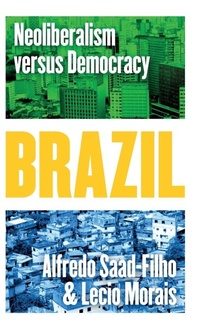
Brazil
Neoliberalism versus Democracy
Published on 20. December 2017
Book
Hardback
256 pages
978-0-7453-3675-6 (ISBN)
Description
Brazil is the world's sixth largest economy, has played a key role as one of the 'pink wave' administrations in Latin America, and was also responsible for wrecking the US-sponsored proposal for a Free Trade Area of the Americas. It is also one of the few large countries where social spending has risen and the distribution of income has improved in the last thirty years.
However, as protests during the World Cup in 2014 have shown, the country remains highly unequal, unmet social needs are vast and its infrastructure is precarious.
Alfredo Saad-Filho and Lecio Morais review the paradox that is modern-day Brazil. Focusing on the period from 1980 onwards, they analyse the tensions between the two systemic transitions to have dominated the country: the political transition from military rule to democracy, and to neoliberalism. The authors show how these transitions had contradictory logics and dynamics, yet ultimately became mutually supportive as they unfolded and intertwined.
However, as protests during the World Cup in 2014 have shown, the country remains highly unequal, unmet social needs are vast and its infrastructure is precarious.
Alfredo Saad-Filho and Lecio Morais review the paradox that is modern-day Brazil. Focusing on the period from 1980 onwards, they analyse the tensions between the two systemic transitions to have dominated the country: the political transition from military rule to democracy, and to neoliberalism. The authors show how these transitions had contradictory logics and dynamics, yet ultimately became mutually supportive as they unfolded and intertwined.
Reviews / Votes
'Saad-Filho and Morais excel at providing a critical, powerful and persuasive analysis for Brazil's economic, social, and political development since the 1930s, emphasizing distinct transition paths from dictatorship to democracy and from state-led industrialization to neoliberalism. Grounded on a solid marxist political economy framework, this book is a must-read to understand Brazil's current predicament and defying challenges ahead' -- Lena Lavinas, Professor of Welfare Economics at the Institute of Economics, Federal University of Rio de Janeiro 'The contradiction between neoliberalism and democracy is now well-known: this book offers a new and profound insight into this through a sharp and convincing account of the Brazilian experience... This is critical political economy at its best' -- Jayati Ghosh, Professor of Economics at the Centre for Economics Studies and Planning, Jawaharlal University, New Delhi 'An excellent short history of Brazil's economic, political and social development since the 1930s' -- Socialist ReviewMore details
Language
English
Place of publication
London
United Kingdom
Target group
Professional and scholarly
Product notice
Library binding
Illustrations
6 b&w figures
Dimensions
Height: 222 mm
Width: 145 mm
Thickness: 19 mm
Weight
499 gr
ISBN-13
978-0-7453-3675-6 (9780745336756)
Copyright in bibliographic data and cover images is held by Nielsen Book Services Limited or by the publishers or by their respective licensors: all rights reserved.
Schweitzer Classification
Persons
Alfredo Saad-Filho is Professor of Political Economy and International Development in the Department of International Development. Previously, he was Professor of Political Economy at SOAS University of London and Senior Economic Affairs Officer at the United Nations Conference on Trade and Development (2011-12).
Alfredo was awarded the Lifetime Achievement Medal from the Federal University of Goias, Brazil in 2014 and the SOAS Director's Teaching Prize in 2016.
His academic publications include Marx's Capital, Neoliberalism: A Reader, Anti-Capitalism: A Marxist Introduction and Brazil: Neoliberalism versus Democracy, and has produced numerous reports as well and other contributions for the United Nations and other international agencies.
Alfredo Saad Filho is Professor of International Political Economy at Queen's University Belfast, Distinguished Visiting Professor at the University of Johannesburg (South Africa), Visiting Professor at LUT University (Finland), Visiting Professor at Universita degli Studi della Campania 'Luigi Vanvitelli' (Italy), Senior Associate Researcher at the University of Brasilia (Brazil) and Professorial Research Associate at SOAS University of London (UK). He was Senior Economic Affairs Officer at the United Nations Conference on Trade and Development (UNCTAD), in Geneva. He has taught in universities and research institutions in Belgium, Brazil, Canada, China, Finland, Germany, Italy, Japan, Mozambique, South Africa, Switzerland and the UK. His publications include 18 books, 80 journal articles, 60 book chapters, and 30 reports for UN and other international agencies.
Lecio Morais is economics adviser at the Lower House of the Brazilian Parliament. He has published widely on political economy, with a focus on Brazilian financial institutions. He is the author of Brazil (Pluto, 2017) and Anti-Capitalism (Pluto, 2002).
Alfredo was awarded the Lifetime Achievement Medal from the Federal University of Goias, Brazil in 2014 and the SOAS Director's Teaching Prize in 2016.
His academic publications include Marx's Capital, Neoliberalism: A Reader, Anti-Capitalism: A Marxist Introduction and Brazil: Neoliberalism versus Democracy, and has produced numerous reports as well and other contributions for the United Nations and other international agencies.
Alfredo Saad Filho is Professor of International Political Economy at Queen's University Belfast, Distinguished Visiting Professor at the University of Johannesburg (South Africa), Visiting Professor at LUT University (Finland), Visiting Professor at Universita degli Studi della Campania 'Luigi Vanvitelli' (Italy), Senior Associate Researcher at the University of Brasilia (Brazil) and Professorial Research Associate at SOAS University of London (UK). He was Senior Economic Affairs Officer at the United Nations Conference on Trade and Development (UNCTAD), in Geneva. He has taught in universities and research institutions in Belgium, Brazil, Canada, China, Finland, Germany, Italy, Japan, Mozambique, South Africa, Switzerland and the UK. His publications include 18 books, 80 journal articles, 60 book chapters, and 30 reports for UN and other international agencies.
Lecio Morais is economics adviser at the Lower House of the Brazilian Parliament. He has published widely on political economy, with a focus on Brazilian financial institutions. He is the author of Brazil (Pluto, 2017) and Anti-Capitalism (Pluto, 2002).
Content
Tables and Figures
Acknowledgements
Acronyms
Presidents of Brazil, 1930-2017
Preface
Introduction
1. A Troubled Path to Development
2. Building a Fragile Democracy
3. Inflation Stabilisation and the Transition to Neoliberalism
4. Impacts of Neoliberalism
5. Neoliberalism under the Workers' Party
6. Developmental Neoliberalism and the PT
7. From Glory to Disaster
8. Class and Class Politics in Brazilian Neoliberalism
9. From the Confluence of Dissatisfactions to the Restoration of Neoliberalism
Conclusion: Crisis of Neoliberalism, Crisis of Democracy
Notes
References
Index
Acknowledgements
Acronyms
Presidents of Brazil, 1930-2017
Preface
Introduction
1. A Troubled Path to Development
2. Building a Fragile Democracy
3. Inflation Stabilisation and the Transition to Neoliberalism
4. Impacts of Neoliberalism
5. Neoliberalism under the Workers' Party
6. Developmental Neoliberalism and the PT
7. From Glory to Disaster
8. Class and Class Politics in Brazilian Neoliberalism
9. From the Confluence of Dissatisfactions to the Restoration of Neoliberalism
Conclusion: Crisis of Neoliberalism, Crisis of Democracy
Notes
References
Index