

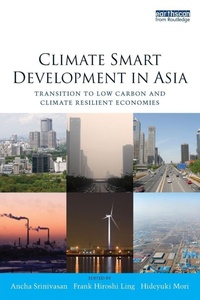
Climate Smart Development in Asia
Transition to Low Carbon and Climate Resilient Economies
1st Edition
Published on 13. February 2012
Book
Paperback/Softback
272 pages
978-1-84407-862-2 (ISBN)
Description
Asia is rapidly becoming a major contributor of global greenhouse gas emissions. Also many countries in the region are highly vulnerable to impacts of climate change. With a growing consensus that there is limited time to avoid dangerous climate change, scientists, engineers, economists and policymakers worldwide have begun exploring how developing Asia can capitalize on the transition to a climate-smart development paradigm. Most discussions, however, have focused primarily on the transfer of technologies from developed to developing countries and have overlooked other equally important issues such as financing, governance, and capacity.
This book covers all critical aspects of climate-smart development and attempts to integrate both market-based and technology-based solutions into a comprehensive approach for creating a roadmap for low carbon, climate-resilient economies in Asia. It examines strategies, policies and incentives in selected countries for reducing greenhouse gas emissions in the energy, transportation, land use, and buildings sectors. It also identifies policies that are essential to improve resilience to both current and future impacts of climate change.
The book highlights technical, economic, financial, and institutional challenges and opportunities for realizing climate-smart development in Asia at the national and sub-national levels. How the international climate regime can facilitate appropriate enabling environment in developing Asia is also examined.
This book is essential reading for policy makers, students, practitioners, and researchers concerned with climate change mitigation and adaptation, and sustainable development in Asia and the wider world. It is hoped that the book will contribute to discussions on the theme of "green economy in the context of sustainable development and poverty eradication" in the run-up to the United Nations Conference on Sustainable Development or "Rio +20" and beyond.
This book covers all critical aspects of climate-smart development and attempts to integrate both market-based and technology-based solutions into a comprehensive approach for creating a roadmap for low carbon, climate-resilient economies in Asia. It examines strategies, policies and incentives in selected countries for reducing greenhouse gas emissions in the energy, transportation, land use, and buildings sectors. It also identifies policies that are essential to improve resilience to both current and future impacts of climate change.
The book highlights technical, economic, financial, and institutional challenges and opportunities for realizing climate-smart development in Asia at the national and sub-national levels. How the international climate regime can facilitate appropriate enabling environment in developing Asia is also examined.
This book is essential reading for policy makers, students, practitioners, and researchers concerned with climate change mitigation and adaptation, and sustainable development in Asia and the wider world. It is hoped that the book will contribute to discussions on the theme of "green economy in the context of sustainable development and poverty eradication" in the run-up to the United Nations Conference on Sustainable Development or "Rio +20" and beyond.
Reviews / Votes
"This book provides a comprehensive and detailed primer to climate-smart development. It covers all critical aspects of LCE and attempts to integrate both market- and technology-based solutions into a comprehensive approach for achieving LCE and climate resilience in Asia. [...] The book should be particularly useful for policymakers, scientists, researchers, and students in the fields of low-carbon economy, clean and renewable energy, climate change mitigation and adaptation, and sustainable development in Asia as well as globally." - Wen J. Wang, University of Missouri, and Hong S. He, Chinese Academy of Sciences, in Landscape EcologyMore details
Language
English
Place of publication
London
United Kingdom
Publishing group
Taylor & Francis Ltd
Target group
College/higher education
Professional and scholarly
Illustrations
31 s/w Tabellen, 37 s/w Zeichnungen
31 Tables, black and white; 37 Line drawings, black and white
Dimensions
Height: 234 mm
Width: 156 mm
Thickness: 15 mm
Weight
421 gr
ISBN-13
978-1-84407-862-2 (9781844078622)
Copyright in bibliographic data and cover images is held by Nielsen Book Services Limited or by the publishers or by their respective licensors: all rights reserved.
Schweitzer Classification
Other editions
Additional editions
ANCHA SRINIVASAN | Frank Hiroshi Ling | Hideyuki Mori
Climate Smart Development in Asia
Transition to Low Carbon and Climate Resilient Economies
E-Book
07/2013
1st Edition
Routledge
€59.49
Available for download
ANCHA SRINIVASAN | Frank Hiroshi Ling | Hideyuki Mori
Climate Smart Development in Asia
Transition to Low Carbon and Climate Resilient Economies
E-Book
07/2013
1st Edition
Routledge
€59.49
Available for download
ANCHA SRINIVASAN | Frank Ling | Hideyuki Mori
Climate Smart Development in Asia
Transition to Low Carbon and Climate Resilient Economies
Book
02/2012
1st Edition
Earthscan Ltd
€231.90
Shipment within 3-4 weeks
Persons
Ancha Srinivasan, formerly a Principal Researcher and Manager at the Institute for Global Environmental Strategies (IGES), is a Principal Climate Change Specialist at the Asian Development Bank in Manila, Philippines.
Frank Hiroshi Ling is an Associate Researcher at IGES and a Researcher at Ibaraki University in Mito, Japan.
Hideyuki Mori is the President of IGES, Hayama, Japan.
Frank Hiroshi Ling is an Associate Researcher at IGES and a Researcher at Ibaraki University in Mito, Japan.
Hideyuki Mori is the President of IGES, Hayama, Japan.
Content
Part 1: Introduction 1. Low Carbon Climate-Resilient Economies (LCE) in Asia: An Overview Part 2: Case Studies 2.The Potential for Low Carbon Climate-Resilient Economy (LCE) in Japan 3. The Potential for LCE in India 4. Challenges and Opportunities for LCE in China: A Case Study of Policies for Wind Development 5. LCE in Indonesia: A Review of National Programs for GHG Emissions Mitigation and Climate Resilience 6. The Potential for Voluntary Approaches to Realize a Low Carbon Economy: Private-Public Partnerships in Taiwan Part 3: Enabling Conditions 7. Technologies for Transition to LCE: A Case Study of CCS in Asia 8. Financing the Low-Carbon Energy Sector in the Context of Post-2012 Climate Regime Negotiations 9. Enabling the Transition to a Low Carbon Climate Resilient Economy in Asian Cities: Drivers, Barriers and Solutions 10. Policy Frameworks and Climate Feedbacks for LCE: The Case of Hydropower 11. Bioenergy Deployment for a Low Carbon Climate Resilient Economy: Biogas for Cooking in India Part 4: The Way Forward 12. LCE in Asia: Looking Back to Move Forward