

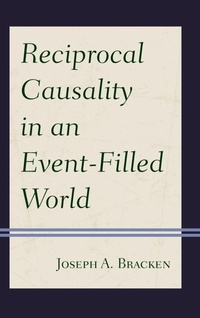
Reciprocal Causality in an Event-Filled World
Published on 4. March 2022
Book
Hardback
168 pages
978-1-9787-0978-2 (ISBN)
Description
Given the current sense of helplessness in dealing with environmental change and other urgent issues, a new world view is needed that emphasizes the unique contribution that individual citizens can make to the common good as opposed to their individual needs and desires. In a recent encyclical on the environment, Pope Francis set forth reasons from Scripture and Church teaching for this shift in perspective, but he did not provide a philosophically based foundation for this change of heart. To fill that gap, Joseph Bracken examines key writings of process-oriented philosophers like Henri Bergson and Alfred North Whitehead along with systems-oriented thinkers like Ludwig von Bertalanffy and Ervin Laszlo to create a systems-oriented understanding of the God-world relation.
Reviews / Votes
Ecology is all about sustaining vital connections. Understanding these connections, however, is not easy. We need the help of philosophers and-at least according to Joseph Bracken-theologians too. This challenging book undertakes the important work of exploring a wide variety of ideas on the complex relationships that tie life, evolution, and humanity to the physical universe and to God. Those who follow its expositions and arguments will be amply rewarded. -- John Haught, Georgetown University Without a view of the world that privileges interrelatedness, events, and systems, major problems of our world will remain unsolved. In this book, Joseph Bracken lays out a conceptual framework that explains why sytsems-oriented thinking matters. His proposal represents a way of seeing reality that not only makes sense but seems necessary to answer our biggest questions! -- Thomas Jay Oord, author of Open and Relational Theology Spanning over a long philosophical career, Joseph Bracken has been an avid proponent of process thought as the most adequate philosophy for today's complex world. Just as Alfred North Whitehead developed a new philosophical system based on process and flow, so too, Bracken has contributed his own metaphysical scheme based on a trinitarian understanding of intersubjectivity. In this new book, Fr. Bracken brings together a wealth of understanding and insight that allows the reader to appreciate the significant role process philosophy offers to a world of emergent evolution, holons, and systems thinking. This is a wonderful book for those interested in pursuing a new metaphysical understanding of a deeply entangled and interconnected universe. -- Ilia Delio Joseph Bracken, like me, finds the work of Whitehead extremely helpful. Neither of us is satisfied with his treatment of societies and the relation of societies to its parts or members. Bracken has found help in system theory to remedy this deficiency, and in this book he not only explains his modification of Whitehead, but also shows the value of this modified Whitehead in responding to a variety of issues with special concern for environmental ones. We are in his debt. -- John Cobb, Jr., co-founder, Center for Process Studies This book deepens and clarifies Bracken's on-going efforts to show both the coherence and the urgency of a systems-oriented worldview: individual entities from atoms to persons receive their being within larger organic systems, but at the same time they contribute to the ongoing vitality of those systems. Bracken lays out how such a worldview can foster a dialogue between science and theology, as well as nurture action for social and environmental justice and well-being. This book is as rewarding as it is challenging. -- Paul Knitter, Paul Tillich Emeritus Professor of Theology & Religions, Union Theological Seminary Bracken displays his wide range of familiarity with just about every philosopher who has dealt with the topic of science and religion. Some of Bracken's assertions may cause consternation among metaphysicians. His theses about reciprocal causality reflect a postmodern skepticism toward the classical understanding of the world. However, his new worldview presents a vision of how science can open for us a model of interconnectedness. Take a look at how systems work. There's no answer to human and world problems without it. * Catholic Books Review *More details
Language
English
Place of publication
United States
Publishing group
Bloomsbury Publishing Plc
Target group
Professional and scholarly
Dimensions
Height: 235 mm
Width: 157 mm
Thickness: 14 mm
Weight
403 gr
ISBN-13
978-1-9787-0978-2 (9781978709782)
Copyright in bibliographic data and cover images is held by Nielsen Book Services Limited or by the publishers or by their respective licensors: all rights reserved.
Schweitzer Classification
Other editions
Additional editions
Joseph A. Bracken S.J.
Reciprocal Causality in an Event-Filled World
E-Book
03/2022
1st Edition
Lexington Books/Fortress Academic
€90.99
Available for download
Joseph A. Bracken S.J.
Reciprocal Causality in an Event-Filled World
E-Book
03/2022
1st Edition
Lexington Books/Fortress Academic
€90.99
Available for download
Person
Joseph A. Bracken, SJ, is emeritus professor of theology at Xavier University in Cincinnati, Ohio.
Content
Part One: Bergson and Whitehead on the One and the Many from a Process-Oriented Approach
1. Living in an Event-Filled World
2. Living in a Dynamically Interconnected World
3. Living in a World of Open-Ended Systems
Part Two: Failure to deal with Major Issues re the Common Good
4. Critical Evaluation of Modern Scientific Method
5. Reconciling the Truth-Claims of Science and Religion
Part Three: Reason and Revelation in Dealing with the Environmental Crisis
6. A Systems-Oriented Environmental Ethic
7. Divine and Human Personhood in a Systems-Oriented Approach to Reality
8. Linking Science and Religion within a New World View
1. Living in an Event-Filled World
2. Living in a Dynamically Interconnected World
3. Living in a World of Open-Ended Systems
Part Two: Failure to deal with Major Issues re the Common Good
4. Critical Evaluation of Modern Scientific Method
5. Reconciling the Truth-Claims of Science and Religion
Part Three: Reason and Revelation in Dealing with the Environmental Crisis
6. A Systems-Oriented Environmental Ethic
7. Divine and Human Personhood in a Systems-Oriented Approach to Reality
8. Linking Science and Religion within a New World View