

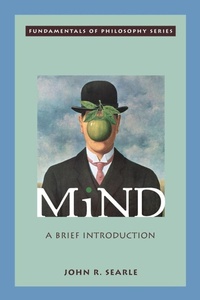
Mind
A Brief Introduction
Published on 22. September 2005
Book
Paperback/Softback
240 pages
978-0-19-515734-5 (ISBN)
Description
"The philosophy of mind is unique among contemporary philosophical subjects," writes John Searle, "in that all of the most famous and influential theories are false." In Mind, Searle dismantles these famous and influential theories as he presents a vividly written, comprehensive introduction to the mind.
Here readers will find one of the world's most eminent thinkers shedding light on the central concern of modern philosophy. Searle begins with a look at the twelve problems of philosophy of mind--which he calls "Descartes and Other Disasters"--problems which he returns to throughout the volume, as he illuminates such topics as the freedom of the will, the actual operation of mental causation, the nature and functioning of the unconscious, the analysis of perception, and the concept of the self. One of the key chapters is on the mind-body problem, which Searle analyzes brilliantly. He argues that all forms of consciousness--from feeling thirsty to wondering how to translate Mallarme--are caused by the behavior of neurons and are realized in the brain system, which is itself composed of neurons. But this does not mean that consciousness is nothing but neuronal behavior. The main point of having the concept of consciousness, Searle points out, is to capture the first person subjective features of the phenomenon and this point is lost if we redefine consciousness in third person objective terms.
Described as a "dragonslayer by temperament," John Searle offers here a refreshingly direct and open discussion of philosophy, one that skewers accepted wisdom even as it offers striking new insights into the nature of consciousness and the mind.
Here readers will find one of the world's most eminent thinkers shedding light on the central concern of modern philosophy. Searle begins with a look at the twelve problems of philosophy of mind--which he calls "Descartes and Other Disasters"--problems which he returns to throughout the volume, as he illuminates such topics as the freedom of the will, the actual operation of mental causation, the nature and functioning of the unconscious, the analysis of perception, and the concept of the self. One of the key chapters is on the mind-body problem, which Searle analyzes brilliantly. He argues that all forms of consciousness--from feeling thirsty to wondering how to translate Mallarme--are caused by the behavior of neurons and are realized in the brain system, which is itself composed of neurons. But this does not mean that consciousness is nothing but neuronal behavior. The main point of having the concept of consciousness, Searle points out, is to capture the first person subjective features of the phenomenon and this point is lost if we redefine consciousness in third person objective terms.
Described as a "dragonslayer by temperament," John Searle offers here a refreshingly direct and open discussion of philosophy, one that skewers accepted wisdom even as it offers striking new insights into the nature of consciousness and the mind.
Reviews / Votes
Searle's deeply thought-out naturalism and ontological realism are refreshing and his arguments are rigorous and compelling, which makes this a highly engaging and brilliant piece of philosophical writing for any serious reader to enjoy. * Maria Antonietta Perna, University College London *More details
Series
Language
English
Place of publication
New York
United States
Illustrations
5 line drawings
Dimensions
Height: 210 mm
Width: 140 mm
Thickness: 14 mm
Weight
332 gr
ISBN-13
978-0-19-515734-5 (9780195157345)
Copyright in bibliographic data and cover images is held by Nielsen Book Services Limited or by the publishers or by their respective licensors: all rights reserved.
Schweitzer Classification
Other editions
Additional editions
E-Book
11/2004
1st Edition
OUP eBook
€10.99
Available for download
Person
John R. Searle is Mills Professor in the Department of Philosophy, University of California, Berkeley. He is the author of many books, including The Rediscovery of the Mind, The Mystery of Consciousness, Mind, Language and Society, Philosophy in the Real World, and Consciousness and Language.
Content
Acknowledgments ; Introduction: Why I Wrote This Book ; 1. A Dozen Problems in the Philosophy of Mind ; 2. The Turn to Materialism ; 3. Arguments against Materialism ; 4. Consciousness Part I: Consciousness and the Mind-Body Problem ; 5. Consciousness Part II: The Structure of Consciousness and Neurobiology ; 6. Intentionality ; 7. Mental Causation ; 8. Free Will ; 9. The Unconscious and the Explanation of Behavior ; 10. Perception ; 11. The Self ; Epilogue: Philosophy and the Scientific World-View ; Notes ; Suggestions for Further Reading ; Index