

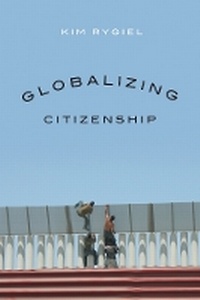
Globalizing Citizenship
Will be published approx. on 1. September 2010
Book
Hardback
272 pages
978-0-7748-1804-9 (ISBN)
Description
The events of 9/11 exposed and enhanced tensions between globalcapitalism and the nation-state. Governments struggle more than ever togovern populations and manage cross-border traffic without building newbarriers to trade and commerce. What does citizenship mean in thiscontext? Is it in crisis?
Kim Rygiel explores these questions by examining border anddetention policies in the United States, the United Kingdom, Canada,and Australia as part of a larger politics of citizenship that preceded9/11. Building on Foucault's concept of biopolitics, she arguesthat citizenship is becoming a globalizing regime to govern mobility asnations harmonize border and detention policies, outsource statefunctions to international organizations and private companies, andrely on technologies of governing to discipline the body. The newmobility regime is not only deepening boundaries based on race, class,and gender, it is causing Western nations to embrace a moretechnocratic, depoliticized understanding of citizenship.
Kim Rygiel explores these questions by examining border anddetention policies in the United States, the United Kingdom, Canada,and Australia as part of a larger politics of citizenship that preceded9/11. Building on Foucault's concept of biopolitics, she arguesthat citizenship is becoming a globalizing regime to govern mobility asnations harmonize border and detention policies, outsource statefunctions to international organizations and private companies, andrely on technologies of governing to discipline the body. The newmobility regime is not only deepening boundaries based on race, class,and gender, it is causing Western nations to embrace a moretechnocratic, depoliticized understanding of citizenship.
More details
Language
English
Place of publication
Vancouver
Canada
Target group
Professional and scholarly
Product notice
sewn/stitched
Dimensions
Height: 229 mm
Width: 152 mm
Weight
520 gr
ISBN-13
978-0-7748-1804-9 (9780774818049)
Copyright in bibliographic data and cover images is held by Nielsen Book Services Limited or by the publishers or by their respective licensors: all rights reserved.
Schweitzer Classification
Person
Kim Rygiel is an assistant professor of politicalscience at Wilfrid Laurier University and co-editor of(En)Gendering the War on Terror: War Stories and CamouflagedPolitics.
Content
1 Introduction: Globalization, Security, and Citizenship
2 Citizenshipin Crisis? Rethinking Citizenship as Government and Resistance
3 GlobalizingCitizenship: Governing Global Mobility through Citizenship
4 SecuritizingCitizenship: Citizenship as Biopolitics
5 MobileCitizens and Systems of Surveillance: Border Controls as Technologiesof Citizenship
6 (Un)MakingCitizens and Abject Others: Detention Practices as Technologies ofCitizenship
7 Conclusion:Towards a Politics of Citizenship as Resistance
Notes
References
Index
2 Citizenshipin Crisis? Rethinking Citizenship as Government and Resistance
3 GlobalizingCitizenship: Governing Global Mobility through Citizenship
4 SecuritizingCitizenship: Citizenship as Biopolitics
5 MobileCitizens and Systems of Surveillance: Border Controls as Technologiesof Citizenship
6 (Un)MakingCitizens and Abject Others: Detention Practices as Technologies ofCitizenship
7 Conclusion:Towards a Politics of Citizenship as Resistance
Notes
References
Index