

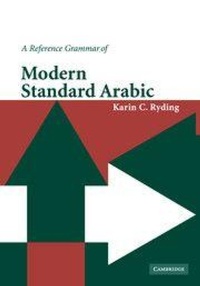
A Reference Grammar of Modern Standard Arabic
Published on 25. August 2005
Book
Hardback
734 pages
978-0-521-77151-1 (ISBN)
Description
A Reference Grammar of Modern Standard Arabic is a comprehensive handbook on the structure of Arabic. Keeping technical terminology to a minimum, it provides a detailed yet accessible overview of Modern Standard Arabic in which the essential aspects of its phonology, morphology and syntax can be readily looked up and understood. Accompanied by extensive carefully-chosen examples, it will prove invaluable as a practical guide for supporting students' textbooks, classroom work or self-study, and will also be a useful resource for scholars and professionals wishing to develop an understanding of the key features of the language. Grammar notes are numbered for ease of reference, and a section is included on how to use an Arabic dictionary, as well as helpful glossaries of Arabic and English linguistic terms and a useful bibliography. Clearly structured and systematically organised, this book is set to become the standard guide to the grammar of contemporary Arabic.
More details
Series
Language
English
Place of publication
Cambridge
United Kingdom
Target group
Professional and scholarly
College/higher education
Dimensions
Height: 250 mm
Width: 175 mm
Thickness: 44 mm
Weight
1427 gr
ISBN-13
978-0-521-77151-1 (9780521771511)
Copyright in bibliographic data and cover images is held by Nielsen Book Services Limited or by the publishers or by their respective licensors: all rights reserved.
Schweitzer Classification
Other editions
Additional editions
Karin C. Ryding
A Reference Grammar of Modern Standard Arabic
E-Book
09/2005
1st Edition
Cambridge University Press
€81.49
Available for download
Karin C. Ryding
A Reference Grammar of Modern Standard Arabic
Book
08/2005
Cambridge University Press
€105.00
Shipment within 15-20 days
Karin C. Ryding
Reference Grammar of Modern Standard Arabic
E-Book
08/2005
Cambridge University Press
€63.99
Available for download
Person
Karin C. Ryding is Sultan Qaboos bin Said Professor of Arabic, Department of Arabic Language, Literature and Linguistics, Georgetown University.
Content
1. Introduction to Arabic; 2. Modern Standard Arabic phonology and script; 3. Arabic word structure: an overview; 4. Basic Arabic sentence structures; 5. Arabic noun types; 6. Participles: active and passive; 7. Noun inflections: gender, humanness, number, definiteness, and case; 8. Construct phrases and nouns in apposition; 9. Noun specifiers and quantifiers; 10. Adjectives: form and function; 11. Adverbs and adverbial expressions; 12. Personal pronouns; 13. Demonstrative pronouns and their functions; 14. Relative pronouns and relative clauses; 15. Arabic numerals and numeral phrases; 16. Prepositions and prepositional phrases; 17. Questions and question words; 18. Connectives and conjunctions; 19. Subordinating conjunctions: the particle 'inna and her sisters; 20. The classes of Arabic verbs; 21. Verb inflection: a summary; 22. Form I the base form of the triliteral verb: verb types, verbal nouns and participles; 23. Form II triliteral verb: verb types, verbal nouns, and participles; 24. Form III triliteral verb: verb types, verbal nouns, and participles; 25. Form IV triliteral verb: verb types, verbal nouns, and participles; 26. Form V triliteral verb: verb types, verbal nouns, and participles; 27. Form VI triliteral verb: verb types, verbal nouns, and participles; 28. Form VII triliteral verb: verb types, verbal nouns, and participles; 29. Form VIII triliteral verb: verb types, verbal nouns, and participles; 30. Form IX triliteral verb: verb types, verbal nouns, and participles; 31. Form X triliteral verb: verb types, verbal nouns, and participles; 32. Forms XI-XV triliteral verb; 33. Quadriliteral verbs: verb types, verbal nouns, and participles; 34. Moods of the verb I: indicative and subjunctive; 35. Moods of the verb II: jussive and imperative; 36. Verbs of being, becoming, remaining, seeming; 37. Negation and exception; 38. Passive and passive-type expressions; 39. Conditional and opative expressions.