

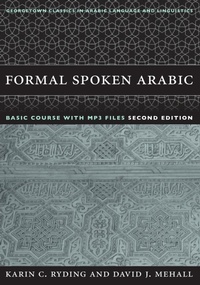
Formal Spoken Arabic Basic Course with MP3 Files
Second Edition
2nd Edition
Published on 18. November 2005
Book
Paperback/Softback
400 pages
978-1-58901-060-4 (ISBN)
Description
This new edition, updated and with additional exercises, equips those who work, travel, and study in Arab countries with an educated form of spoken Arabic that functions flexibly in the face of various regional colloquial variants in the Arab world. Because the Arabic language has a number of very different spoken vernaculars, being able to speak and be understood in all Arab countries has become a challenge for English speakers. Ryding and Mehall have designed a course that teaches a standardized variant of spoken Arabic that is close to, but more natural than, the literary Modern Standard Arabic. With a non-grammar-based approach, this book fosters communicative competence in Arabic on all levels and develops speaking proficiency without abandoning Arabic script. It has proven to be clear, effective, and relevant to the needs of Americans living and working in the Arab East.
Task-based lessons feature basic dialogues between Americans and Arabs, explanations of new structures, vocabulary expansion, and exercises; and provide gradual access to the sounds and script of Arabic by emphasizing listening and reading comprehension first, then slowly adding oral exercises and activities until the student has achieved basic proficiency. Not intended for self-instruction for beginners, "Formal Spoken Arabic Basic Course with MP3 Files" assumes some previous knowledge of Modern Standard Arabic, Arabic script and phonology, and previous or simultaneous instruction in orthography. This new edition includes a CD of MP3 audio exercises that are keyed to the text and drill students on listening and speaking. Lessons cover topics including: Heads of State; Cities and Countries; Official Titles; Geography; Systems of Government; Lost Luggage; Getting Acquainted; Establishing Common Ground; Seeking and Giving Information; Personal Needs and Family; Handling Problems; Eating Out; and, Bargaining and Buying.
Task-based lessons feature basic dialogues between Americans and Arabs, explanations of new structures, vocabulary expansion, and exercises; and provide gradual access to the sounds and script of Arabic by emphasizing listening and reading comprehension first, then slowly adding oral exercises and activities until the student has achieved basic proficiency. Not intended for self-instruction for beginners, "Formal Spoken Arabic Basic Course with MP3 Files" assumes some previous knowledge of Modern Standard Arabic, Arabic script and phonology, and previous or simultaneous instruction in orthography. This new edition includes a CD of MP3 audio exercises that are keyed to the text and drill students on listening and speaking. Lessons cover topics including: Heads of State; Cities and Countries; Official Titles; Geography; Systems of Government; Lost Luggage; Getting Acquainted; Establishing Common Ground; Seeking and Giving Information; Personal Needs and Family; Handling Problems; Eating Out; and, Bargaining and Buying.
Reviews / Votes
"Goes a long way toward bridging the gap between Arabic Colloquial Dialects at the one end of the spectrum and Modern Standard Arabic (MSA) at the other end, and with the addition of a number of key Levantine Colloquial vocabulary items, it allows learners who have a certain expertise in MSA to make use of that expertise appropriately and effectively as they pursue their daily lives in the Middle East." - Gerald E. Lampe, deputy director of the National Foreign Language Center and president of the American Association of Teachers of Arabic "This revised edition is sound in approach and cultural content; it enables academicians and professionals alike to acquire a spoken vernacular that transcends the boundaries of diverse Arabic dialects while carefully overcoming localisms - thanks to the authors' classroom-tested and adaptable materials and masterful approach that seamlessly weaves commonalities among spoken dialects into one learnable language variety." - Mohssen Esseesy, assistant professor and coordinator, Arabic Program, George Washington University"More details
Series
Edition
Second Edition
Language
English
Place of publication
Washington, DC
United States
Target group
US School Grade: From College Freshman to College Graduate Student
Edition type
Revised edition
Product notice
Paperback (trade)
Illustrations
Not illustrated
Dimensions
Height: 253 mm
Width: 178 mm
Thickness: 21 mm
Weight
703 gr
ISBN-13
978-1-58901-060-4 (9781589010604)
Copyright in bibliographic data and cover images is held by Nielsen Book Services Limited or by the publishers or by their respective licensors: all rights reserved.
Schweitzer Classification
Persons
Karin C. Ryding is the Sultan Qaboos bin Said Professor of Arabic at Georgetown University. David Mehall is a research associate at the Center for Advanced Study of Language (CASL), University of Maryland.
Content
Contents of the MP3 FilesArabic Research at Georgetown University Preface Preface to the first edition Acknowledgements to the second edition Introduction Teacher's Notes Student's Notes LESSON ONE: HEADS OF STATE LESSON TWO: CITIES AND COUNTRIES LESSON THREE: OFFICIAL TITLES LESSON FOUR: GEOGRAPHY LESSON FIVE: SYSTEMS OF GOVERNMENT LESSON SIX: REVIEW LESSON SEVEN: GEOGRAPHY II LESSON EIGHT: LOST LUGGAGE LESSON NINE: GETTING ACQUAINTED LESSON TEN: ESTABLISHING COMMON GROUND LESSON ELEVEN: SEEKING AND GIVING INFORMATION LESSON TWELVE: PERSONAL NEEDS AND FAMILY LESSON THIRTEEN: REVIEW LESSON FOURTEEN: HANDLING A PROBLEM LESSON FIFTEEN: EATING OUT LESSON SIXTEEN: BARGAINING AND BUYING Arabic-English Glossary English-Arabic Glossary Appendix 1: Names of the Months and Months of the Islamic Calendar Appendix 2: Summary Verb List by Form and Verbal Noun