

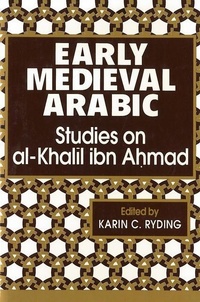
Early Medieval Arabic
Studies on Al-Khalil ibn Ahmad
Will be published approx. on 1. January 1998
Book
Hardback
160 pages
978-0-87840-663-0 (ISBN)
Description
The first book in English on the founder of Arabic linguistic theory, this interdisciplinary collection explores the contributions to Arabic intellectual history of al-Khalil ibn Ahmad, (d. A.H. 175/A.D. 791). Al-Khalil was distinguished in his own time as a lexicographer, phonologist, grammarian, educator and musicologist. In the Arab world, his stature is almost legendary, although information on his life, his works and his achievements is fragmented. He is remembered principally for two achievements: the creation of the first dictionary of the Arabic language ( Kitab al-'ayn, "The Book of 'ayn"), and discovery of the rule-governed metrical systems used in pre-Islamic Arabic poetry. His biographers also cite publications on musical theory and have preserved fragments of his poetry. In addition to these achievements, he was also the teacher of the medieval Islamic world's most distinguished authority on Arabic grammar, Sibawayh. Conceived as a tribute to al-Khalil's influence on Arabic language sciences, this book provides a new and broader perspective on al-Khalil's talents, character, and fields of interest.
It should be of interest to Arabic linguists, medievalists, historians of linguistics, theoretical linguists, historians of science and scholars of medieval Arab intellectual history.
It should be of interest to Arabic linguists, medievalists, historians of linguistics, theoretical linguists, historians of science and scholars of medieval Arab intellectual history.
Reviews / Votes
All four essays are valuable, and together they cast light both on al-Khalil and on the question of how much can ever be known about a pioneering thinker of whose work so little has survived. MESA Bulletin These essays are stimulating and offer new material on the role and work of al-Khalil, one of the most famous of the classical Arab philologists. MELA NotesMore details
Language
English
Place of publication
Washington, DC
United States
Target group
College/higher education
Professional and scholarly
US School Grade: College Graduate Student and over
Product notice
sewn/stitched
Cloth over boards
With dust jacket
Illustrations
Not illustrated
Dimensions
Height: 238 mm
Width: 161 mm
Thickness: 25 mm
Weight
440 gr
ISBN-13
978-0-87840-663-0 (9780878406630)
Copyright in bibliographic data and cover images is held by Nielsen Book Services Limited or by the publishers or by their respective licensors: all rights reserved.
Schweitzer Classification
Person
Karin C. Ryding is professor emerita in the Department of Arabic and Islamic Studies Georgetown University. She is the author of Formal Spoken Arabic: Basic Course and Formal Spoken Arabic: FAST Course (both published by Georgetown University Press).
Content
Foreword by Roger Allen Introduction Section One: Fundamentals of Foreign Language Pedagogy 1. Some Pedagogical Principles 2. Theory and Practice 3. Professionalism and Professional Standards Section Two: Approaches to Foreign Language Teaching 4. Traditional Methods and Approaches for Language Teaching 5. Newer Methods in Foreign Language Teaching Section Three: Programmatic Issues 6. Learning Goals, Curricula, and Syllabi 7. Materials, Resources, Technology 8. Assessment and Testing Section Four: Planning and Managing the Elements of Teaching 9. Pedagogical Practice: Classroom Management 10. Learning Styles, Strategies, and Affective Factors 11. Mixed Classes and Heritage Learners Section Five: The Pedagogy of Comprehension 12. Comprehension and Arabic Input: Overview 13. Reading Comprehension in Arabic 14. Listening Comprehension in Arabic Section Six: Teaching Productive Skills 15. Teaching Arabic Pronunciation 16. Teaching Spoken Arabic 17. Writing in Arabic Section Seven: Teaching Core Competencies 18. Teaching and Learning Vocabulary 19. Pedagogical Grammar 20. Teaching Arabic CultureAppendicesReferences Index