

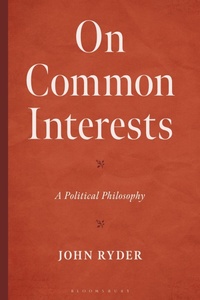
On Common Interests
A Political Philosophy
Published on 18. September 2025
Book
Hardback
368 pages
979-8-7651-4349-0 (ISBN)
Description
This book develops an original theory that grounds political principles and practices in common interests among citizens and residents of a country. This theory differs from most prevalent political philosophies in that they focus on common ideas which emphasize how we might think rather than how we actually live, or on competing or conflicting interests for the purpose of balancing or advancing one set of interests over another. On Common Interests offers principles, possible structures, and practices that enable government to help us advance the interests we share. As a political philosophy, it values cooperation and collaboration over conflict and competition.
Reviews / Votes
Ryder develops a detailed and tightly reasoned pragmatic alternative to political philosophies constructed on left/right/center and liberal/anti-liberal assumptions. His innovative approach is pluralistic and ecumenical. He urges consensus-building motivated not by what people think or believe, but by how their experiences shape their lives as individuals and members of communities. -- Larry A. Hickman, former director, Center for Dewey Studies, Southern Illinois University Carbondale, USA This is a radical exercise of the political imagination, in the sense that the author at every turn attempts to get to the root of the matter, digging deeper than any other contemporary theorist is disposed to do. John Ryder is unafraid to draw out disconcertingly novel implications from his historical observations and theoretical conclusions, to entertain utterly unorthodox possibilities. He does so in an historically informed, philosophically rigorous, and rhetorically engaging manner. This is a very serious and, in the best sense, disturbing work. His position does not neatly fit into any traditional category-so much the worse for those categories, so much to the credit of this author. -- Vincent Colapietro, professor emeritus of philosophy, Pennsylvania State University, USAMore details
Language
English
Place of publication
New York
United States
Publishing group
Bloomsbury Publishing Plc
Target group
Professional and scholarly
Dimensions
Height: 235 mm
Width: 157 mm
Thickness: 24 mm
Weight
675 gr
ISBN-13
979-8-7651-4349-0 (9798765143490)
Copyright in bibliographic data and cover images is held by Nielsen Book Services Limited or by the publishers or by their respective licensors: all rights reserved.
Schweitzer Classification
Other editions
Additional editions
E-Book
07/2025
1st Edition
Bloomsbury Academic
€32.99
Available for download
E-Book
07/2025
1st Edition
Bloomsbury Academic
€32.99
Available for download
Person
John Ryder has been a professor of philosophy and a senior administrator at several universities in the United States and abroad. He is the author or editor of over one hundred publications, as well as a former president of the Alliance of Universities for Democracy, and co-founder of the Central European Pragmatist Forum.
Content
Acknowledgements
Preface
Introduction
Part I: Preliminary Considerations and Background Conceptions
Chapter 1. The Failure of Political Philosophy
Chapter 2. The Varieties of Political Experience
Chapter 3. Practice Over Propositions
Chapter 4. Experience and Social Values
Part II: Political Principles, Common Interests, and the Polity
Chapter 5. Political Principles
Chapter 6. The Plurality and Diversity of Common Interests
Chapter 7. Common Interests and the Polity
Conclusion
Bibliography
Index
About the Author
Preface
Introduction
Part I: Preliminary Considerations and Background Conceptions
Chapter 1. The Failure of Political Philosophy
Chapter 2. The Varieties of Political Experience
Chapter 3. Practice Over Propositions
Chapter 4. Experience and Social Values
Part II: Political Principles, Common Interests, and the Polity
Chapter 5. Political Principles
Chapter 6. The Plurality and Diversity of Common Interests
Chapter 7. Common Interests and the Polity
Conclusion
Bibliography
Index
About the Author