

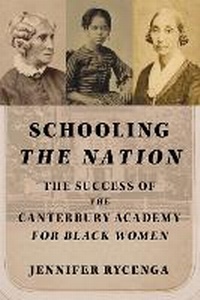
Schooling the Nation
The Success of the Canterbury Academy for Black Women
Published on 7. January 2025
Book
Hardback
328 pages
978-0-252-04630-8 (ISBN)
Description
Founded in 1833 by white teacher Prudence Crandell, Canterbury Academy educated more than two dozen Black women during its eighteen-month existence. Racism in eastern Connecticut forced the teen students to walk a gauntlet of taunts, threats, and legal action to pursue their studies, but the school of higher learning flourished until a vigilante attack destroyed the Academy. Jennifer Rycenga recovers a pioneering example of antiracism and Black-white cooperation. At once an inspirational and cautionary tale, Canterbury Academy succeeded thanks to far-reaching networks, alliances, and activism that placed it within Black, women's, and abolitionist history. Rycenga focuses on the people like Sarah Harris, the Academy's first Black student; Maria Davis, Crandall's Black housekeeper and her early connection to the embryonic abolitionist movement; and Crandall herself. Telling their stories, she highlights the agency of Black and white women within the currents, and as a force changing those currents, in nineteenth-century America.
Insightful and provocative, Schooling the Nation tells the forgotten story of remarkable women and a collaboration across racial and gender lines.
Insightful and provocative, Schooling the Nation tells the forgotten story of remarkable women and a collaboration across racial and gender lines.
Reviews / Votes
"Jennifer Rycenga's book is a brilliant work of scholarship that positions the Black and Brown young women of the Canterbury Female Boarding School as leaders in their own fight for education and early civil rights. Dr. Rycenga has accomplished what few scholars have done: to use history as a roadmap for today to seek justice in education and continue the work of Maria Davis, Sarah Harris, and Prudence Crandall. Dr. Rycenga's research has changed the way this story is told."--Joan M. DiMartino, Museum Curator and Site Superintendent, Prudence Crandall Museum "Original and enlightening. Delving deeply, Rycenga explores Crandall's life and influences while revealing the students who attended the Academy as members of a remarkable group."--Julie Winch, author of A Gentleman of Color: The Life of James FortenMore details
Series
Edition
New edition
Language
English
Place of publication
Baltimore
United States
Target group
Professional and scholarly
Edition type
New edition
Illustrations
22 black & white photographs, 3 tables
Dimensions
Height: 235 mm
Width: 156 mm
Weight
454 gr
ISBN-13
978-0-252-04630-8 (9780252046308)
Copyright in bibliographic data and cover images is held by Nielsen Book Services Limited or by the publishers or by their respective licensors: all rights reserved.
Schweitzer Classification
Persons
Jennifer Rycenga is a professor emerita of comparative religious studies and humanities at San JosE State University. She is the coeditor of Frontline Feminisms: Women, War, and Resistance.
Content
Foreword Kazimiera Kozlowski
Preface
Acknowledgments
Introduction. A Luminous Moment
Crandall and Canterbury: The (Un)Steady State of the Standing Order
The Women and the Issues Are Joined: Maria Davis, Prudence Crandall, and Sarah Harris
Activating the Abolitionist Networks
Martyrs in the Classroom: The Whip and he Prison
Young Ladies and Little Misses: The Black Students and Their Contexts
Ripples and Reflections in the Abolitionist Networks: Conventions and Curriculum
Students on Trial: Thrice inside the Courtroom
Patriarchal Marriage and White Violence: The Closing of the Canterbury Academy
You Are Trying to Improve Your Mind in Every Way: Lives after the Academy
Conclusion. Hearing All the Voices
Notes
Bibliography
Index
Preface
Acknowledgments
Introduction. A Luminous Moment
Crandall and Canterbury: The (Un)Steady State of the Standing Order
The Women and the Issues Are Joined: Maria Davis, Prudence Crandall, and Sarah Harris
Activating the Abolitionist Networks
Martyrs in the Classroom: The Whip and he Prison
Young Ladies and Little Misses: The Black Students and Their Contexts
Ripples and Reflections in the Abolitionist Networks: Conventions and Curriculum
Students on Trial: Thrice inside the Courtroom
Patriarchal Marriage and White Violence: The Closing of the Canterbury Academy
You Are Trying to Improve Your Mind in Every Way: Lives after the Academy
Conclusion. Hearing All the Voices
Notes
Bibliography
Index