

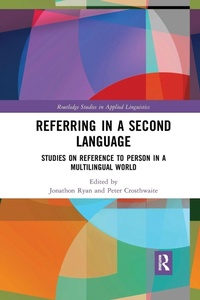
Referring in a Second Language
Studies on Reference to Person in a Multilingual World
1st Edition
Published on 13. December 2021
Book
Paperback/Softback
232 pages
978-1-032-17284-2 (ISBN)
Description
The introduction and tracking of reference to people or individuals, known as referential movement, is a central feature of coherence, and accounts for "about every third word of discourse". Located at the intersection of pragmatics and grammar, reference is now proving a rich and enduring source of insight into second language development. The challenge for second language (L2) learners involves navigating the selection and positioning of reference in the target language, continually shifting and balancing the referential means used to maintain coherence, while remaining acutely sensitive to the discourse and social context.
The present volume focuses on how L2 learners meet that challenge, bringing together both eminent and up-and-coming researchers in the field of L2 acquisition. The chapters address a range of problems in second language acquisition (SLA) (e.g., form-function mapping, first language [L1] influence, developmental trajectories), and do so in relation to various theoretical approaches to reference (e.g., Accessibility Theory, Givenness Hierarchy). The global outlook of these studies relates to the L2 acquisition of English, French, Japanese, Korean, and Spanish and covers a diverse range of situational contexts including heritage language learning, English as a medium of instruction, and the development of sociolinguistic competence.
The present volume focuses on how L2 learners meet that challenge, bringing together both eminent and up-and-coming researchers in the field of L2 acquisition. The chapters address a range of problems in second language acquisition (SLA) (e.g., form-function mapping, first language [L1] influence, developmental trajectories), and do so in relation to various theoretical approaches to reference (e.g., Accessibility Theory, Givenness Hierarchy). The global outlook of these studies relates to the L2 acquisition of English, French, Japanese, Korean, and Spanish and covers a diverse range of situational contexts including heritage language learning, English as a medium of instruction, and the development of sociolinguistic competence.
More details
Series
Language
English
Place of publication
London
United Kingdom
Publishing group
Taylor & Francis Ltd
Target group
College/higher education
Postgraduate
Illustrations
21 s/w Abbildungen
21 Illustrations, black and white
Dimensions
Height: 234 mm
Width: 156 mm
Thickness: 13 mm
Weight
363 gr
ISBN-13
978-1-032-17284-2 (9781032172842)
Copyright in bibliographic data and cover images is held by Nielsen Book Services Limited or by the publishers or by their respective licensors: all rights reserved.
Schweitzer Classification
Other editions
Additional editions
Jonathon Ryan | Peter Crosthwaite
Referring in a Second Language
Studies on Reference to Person in a Multilingual World
Book
03/2020
1st Edition
Routledge
€207.60
Shipment within 15-20 days
Jonathon Ryan | Peter Crosthwaite
Referring in a Second Language
Studies on Reference to Person in a Multilingual World
E-Book
03/2020
1st Edition
Routledge
€60.49
Available for download
Jonathon Ryan | Peter Crosthwaite
Referring in a Second Language
Studies on Reference to Person in a Multilingual World
E-Book
03/2020
1st Edition
Routledge
€60.49
Available for download
Persons
Jonathon Ryan is a principal academic staff member at Wintec in Hamilton, New Zealand, with the Centre for Languages and the Master of Applied Innovation programme. He is also Head of Materials Development for Chasing Time English. His research interests include reference, practitioner research, L2 pragmatics, and Conversation Analysis for language teaching.
Peter Crosthwaite is a senior lecturer in the School of Languages and Cultures at the University of Queensland, Australia (since 2017), having formerly been an assistant professor at the Centre for Applied English Studies (CAES), University of Hong Kong, China (since 2014). His areas of research and supervisory expertise include second language acquisition, reference to person, the use of corpora for language learning (known as "data-driven learning"), and English for General and Specific Academic Purposes.
Peter Crosthwaite is a senior lecturer in the School of Languages and Cultures at the University of Queensland, Australia (since 2017), having formerly been an assistant professor at the Centre for Applied English Studies (CAES), University of Hong Kong, China (since 2014). His areas of research and supervisory expertise include second language acquisition, reference to person, the use of corpora for language learning (known as "data-driven learning"), and English for General and Specific Academic Purposes.
Content
Foreword (Henriette Hendriks) 1. Referring in a second language: Introduction to the volume (Peter Crosthwaite and Jonathon Ryan) 2. Referent accessibility marking and referent's social status in Japanese as a second language (Jo Lumley) 3. Use of demonstratives in oral narratives by Japanese learners of English (Bonnie Swierzbin) 4. Do referential marking styles transfer to L2 story retelling? (Yuko Nakahama) 5. Referential movement in L2 vs Heritage Korean: A learner corpus study (Peter Crosthwaite and Min Jung Jee) 6. Under-explicit and minimally explicit reference: Evidence from a longitudinal case study (Jonathon Ryan) 7. Anaphora resolution in topic continuity: Evidence from L1 English-L2 Spanish data in the CEDEL2 corpus (Fernando Martin-Villena and Cristobal Lozano) 8. Using the Givenness Hierarchy to examine article use in academic writing: A case study of adult Spanish-speaking learners of English (Jennifer Killam) 9. Referent introducing strategies in advanced L2 usage: A bi-directional study on French learners of Chinese and Chinese learners of French (Ludovica Lena) 10. Nominal reference in L2 French: How do adult learners manage to understand the multifunctionality of determiners and their discourse counterparts? (Ewa Lenart) 11. Afterword: New directions in L2 reference research (Jonathon Ryan and Peter Crosthwaite)