

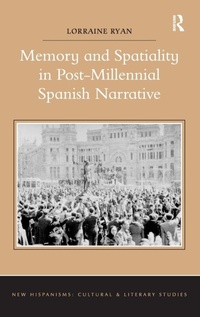
Memory and Spatiality in Post-Millennial Spanish Narrative
1st Edition
Published on 28. July 2014
Book
Hardback
248 pages
978-1-4724-3570-5 (ISBN)
Description
Focusing on literary texts produced from 2000 to 2009, Lorraine Ryan examines the imbrication between the preservation of Republican memory and the transformations of Spanish public space during the period from 1931 to 2005. Accordingly, Ryan analyzes the spatial empowerment and disempowerment of Republican memory and identity in Dulce ChacA (3)n's Cielos de barro, A?ngeles LA (3)pez's Martina, la rosa nA?mero trece, Alberto Mendez's 'Los girasoles ciegos,' Carlos Ruiz ZafA (3)nA?s La sombra del viento, Emili Teixidor's Pan negro, Bernardo Atxaga's El hijo del acordeonista, and Jose MarA-a Merino's La sima. The interrelationship between Republican subalternity and space is redefined by these writers as tense and constantly in flux, undermined by its inexorable relationality, which leads to subjects endeavoring to instill into space their own values. Subjects erode the hegemonic power of the public space by articulating in an often surreptitious form their sense of belonging to a prohibited Republican memory culture. In the democratic period, they seek a categorical reinstatement of same on the public terrain. Ryan also considers the motivation underlying this coterie of authors' commitment to the issue of historical memory, an analysis which serves to amplify the ambits of existing scholarship that tends to ascribe it solely to postmemory.
Reviews / Votes
'What is primarily new and important about this study is the commingling of memory and space in the context of memory studies in Spain. Ryan argues persuasively for the necessary integration of the temporal and the spatial and illustrates her point through the close reading of seven different narrative texts. Ryan is sophisticated theoretically, is an excellent reader-and it shows throughout her work.' - David Herzberger, University of California, Riverside, USA'Within the present Spanish context of the reconceptualization of historical memory during the Civil War and postwar periods, this book shows the importance of spatial narrative in order to appropriate one's own (collective) history and identity.' - Forum for Modern Language Studies
'Lorraine Ryan's Memory and Spatiality in Post-Millenial Spanish Narrative offers a novel approach to memory studies ... Ryan's monograph makes a valuable and original contribution to the burgeoning field of memory studies. Her focus on space, her concern with authorial motivation, her deft use of a range of conceptual frameworks, and her detailed contextualization make it essential reading for those working on memory studies in Spain.' - Bulletin of Hispanic Studies
'Ryan does an excellent job of exploring the approach contemporary writers have taken to Republicanism in order to reclaim a political position which had been silenced for many years...Overall, the book is an informative, tendentious, and penetrating analysis of Republican memory after the Civil war.'- Angela P. Pacheco, Purdue University, British Society for Literature and Science
More details
Language
English
Place of publication
London
United Kingdom
Publishing group
Taylor & Francis Ltd
Target group
College/higher education
Dimensions
Height: 240 mm
Width: 161 mm
Thickness: 18 mm
Weight
543 gr
ISBN-13
978-1-4724-3570-5 (9781472435705)
Copyright in bibliographic data and cover images is held by Nielsen Book Services Limited or by the publishers or by their respective licensors: all rights reserved.
Schweitzer Classification
Other editions
Additional editions
Book
09/2016
1st Edition
Routledge
€79.50
Shipment within 10-20 days
E-Book
04/2016
Routledge
€73.49
Available for download
E-Book
04/2016
Routledge
€73.99
Available for download
Person
Lorraine Ryan is a Birmingham fellow at the University of Birmingham, United Kingdom.
Content
Introduction; Chapter 1 Degenerative Space, Fertility, and Post-Transitional Justice in Dulce Chacon's Cielos de barro; Chapter 2 The City and the Body in Angeles Lopez's Martina, la rosa numero trece; Chapter 3 The Nullification of Domestic Space in Alberto Mendez's "Los girasoles ciegos"; Chapter 4 Spatial Assimilation and the Corruption of the Child in Emili Teixidor's Pan negro; Chapter 5 A Resistant Barcelona: Hidden Transcripts in Carlos Ruiz Zafon's La sombra del viento; Chapter 6 Rurality, the Second Space, and Global Memory Structures in Bernardo Atxaga's El hijo del acordeonista; Chapter 7 Rememory, Hybridity, and in-between Space in Jose Maria Merino's La sima; conclusion Conclusion;