

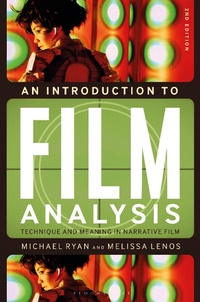
An Introduction to Film Analysis
Technique and Meaning in Narrative Film
2nd Edition
Published on 16. April 2020
Book
Paperback/Softback
288 pages
978-1-5013-1854-2 (ISBN)
Description
An Introduction to Film Analysis is designed to introduce students to filmmaking techniques while also providing an invaluable guide to film interpretation. It takes readers step by step through:
-the basic technical terms
-shot-by-shot analyses of film sequences
-set design, composition, editing, camera work, post-production, art direction and more
-each chapter provides clear examples and full colour images from classic as well as contemporary films
Ryan and Lenos's updated edition introduces students to the different kinds of lenses and their effects, the multiple possibilities of lighting, and the way post-production modifies images through such processes as saturation and desaturation. Students will learn to ask why the camera is placed where it is, why an edit occurs where it does, or why the set is designed in a certain way.
The second section of the book focuses on critical analysis, introducing students to the various approaches to film, from psychology to history, with new analysis on postcolonial, transnational and Affect Theory.
New to this edition is a third section featuring several in-depth analyses of films to put into practice what comes before: The Birds, The Shining, Vagabond, In the Mood for Love, Before the Devil Knows You're Dead.
-the basic technical terms
-shot-by-shot analyses of film sequences
-set design, composition, editing, camera work, post-production, art direction and more
-each chapter provides clear examples and full colour images from classic as well as contemporary films
Ryan and Lenos's updated edition introduces students to the different kinds of lenses and their effects, the multiple possibilities of lighting, and the way post-production modifies images through such processes as saturation and desaturation. Students will learn to ask why the camera is placed where it is, why an edit occurs where it does, or why the set is designed in a certain way.
The second section of the book focuses on critical analysis, introducing students to the various approaches to film, from psychology to history, with new analysis on postcolonial, transnational and Affect Theory.
New to this edition is a third section featuring several in-depth analyses of films to put into practice what comes before: The Birds, The Shining, Vagabond, In the Mood for Love, Before the Devil Knows You're Dead.
Reviews / Votes
An exceptionally clear and thorough account of the explicit and implicit ways that narrative cinema makes meaning for viewers. Filled with lucid writing and a profitably wide variety of examples, An Introduction to Film Analysis empowers students to analyze film technique from a range of diverse perspectives. * Kevin L. Ferguson, Associate Professor, Queens College, CUNY, USA * This step-by-step guide to film analysis by Ryan and Lenos is full of beautiful and instructive photography to make the art of moving images come alive on the page. It will entice students into a passion for film through its sophisticated and thorough discussions of a wide range of films, including historical classics, contemporary movies, independent films, and global cinema. This is a textbook that teaches by doing, modeling different approaches to film analysis through thorough and insightful case studies of a unique set of films, including The Silence of the Lambs, Mildred Pierce, Run, Lola, Run, and others. Worthy of special note, Ryan and Lenos provide accessible and productive tools for teachers, including student assignment instructions for specific clips from different films that invite students to develop and demonstrate their analytical skills. Through their many examples, the authors empower students to articulate not only how they react to a movie but also why, drawing clear lines between the cinematic vocabulary they are building with the work of meaning making. * Karen Petruska, Assistant Professor in Communication Studies, Gonzaga University, USA *More details
Edition
2nd edition
Language
English
Place of publication
New York
United States
Publishing group
Bloomsbury Publishing Plc
Target group
College/higher education
Illustrations
296 color illus
Dimensions
Height: 232 mm
Width: 158 mm
Thickness: 17 mm
Weight
584 gr
ISBN-13
978-1-5013-1854-2 (9781501318542)
Copyright in bibliographic data and cover images is held by Nielsen Book Services Limited or by the publishers or by their respective licensors: all rights reserved.
Schweitzer Classification
Other editions
Additional editions
Michael Ryan | Melissa Lenos
An Introduction to Film Analysis
Technique and Meaning in Narrative Film
E-Book
04/2020
2nd Edition
Bloomsbury Academic USA
€38.49
Available for download
Michael Ryan | Melissa Lenos
An Introduction to Film Analysis
Technique and Meaning in Narrative Film
E-Book
04/2020
2nd Edition
Bloomsbury Academic USA
€38.49
Available for download
Previous edition
Michael Ryan | Melissa Lenos
An Introduction to Film Analysis
Technique and Meaning in Narrative Film
Book
10/2012
Continuum Publishing Corporation
€62.08
Article exhausted; check for reprint
Persons
Michael Ryan is Emeritus Professor in the Center for the Arts at Temple University, USA. His books include Marxism and Deconstruction (1982), Politics and Culture (1989), Camera Politica (1988), An Introduction to Criticism (2012), and Literary Theory: A Practical Introduction (2017). His book, Politics and Evolution: Conservatism and Liberalism in Human History, is forthcoming. He is at work on a book entitled The Politics of Form.
Melissa Lenos is Chair of Liberal Arts and Sciences at Donnelly College in Kansas City, USA. Her primary areas of research are narratology and media pedagogy and her work has appeared in Cinema Journal: In Focus, Antenna, and In Media Res. She is co-author (with Kevin L. Ferguson) of the forthcoming Generation X: The Popular Culture that Defined the MTV Generation.
Melissa Lenos is Chair of Liberal Arts and Sciences at Donnelly College in Kansas City, USA. Her primary areas of research are narratology and media pedagogy and her work has appeared in Cinema Journal: In Focus, Antenna, and In Media Res. She is co-author (with Kevin L. Ferguson) of the forthcoming Generation X: The Popular Culture that Defined the MTV Generation.
Content
Introduction
Meaning in Movies
Shot-by-Shot Analysis
Writing About Film: The Art of Active Viewing
Part 1: Technique and Meaning
1. Composition
2. Camera Work
3. Editing
4. Set Design
5. Lighting
6. Sound
7. Color
8. Narration
9. Structure, Character, Motif
10. Film Style: Realism and Expressionism
Part 2: Critical Analysis
11. Historical Criticism
12. Structuralist Criticism
13. Psychological Criticism
14. Ideological Criticism
15. Gender Criticism
16. Ethnic Criticism
17. Post-Colonial / Transnational Criticism
18. Post-Structuralist Criticism
19. Political Criticism
20. Evolutionary Theory
21. Affect & Emotion
Part 3: Sample Analyses
22. The Birds
23. The Shining
24. Vagabond
25. In the Mood for Love
26. Before the Devil Knows You're Dead
Student Assignments
Further Reading
Bibliography
Index
Meaning in Movies
Shot-by-Shot Analysis
Writing About Film: The Art of Active Viewing
Part 1: Technique and Meaning
1. Composition
2. Camera Work
3. Editing
4. Set Design
5. Lighting
6. Sound
7. Color
8. Narration
9. Structure, Character, Motif
10. Film Style: Realism and Expressionism
Part 2: Critical Analysis
11. Historical Criticism
12. Structuralist Criticism
13. Psychological Criticism
14. Ideological Criticism
15. Gender Criticism
16. Ethnic Criticism
17. Post-Colonial / Transnational Criticism
18. Post-Structuralist Criticism
19. Political Criticism
20. Evolutionary Theory
21. Affect & Emotion
Part 3: Sample Analyses
22. The Birds
23. The Shining
24. Vagabond
25. In the Mood for Love
26. Before the Devil Knows You're Dead
Student Assignments
Further Reading
Bibliography
Index