

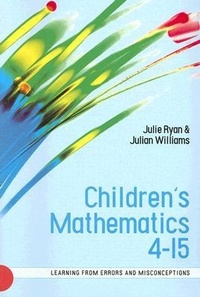
Children's Mathematics 4-15: Learning from Errors and Misconceptions
Learning from Errors and Misconceptions
Published on 16. April 2007
Book
Paperback/Softback
264 pages
978-0-335-22042-7 (ISBN)
Description
The mistakes children make in mathematics are usually not just 'mistakes' - they are often intelligent generalizations from previous learning. Following several decades of academic study of such mistakes, the phrase 'errors and misconceptions' has recently entered the vocabulary of mathematics teacher education and has become prominent in the curriculum for initial teacher education.The popular view of children's errors and misconceptions is that they should be corrected as soon as possible. The authors contest this, perceiving them as potential windows into children's mathematics. Errors may diagnose significant ways of thinking and stages in learning that highlight important opportunities for new learning.This book uses extensive, original data from the authors' own research on children's performance, errors and misconceptions across the mathematics curriculum. It progressively develops concepts for teachers to use in organizing their understanding and knowledge of children's mathematics, offers practical guidance for classroom teaching and concludes with theoretical accounts of learning and teaching.Children's Mathematics 4-15 is a groundbreaking book, which transforms research on diagnostic errors into knowledge for teaching, teacher education and research on teaching. It is essential reading for teachers, students on undergraduate teacher training courses and graduate and PGCE mathematics teacher trainees, as well as teacher educators and researchers.
More details
Other editions
Additional editions
E-Book
04/2007
1st Edition
McGraw-Hill Education
€63.89
Available for download
Persons
Julie Ryan and Julian Williams have worked together for several years in England exploring children's mathematical errors and misconceptions with a view to informing and developing classroom teaching practice. Both came to research from school teaching careers. Their latest collaborative research draws on children's argument in discussion by provoking reasoned 'changes of mind' in classrooms. Julie Ryan taught mathematics in secondary schools in Melbourne for ten years. Her interest in research grew from children's problems with algebra. Her research led her to believe that the move from arithmetic to algebra involved a new frame of thinking -- creating a challenge for the development of suitable teaching tasks. She was particularly taken by the intelligent 'mistakes' that children made. She has been involved in teacher education in Australia and England and is Senior Lecturer in Mathematics Education at Manchester Metropolitan University. Her research fucuses on pedagogy and teacher education. Julian Williams taught mathematics for eight years before he moved to teacher education and curriculum research and development , more recently focussing on research into learning, assessment and pedagogy. His particular focus on assessment grew from a belief that national testing of all pupils in England and Wales was impoverished -- the most useful formative data are to be found if test items are carefully crafted to uncover common misconceptions well known in the literature. He is Professor of Mathematics Education, and Director of Graduate Research students at the University of Manchester.
Content
Introduction
Learning from errors and misconceptions
Children's mathematical discussions
Developing number
Shape, space and measurement
From number to algebra
Data-handling, graphicacy, probability and statistics
Pre-service teachers' mathematics subject matter knowledge
Learning and teaching mathematics: Towards a theory of pedagogy
Appendix 1 Common errors and misconceptions
Appendix 2 Discussion prompt sheets
References
Learning from errors and misconceptions
Children's mathematical discussions
Developing number
Shape, space and measurement
From number to algebra
Data-handling, graphicacy, probability and statistics
Pre-service teachers' mathematics subject matter knowledge
Learning and teaching mathematics: Towards a theory of pedagogy
Appendix 1 Common errors and misconceptions
Appendix 2 Discussion prompt sheets
References