

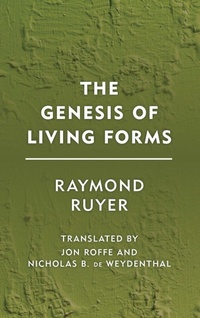
The Genesis of Living Forms
Published on 18. October 2019
Book
Hardback
226 pages
978-1-78660-087-5 (ISBN)
Description
The philosophy of Raymond Ruyer was an important if subterranean influence on twentieth-century French thought, and explicitly engaged with by figures such as Maurice Merleau-Ponty, Georges Canguilhem, Gilbert Simondon, and Gilles Deleuze. The Genesis of Living Forms is Ruyer's most focussed and forceful analysis of a central but apparently paradoxical biological phenomenon that also presents serious problems for philosophy: embryogenesis. When a cat develops from the early stages of fertilization to an adult, what is it that makes it the same cat? How is it that a living being can at once be the same and constantly changing?
Ruyer's answer to these questions unfolds through a detailed set of encounters with major scientific fields, from particle physics to social psychology, arguing that the paradox can only be dissolved by seeing the role that form plays in the ongoing development of living beings. In Ruyer's view, embryogenesis is a central problem not just in the life sciences; every thing must possess a relation to a form that is characteristic of it, from carbon atoms to embryos, and to embryologists themselves.
Ruyer's answer to these questions unfolds through a detailed set of encounters with major scientific fields, from particle physics to social psychology, arguing that the paradox can only be dissolved by seeing the role that form plays in the ongoing development of living beings. In Ruyer's view, embryogenesis is a central problem not just in the life sciences; every thing must possess a relation to a form that is characteristic of it, from carbon atoms to embryos, and to embryologists themselves.
Reviews / Votes
This translation of Genese des formes vivantes (first published in French in 1958) is part of the "Groundworks" series, which includes less-known seminal texts that have shaped contemporary Continental thought. The success of Gilles Deleuze and Felix Guattari's What Is Philosophy? (Eng. tr., CH, Dec'94, 32-2061), which described the brain in terms of Ruyer's developmental processes, led to a resurgence of interest in Ruyer's work. Roffe and Weydenthal's translation masterfully elucidates Ruyer's exposition of the embryonic development of an organism's unfolding organization of cells. Consciousness in this morphogenesis is identified with active formation of biological structure. The metaphysical interpretation of these biological processes, in addition to themes from Ruyer's magnum opus Ne?o-finalisme (1952; Eng. tr., Neofinalism, 2016), influenced much later 20th-century French thought, especially informing Deleuze's exposition of self-forming beings and Maurice Merleau-Ponty's phenomenology of living beings. The particular value of The Genesis of Living Forms rests not on the novel historical scientific ideas of the mid-20th century on which its biophilosophical explication of morphogenesis is drawn, but rather on its influence on the development of post-WW II French structuralism and posthumanism. This is a book for scholars of Continental philosophy. Summing Up: Recommended. Graduate students, researchers, faculty. * Choice Reviews * Raymond Ruyer's writings are quietly astounding provocations for a more careful understanding of morphogenesis, not only of living beings, but of the almost magical, elusive processes by which such beings form themselves. This book makes us rethink the relations between philosophy, biology, science and technology by insisting on the self-orienting forces that make and direct life. -- Elizabeth Grosz, Jean Fox O'Barr Women's Studies Professor, Duke University At long last Ruyer's essential text is available in English. Thanks to Roffe and de Weydenthal's graceful and reliable translation, Anglophone readers will now know why Deleuze and many other French thinkers have found Ruyer such an innovative and provocative figure in the philosophy of biology. -- Ronald Bogue, Professor Emeritus of Comparative Literature, University of Georgia It is because Ruyer understands machines very well that he is able to clarify the confusion often arising between machines and life forms. His critique of misplaced vitalism is as perceptive as that of misplaced mechanism. This is why his philosophy of biology is becoming even more relevant today when we have to understand Earth as an entanglement of life forms and machines. -- Bruno Latour, Professor Emeritus, Sciences PoMore details
Series
Language
English
Place of publication
United Kingdom
Publishing group
Bloomsbury Publishing PLC
Target group
Professional and scholarly
US School Grade: From College Sophomore to College Graduate Student
Illustrations
18 b/w illustrations;
Dimensions
Height: 235 mm
Width: 157 mm
Thickness: 18 mm
Weight
524 gr
ISBN-13
978-1-78660-087-5 (9781786600875)
Copyright in bibliographic data and cover images is held by Nielsen Book Services Limited or by the publishers or by their respective licensors: all rights reserved.
Schweitzer Classification
Other editions
Additional editions
Raymond Ruyer
The Genesis of Living Forms
E-Book
10/2019
1st Edition
Rowman & Littlefield Publishers
€30.99
Available for download
Persons
Raymond Ruyer (1902-1987) was an influential philosopher of science and Professor of Philosophy at the Universite de Nancy.
Jon Roffe is Vice-Chancellor's Postdoctoral Fellow at the University of New South Wales, and a founding editor of Parrhesia: A Journal of Critical Philosophy. The co-editor of a number of volumes on twentieth-century French philosophy, he is the author of Badiou's Deleuze (2012), Abstract Market Theory (forthcoming), Gilles Deleuze's Empiricism and Subjectivity (forthcoming), and the co-author of Lacan Deleuze Badiou (2014, with AJ Bartlett and Justin Clemens).
Nicholas B. de Weydenthal is a doctoral candidate based in the School of Historical and Philosophical Studies and the Department of Management and Marketing at the University of Melbourne.
Jon Roffe is Vice-Chancellor's Postdoctoral Fellow at the University of New South Wales, and a founding editor of Parrhesia: A Journal of Critical Philosophy. The co-editor of a number of volumes on twentieth-century French philosophy, he is the author of Badiou's Deleuze (2012), Abstract Market Theory (forthcoming), Gilles Deleuze's Empiricism and Subjectivity (forthcoming), and the co-author of Lacan Deleuze Badiou (2014, with AJ Bartlett and Justin Clemens).
Nicholas B. de Weydenthal is a doctoral candidate based in the School of Historical and Philosophical Studies and the Department of Management and Marketing at the University of Melbourne.
Content
Translator's Preface / Introduction / 1. Verticalism and Thematism / 2. From the Molecule to the Organism / 3. Internal Reproduction / 4. The Division and Socialisation of Development / 5. Signals-Stimuli / 6. 'Competence' / 7. Autonomous Procedures and Regulated Behaviour / 8. Open Formations and Markovian Jargon / 9. 'Crossword' Formations / 10. The 'Spectacle-Spectator' Complex / 11. I-Forms, II-Forms, III-Forms / 12. The Philosophy of Morphogenesis / Further Reading / Index