

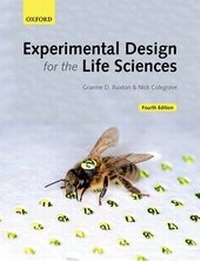
Experimental Design for the Life Sciences
4th Edition
Published on 9. June 2016
Book
Paperback/Softback
222 pages
978-0-19-871735-5 (ISBN)
Description
The careful design of experiments lies at the core of good research. Experimental Design for the Life Sciences equips you with the skills you need to effectively design experiments, making this essential aspect of the research process readily understandable. It demonstrates how good experimental design relies on clear thinking and biological understanding, not mathematical or statistical complexity.
With a refreshingly approachable and articulate style, the book walks you through the considerations that go into designing an experiment in clear, practical terms. Using examples drawn from across the life sciences - from ecology, biochemistry, molecular biology, genetics, and health sciences - the authors illustrate how these concepts are applied within the broad context of real biological research.
Online Resources
The online resources to accompany Experimental Design for the Life Sciences feature:
For students:
? Self-test questions and answers
? Additional examples
? Supplementary sections discuss complex concepts and statistical issues in more depth
? Links to useful websites and free software
For lecturers:
? Suggested course structures, complete with practical exercises
? Figures from the book, available to download
With a refreshingly approachable and articulate style, the book walks you through the considerations that go into designing an experiment in clear, practical terms. Using examples drawn from across the life sciences - from ecology, biochemistry, molecular biology, genetics, and health sciences - the authors illustrate how these concepts are applied within the broad context of real biological research.
Online Resources
The online resources to accompany Experimental Design for the Life Sciences feature:
For students:
? Self-test questions and answers
? Additional examples
? Supplementary sections discuss complex concepts and statistical issues in more depth
? Links to useful websites and free software
For lecturers:
? Suggested course structures, complete with practical exercises
? Figures from the book, available to download
Reviews / Votes
Review from previous edition This is an excellent book for learning how to approach the design of experimental and, indeed, observational work. It avoids the usual inclusion of statistical detail that turns many students off while retaining all the key issues that are necessary for planning studies that produce good science. I commend this book to all those who struggle to get students to think seriously about designing good scientific studies. * Higher Education Academy, Bioscience e-Journal, June 2006 * I think it is splendid; it is the sort of short and concise text which students remember for a long time and which they hang on to long after the course is passed. * Bernt Walther, Department of Fisheries and Marine Biology, University of Bergen * A well-presented, clearly argued, concise and witty introduction to one of the most important topics in the life sciences. * Nick Royle, School of Biosciences, Exeter University *More details
Edition
4th Revised edition
Language
English
Place of publication
Oxford
United Kingdom
Target group
College/higher education
Professional and scholarly
Edition type
Revised edition
Illustrations
35 b/w illustrations
Dimensions
Height: 246 mm
Width: 193 mm
Thickness: 11 mm
Weight
390 gr
ISBN-13
978-0-19-871735-5 (9780198717355)
Copyright in bibliographic data and cover images is held by Nielsen Book Services Limited or by the publishers or by their respective licensors: all rights reserved.
Schweitzer Classification
Persons
Content
1: Why you should care about design 2: Starting with a well-defined hypothesis 3: Selecting the broad design of your study 4: Between-individual variation, replication, and sampling 5: Pseudoreplication 6: Sample size, power, and efficient design 7: The simplest type of experimental design: completely randomized single-factor 8: Experiments with several factors (factorial designs) 9: Beyond complete randomization: blocking and covariates 10: Within-subject designs 11: Taking measurements