

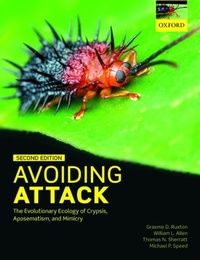
Avoiding Attack
The Evolutionary Ecology of Crypsis, Aposematism, and Mimicry
2nd Edition
Published on 9. August 2018
Book
Paperback/Softback
292 pages
978-0-19-968868-5 (ISBN)
Description
Avoiding Attack discusses the diversity of mechanisms by which prey avoid predator attacks and explores how such defensive mechanisms have evolved through natural selection. It considers how potential prey avoid detection, how they make themselves unprofitable to attack, how they communicate this status, and how other species have exploited these signals. Using carefully selected examples of camouflage, mimicry, and warning signals drawn from a wide range of species and ecosystems, the authors summarise the latest research into these fascinating adaptations, developing mathematical models where appropriate and making recommendations for future study.
This second edition has been extensively rewritten, particularly in the application of modern genetic research techniques which have transformed our recent understanding of adaptations in evolutionary genomics and phylogenetics. The book also employs a more integrated and systematic approach, ensuring that each chapter has a broader focus on the evolutionary and ecological consequences of anti-predator adaptation. The field has grown and developed considerably over the last decade with an explosion of new research literature, making this new edition timely.
This second edition has been extensively rewritten, particularly in the application of modern genetic research techniques which have transformed our recent understanding of adaptations in evolutionary genomics and phylogenetics. The book also employs a more integrated and systematic approach, ensuring that each chapter has a broader focus on the evolutionary and ecological consequences of anti-predator adaptation. The field has grown and developed considerably over the last decade with an explosion of new research literature, making this new edition timely.
Reviews / Votes
we enjoyed reading this new edition and cannot wait to recommend it to our students and colleagues ... the authors have done an excellent job at synthesizing the vast literature on predator-prey interactions into one relatively compact text. This makes this book a must read for any scientist or non-scientist who has any level of interest in the subject. * Swanne Gordon & Emily Burdfield, Washington University in St. Louis & University of Amsterdam, Basic and Applied Ecology * This is the second edition of Avoiding Attack now thoroughly revised and updated with the help of Will Allen. Using the predatory sequence as a road map through classes of anti-predator defenses, 14 chapters systematically address the ways in which prey avoid detection, thwart recognition, dodge attack and prevent consumption. In the sense of being a comprehensive and thoughtful synthesis of a growing sub-field in behavioural/evolutionary ecology, it is an absolute tour de force. * Tim Caro, University of California, Davis, ISBE Newsletter *More details
Edition
2nd Revised edition
Language
English
Place of publication
Oxford
United Kingdom
Target group
Professional and scholarly
Edition type
Revised edition
Product notice
Paperback (trade)
Unsewn / adhesive bound
Illustrations
Over 70 illustrations
Dimensions
Height: 247 mm
Width: 189 mm
Thickness: 19 mm
Weight
684 gr
ISBN-13
978-0-19-968868-5 (9780199688685)
Copyright in bibliographic data and cover images is held by Nielsen Book Services Limited or by the publishers or by their respective licensors: all rights reserved.
Schweitzer Classification
Other editions
Additional editions
Graeme D. Ruxton | William L. Allen | Thomas N. Sherratt
Avoiding Attack
The Evolutionary Ecology of Crypsis, Aposematism, and Mimicry
E-Book
01/2019
2nd Edition
OUP eBook
€53.99
Available for download
Graeme D. Ruxton | William L. Allen | Thomas N. Sherratt
Avoiding Attack
The Evolutionary Ecology of Crypsis, Aposematism, and Mimicry
Book
08/2018
2nd Edition
Oxford University Press
€167.20
Article exhausted; check different version
Persons
Graeme Ruxton is Professor of Evolutionary Ecology at the University of St Andrews, Scotland. He has broad interests in behavioural ecology, but mostly focusses on predator-prey interactions. His main means of investigation is in various types of theoretical modelling, but this is generally linked to empirical data collection in the field or laboratory. His interests are wide in terms of ecosystems and taxonomy too, and he has occasionally published speculations on the ecologies of extinct species. Graeme's interest in predator-prey interactions has grown to include between-species communication more generally and he has a strong interest in how plants interact with animal antagonists and mutualists.
William Allen is an evolutionary ecologist who investigates antipredator defences at macroecological and macroevolutionary scales. His interdisciplinary training at the University of Bristol in human, animal, and machine vision has allowed him to apply novel techniques to understanding the visual ecology of defences in diverse taxa, including felids, reptiles, and ungulates. Other research interests include intraspecific visual signalling in primates and life history evolution. He currently teaches courses on sensory ecology and the evolution of tetrapods.
Tom Sherratt has a broad range of interests in the fields of behavioural and evolutionary ecology, notably predator-prey interactions, the evolution of senescence and the evolution of cooperation. Members of the Sherratt lab conduct both field and laboratory experiments, but they also attempt to develop and test biologically relevant theory. Tom also teaches courses in statistics and computer modelling.
Michael Speed is an evolutionary biologist with longstanding interests in predator-prey relationships, evolution, and phylogenetics. He studied at Leeds University, where he began his work on the evolution of signalling in mimicry systems and currently lectures in evolution and behaviour at the University of Liverpool, where he is also Head of the School of Life Sciences.
William Allen is an evolutionary ecologist who investigates antipredator defences at macroecological and macroevolutionary scales. His interdisciplinary training at the University of Bristol in human, animal, and machine vision has allowed him to apply novel techniques to understanding the visual ecology of defences in diverse taxa, including felids, reptiles, and ungulates. Other research interests include intraspecific visual signalling in primates and life history evolution. He currently teaches courses on sensory ecology and the evolution of tetrapods.
Tom Sherratt has a broad range of interests in the fields of behavioural and evolutionary ecology, notably predator-prey interactions, the evolution of senescence and the evolution of cooperation. Members of the Sherratt lab conduct both field and laboratory experiments, but they also attempt to develop and test biologically relevant theory. Tom also teaches courses in statistics and computer modelling.
Michael Speed is an evolutionary biologist with longstanding interests in predator-prey relationships, evolution, and phylogenetics. He studied at Leeds University, where he began his work on the evolution of signalling in mimicry systems and currently lectures in evolution and behaviour at the University of Liverpool, where he is also Head of the School of Life Sciences.
Author
ProfessorProfessor, University of St Andrews, UK
Lecturer in the Department of BiosciencesLecturer in the Department of Biosciences, Swansea University, UK
ProfessorProfessor, Carleton University, Canada
Head of the School of Life SciencesHead of the School of Life Sciences, University of Liverpool, UK
Content
Introduction
Chapter summary
The sequence of a predator-prey encounter and investment across multiple defences
1: Background matching
2: Disruptive camouflage
3: Countershading
4: Transparency
5: Secondary defences
6: Aposematism
7: Muellerian mimicry
8: Advertising elusiveness
9: Batesian mimicry and masquerade
10: Startling predators
11: Deflecting the point of attack
12: Dazzle camouflage
13: Thanatosis
14: Synthesis
Chapter summary
The sequence of a predator-prey encounter and investment across multiple defences
1: Background matching
2: Disruptive camouflage
3: Countershading
4: Transparency
5: Secondary defences
6: Aposematism
7: Muellerian mimicry
8: Advertising elusiveness
9: Batesian mimicry and masquerade
10: Startling predators
11: Deflecting the point of attack
12: Dazzle camouflage
13: Thanatosis
14: Synthesis