

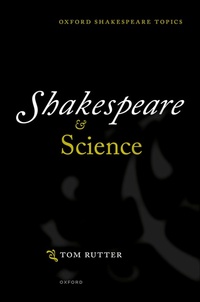
Shakespeare and Science
1st Edition
Published on 19. September 2024
Book
Hardback
208 pages
978-0-19-289854-8 (ISBN)
Description
As a figurehead for the literary humanities, and a dramatist whose plays feature fairies, ghosts, and spirits, Shakespeare may not be the first author that comes to mind when thinking about science. Tom Rutter shows, however, that in his plays and poetry Shakespeare made detailed use of the knowledge and theories of the cosmos, the natural world, and human biology that were available to him. These range from astronomical and anatomical ideas derived from medieval scholars, Islamic philosophers, and ancient Greek and Roman authorities, through to the challenges issued to those earlier models by more recent figures such as Copernicus and Vesalius. Shakespeare's treatment of these materials was informed by the poetic and dramatic media in which he worked; the dialogic nature of drama enabled an approach that could be provisional, exploratory, and tolerant of uncertainty and contradiction. Shakespeare made the early modern playhouse a venue for the production of scientific understanding through performance, illusion, and the creative use of space.
As well as surveying current scholarship that contextualizes Shakespeare's work in relation to histories of meteorology, matter theory, humoral physiology, racialization, mathematics, and more, Shakespeare and Science offers detailed original readings of a variety of texts including the Histories, Hamlet, Antony and Cleopatra, Othello, King Lear, The Tempest, the Sonnets, and Lucrece. It also makes extensive reference to works by Shakespeare's near-contemporaries such as Robert Recorde, William Fulke, Juan Huarte, and Thomas Elyot. Its four chapters focus on astronomy and meteorology, matter, the body, and mathematics. Rutter's overall approach is informed by recent studies that interrogate 'science' as a concept, and that question both the boundary between literature and science and the idea of a seventeenth-century 'scientific revolution'.
As well as surveying current scholarship that contextualizes Shakespeare's work in relation to histories of meteorology, matter theory, humoral physiology, racialization, mathematics, and more, Shakespeare and Science offers detailed original readings of a variety of texts including the Histories, Hamlet, Antony and Cleopatra, Othello, King Lear, The Tempest, the Sonnets, and Lucrece. It also makes extensive reference to works by Shakespeare's near-contemporaries such as Robert Recorde, William Fulke, Juan Huarte, and Thomas Elyot. Its four chapters focus on astronomy and meteorology, matter, the body, and mathematics. Rutter's overall approach is informed by recent studies that interrogate 'science' as a concept, and that question both the boundary between literature and science and the idea of a seventeenth-century 'scientific revolution'.
More details
Series
Language
English
Place of publication
Oxford
United Kingdom
Target group
College/higher education
Illustrations
7 black and white illustrations
Dimensions
Height: 142 mm
Width: 210 mm
Thickness: 19 mm
Weight
358 gr
ISBN-13
978-0-19-289854-8 (9780192898548)
Copyright in bibliographic data and cover images is held by Nielsen Book Services Limited or by the publishers or by their respective licensors: all rights reserved.
Schweitzer Classification
Other editions
Additional editions
Person
Tom Rutter is Senior Lecturer in Shakespeare and Renaissance Drama at the University of Sheffield, where he has taught since 2012. Before that he worked at London South Bank University and then Sheffield Hallam. He is the author of Work and Play on the Shakespearean Stage, The Cambridge Introduction to Christopher Marlowe, and Shakespeare and the Admiral's Men, as well as numerous scholarly articles. He has also edited A Companion to the Cavendishes with Lisa Hopkins and The Arden Handbook of Shakespeare and Early Modern Drama with Michelle M. Dowd. He is an editor of Shakespeare, the journal of the British Shakespeare Association.
Content
List of Illustrations
Note on Texts
Introduction
1: Things in Heaven and Earth
2: Matter
3: The Body
4: Maths
Further Reading
Note on Texts
Introduction
1: Things in Heaven and Earth
2: Matter
3: The Body
4: Maths
Further Reading