

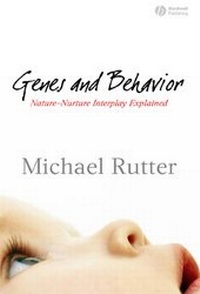
Genes and Behavior
Nature-Nurture Interplay Explained
Published on 13. December 2005
Book
Hardback
296 pages
978-1-4051-1062-4 (ISBN)
Description
In recent years, the subject of genes and their influence on human behavior has become increasingly controversial as concerns about the racist use of genetics, discriminatory eugenics, and neurogenetic determinism have grown. In this major new book, eminent scientist Professor Sir Michael Rutter gets behind the hype to provide a balanced and authoritative overview of the genetic revolution and its implications for understanding human behavior. Rutter sets out in layman's terms what genetic science has discovered to date, explaining exactly what genes do, how much is nature and how much is nurture. He argues that nature and nurture are not truly separate, giving powerful illustrations of how the two interact to determine our behavior. He also considers the implications of genetic findings for policy and practice. This thought-provoking account will inform public debate about the implications of the Human Genome Project and, more broadly, the field of genetic science.
Reviews / Votes
"In this highly readable and intellectually honest book, the latest advances in molecular and behavior genetics are brought to bear on our knowledge of psychology and psychiatry. The end product is an eloquent exposition of "genetic realism" in the context of behavior, and will surely be of interest to all who are curious about the forces that give rise to human behavior, both normal and abnormal." Charles A. Nelson III, Harvard Medical School "Genes and Behavior: Nature - Nurture Interplay Explained manages to be comprehensive, lucid, and clear, without oversimplifying what is an inherently complex subject. It enables a clinician to understand the fundamentals of genetics as they apply to medicine and a geneticist to understand the environmental determinants of the phenotype. What makes it entirely remarkable is that it is comprehensible to generalists and yet has much to teach specialists." Leon Eisenberg, Harvard Medical School "No one but Michael Rutter could have written this remarkable, compelling book. At last we have a clear and balanced treatment of the role genes play in the variations among individuals in behavioral traits and psychosocial pathologies. Rutter rescues the reader from the excesses of both the "evangelical" geneticists and the environmental extremists. He draws on his vast knowledge of the pertinent theories and empirical work, and takes the reader beyond the limited scope of statistical twin and adoption studies into the recent work of molecular geneticists, illuminating some of the complex biological processes that govern the ways in which genetic factors can work or fail to work in influencing behavioral outcomes, and how their effects can be modified by experience. Rutter presents a carefully reasoned case for co-action of genetic and environmental factors at all stages of development. A must-read for anyone seriously interested in nature/nurture issues." Eleanor E. Maccoby, Stanford Center on Adolescence "Rutter offers a highly critical and extremely clear and well-written review of the current state of the nature/nurture argument as it relates to human behaviour and psychiatric illness......it is written in a way that should be easily accessible to the general reader as well as to the specialist. And, since its subject matter affects all of us, it should be read widely." Times Higher Education Supplement "The question of how genes and the environment interact should be an area of interest to all social and physical science; it should not remain solely the domain of geneticists. For anyone interested in developing a greater understanding of the mechanics of this interaction, this book would make an excellent choice." Jonathan Wells, Young Minds Magazine, July/August 2006 "Michael Rutter, the United Kingdom's gift to world psychiatric excellence deals with this issue head-on in an amazingly readable and highly accurate book about genes and behaviour....This book is a gem." Myrna M. Weissman, Psychological Medicine, 36 "If you want an inspiring contribution to the debate in this highly topical area or research and also want to learn about the most up-to-date approaches to genetic research, then this is the book to choose." Svenn Torgersen, Nature, Volume 442More details
Language
English
Place of publication
Oxford
United Kingdom
Publishing group
John Wiley and Sons Ltd
Target group
students of child psychology, psychiatry, social work and social policy, andgeneral readers, also courses in genes and behavior;
Illustrations
20
Dimensions
Height: 229 mm
Width: 152 mm
ISBN-13
978-1-4051-1062-4 (9781405110624)
Copyright in bibliographic data and cover images is held by Nielsen Book Services Limited or by the publishers or by their respective licensors: all rights reserved.
Schweitzer Classification
Other editions
Additional editions
Book
12/2005
1st Edition
Wiley
€35.00
Shipment within 3-4 weeks
Person
Professor Sir Michael Rutter trained in psychiatry at the Maudsley Hospital, London, and in child development at Albert Einstein College of Medicine, New York. He was appointed to the first UK Chair in Child Psychiatry in 1973 and since his retirement in 1998, he has held a research chair in Developmental Psychopathology at the Institute of Psychiatry, Kings College, London. He has authored or edited some forty books, published over four hundred scientific papers, and has received numerous international awards and honors. Sir Michael is a member of the US Academy of Sciences Institute of Medicine and a foreign Honorary Member of the American Academy of Arts and Sciences, and of the US National Academy of Education. He received a CBE in 1985 and was knighted in 1992. He was Deputy Chairman of the Wellcome Trust from 1999 to 2004 and continues as a trustee of several foundations, including the Nuffield Foundation.
Content
Chapter 1: Why is the topic of genes and behavior controversial? Chapter 2: Concepts of behavior and of mental disorder Chapter 3: Environmentally mediated risks Chapter 4: Patterns of inheritance Chapter 5: How much is nature and how much nurture? Chapter 6: The heritability of different mental disorders and traitsChapter 7: Finding and understanding specific susceptibility genes Chapter 8: What genes do Chapter 9: Nature-nurture interplay and causal pathways from genes to psychopathology Chapter 10: What environments do to genes Chapter 11: Conclusions