

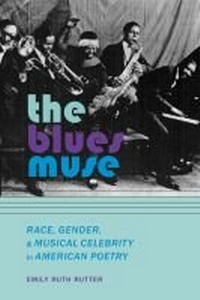
The Blues Muse
Race, Gender, and Musical Celebrity in American Poetry
Will be published approx. on 30. October 2018
Book
Hardback
248 pages
978-0-8173-1994-6 (ISBN)
Description
A critical analysis of the poetic representations and legacies of five landmark blue artists.
The Blues Muse: Race, Gender, and Musical Celebrity in American Poetry focuses on five key blues musicians and singers-Gertrude "Ma" Rainey, Bessie Smith, Billie Holiday, Robert Johnson, and Lead Belly-and traces the ways in which these artists and their personas have been invoked and developed throughout American poetry. This study spans nearly one hundred years of literary and musical history, from the New Negro Renaissance to the present.
Emily Ruth Rutter structures the study around one pivotal understanding: however marginalized, poetry is a crucial medium for comprehending sociopolitical and cultural developments. Building from this idea, Rutter traces the evolution of the poetic invocation of blues muses through a succession of cultural eras, political climates, and artistic movements, asking how and why these protean blues figures change shape both within and across generations. Drawing on the work of poets Langston Hughes, Frank O'Hara, Amiri Baraka, Harryette Mullen, Terrance Hayes, and many more, as a guide, Rutter discusses topics such as the poetic renderings of black struggle, the constantly evolving notions of authenticity, and the portrayal of blues artists as heroic symbols of African American resistance.
The Blues Muse not only examines blues musicians as literary touchstones or poetic devices, but also investigates the relationship between poetic constructions of blues icons and shifting discourses of race and gender. Rutter's nuanced analysis is clear, compelling, and rich in critical assessments of these writers' portraits of the musical artists, attending to their strategies and oversights.
The Blues Muse: Race, Gender, and Musical Celebrity in American Poetry focuses on five key blues musicians and singers-Gertrude "Ma" Rainey, Bessie Smith, Billie Holiday, Robert Johnson, and Lead Belly-and traces the ways in which these artists and their personas have been invoked and developed throughout American poetry. This study spans nearly one hundred years of literary and musical history, from the New Negro Renaissance to the present.
Emily Ruth Rutter structures the study around one pivotal understanding: however marginalized, poetry is a crucial medium for comprehending sociopolitical and cultural developments. Building from this idea, Rutter traces the evolution of the poetic invocation of blues muses through a succession of cultural eras, political climates, and artistic movements, asking how and why these protean blues figures change shape both within and across generations. Drawing on the work of poets Langston Hughes, Frank O'Hara, Amiri Baraka, Harryette Mullen, Terrance Hayes, and many more, as a guide, Rutter discusses topics such as the poetic renderings of black struggle, the constantly evolving notions of authenticity, and the portrayal of blues artists as heroic symbols of African American resistance.
The Blues Muse not only examines blues musicians as literary touchstones or poetic devices, but also investigates the relationship between poetic constructions of blues icons and shifting discourses of race and gender. Rutter's nuanced analysis is clear, compelling, and rich in critical assessments of these writers' portraits of the musical artists, attending to their strategies and oversights.
Reviews / Votes
An impressively researched and lucidly written analysis of nearly one hundred years of American poetry inspired by Ma Rainey, Bessie Smith, Billie Holiday, Lead Belly, and Robert Johnson-those 'blues muses' whose complex lives, art, personae, and historiographies have made them especially rich and persistent subjects for white and black American poets alike."" - Emily J. Lordi, author of Black Resonance: Iconic Women Singers and African American Literature and Donny Hathaway's Donny Hathaway Live""The Blues Muse is an interesting and valuable work which will be of particular interest to those teaching American poetry with an emphasis on its connections with African American vernacular musical traditions."" - Erich Nunn, author of Sounding the Color Line: Music and Race in the Southern Imagination
More details
Language
English
Place of publication
Alabama
United States
Target group
Professional and scholarly
Dimensions
Height: 229 mm
Width: 152 mm
Thickness: 27 mm
Weight
493 gr
ISBN-13
978-0-8173-1994-6 (9780817319946)
Copyright in bibliographic data and cover images is held by Nielsen Book Services Limited or by the publishers or by their respective licensors: all rights reserved.
Schweitzer Classification
Other editions
Additional editions

E-Book
10/2018
1st Edition
University of Alabama Press
€76.99
Available for download
Person
Emily Ruth Rutter is assistant professor of English at Ball State University. She is the author of Invisible Ball of Dreams: Literary Representations of Baseball behind the Color Line. Her research has been published in African American Review, South Atlantic Review, Studies in American Culture, Aethlon, and MELUS.
Content
Acknowledgments
Introduction: The Blues Muse Tradition
1. "Don't Like My Ocean, Don't Fish in My Sea": Blues Muses, Racial Uplift, and Queer Camaraderie
2. "Never Was a White Man Had the Blues": Blues Icons and Black Power
3. "I Ain't Gonna Marry, Ain't Gonna Settle Down": Blues Women and Intersectionality
4. "Blues Falling Down Like Hail": Blues Men and the Second-Wave Blues Revival
5. "It's Gonna Carry Me through This World": The Post-Soul Blues Muse
Coda. Repetition with a Difference: Beyonce Knowles-Carter as Muse
Notes
Bibliography
Index
Introduction: The Blues Muse Tradition
1. "Don't Like My Ocean, Don't Fish in My Sea": Blues Muses, Racial Uplift, and Queer Camaraderie
2. "Never Was a White Man Had the Blues": Blues Icons and Black Power
3. "I Ain't Gonna Marry, Ain't Gonna Settle Down": Blues Women and Intersectionality
4. "Blues Falling Down Like Hail": Blues Men and the Second-Wave Blues Revival
5. "It's Gonna Carry Me through This World": The Post-Soul Blues Muse
Coda. Repetition with a Difference: Beyonce Knowles-Carter as Muse
Notes
Bibliography
Index