

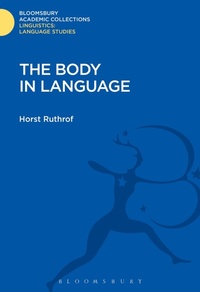
The Body in Language
Published on 17. December 2015
Book
Hardback
208 pages
978-1-4742-4729-0 (ISBN)
Description
This book opposes the position that meanings can be explained by way of intralinguistic relations, as in structural linguistics and its successors, and rejects definitional descriptions of meaning as well as naturalistic accounts. The idea that we are able to live by strings of mere signifiers is shown to rest on a misconception. Ruthrof also attempts an explanation of why arguments grounded in a post-Saussurean view of language, as for instance certain feminist theories, find it so difficult to show how precisely the body can be reclaimed as an integral part of linguistic signs. In reinstating the body in language, Ruthrof draws on Peirce, Husserl, Heidegger, Wittgenstein and Derrida, cognitive linguistics and rhetoric, as well as on the writings of Helen Keller.
More details
Series
Language
English
Place of publication
London
United Kingdom
Publishing group
Bloomsbury Publishing PLC
Target group
College/higher education
Dimensions
Height: 240 mm
Width: 161 mm
Thickness: 16 mm
Weight
485 gr
ISBN-13
978-1-4742-4729-0 (9781474247290)
Copyright in bibliographic data and cover images is held by Nielsen Book Services Limited or by the publishers or by their respective licensors: all rights reserved.
Schweitzer Classification
Other editions
Additional editions
Horst Ruthrof
The Body in Language
E-Book
12/2015
1st Edition
Bloomsbury Academic
€155.99
Available for download
Person
Horst Ruthrof is Emeritus Professor of English and Philosophy at Murdoch University, Western Australia, and Fellow of the Australian Academy of the Humanities.
Content
Preface
Acknowledgements
Introduction
1 The Corporeal Tune
2 There is No Meaning in Language
3 Meaning as Quasi-Perceptual
4 The Body in Deixis and Reference
5 Sign Rapport: Meaning as Intersemiotic
6 Sign Conflict: Meaning as Heterosemiotic
7 The Disembodiment of the Signifier
8 The Corporeality of the Signified
9 Social Traces in Abstract Expressions
10 The Role of the Community
11 Sufficient Semiosis
12 Semantic Assumptions
13 Meaning, Metaphysics and Representation
Afterword: Corporeal Semantics and the Obsolete Body
Bibliography
Index
Acknowledgements
Introduction
1 The Corporeal Tune
2 There is No Meaning in Language
3 Meaning as Quasi-Perceptual
4 The Body in Deixis and Reference
5 Sign Rapport: Meaning as Intersemiotic
6 Sign Conflict: Meaning as Heterosemiotic
7 The Disembodiment of the Signifier
8 The Corporeality of the Signified
9 Social Traces in Abstract Expressions
10 The Role of the Community
11 Sufficient Semiosis
12 Semantic Assumptions
13 Meaning, Metaphysics and Representation
Afterword: Corporeal Semantics and the Obsolete Body
Bibliography
Index