

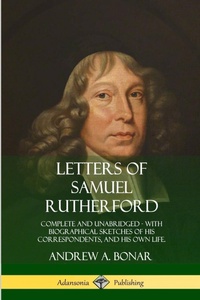
Letters of Samuel Rutherford
Complete and Unabridged, with biographical sketches of his correspondents, and of his own life
Published on 17. August 2018
Book
Paperback/Softback
510 pages
978-0-359-03074-3 (ISBN)
Description
This superb collection of Samuel Rutherford's letters includes a biographical account of his life, together with a copious arrangement of notes and an appendix.
As one of Scotland's foremost theologians and authors in the 17th century, Samuel Rutherford was a gifted and busy wordsmith. Throughout a career spanning decades, he wrote a series of valued books on both religious topics and Presbyterianism in the political sphere. A lively and engaged thinker, Rutherford's life and thoughts offers a good portrayal of the evolution in both church and state in his era.
Although most known for his ideas on constitutionalism and on military principles, Samuel Rutherford in the day-to-day lived for ordinary men and women believers who frequented his church in Kirkcudbrightshire, Galloway. He would often pay visits to the sick, correspond with their families, and offer emotional comfort and reassurance in times of difficulty.
More details
Language
English
Product notice
Paperback (trade)
Unsewn / adhesive bound
Dimensions
Height: 229 mm
Width: 152 mm
Thickness: 30 mm
Weight
820 gr
ISBN-13
978-0-359-03074-3 (9780359030743)
Copyright in bibliographic data and cover images is held by Nielsen Book Services Limited or by the publishers or by their respective licensors: all rights reserved.
Schweitzer Classification
Persons
SAMUEL RUTHERFORD (1600-1661), a Scottish-born Presbyterian minister, scholar, and writer, was influential in Scottish politics through his sermons and widely read theories. His philosophies on limiting government resulted in a charge of high treason, however, he died before the trial.
GEORGE BUCHANAN (1506-1582) was lauded as one of the most profound intellectuals of sixteenth-century Scotland. His writing advocated for power to the people and weakening of the monarchy which incited the ire of political pundits and was condemned by an act of parliament.