

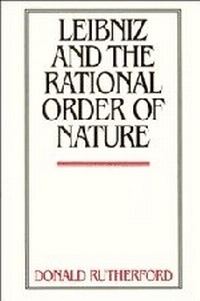
Leibniz and the Rational Order of Nature
Published on 28. April 1995
Book
Hardback
317 pages
978-0-521-46155-9 (ISBN)
Description
This is the most up-to-date and comprehensive interpretation of the philosophy of Gottfried Wilhelm Leibniz (1646-1716). Amongst its other virtues, it makes considerable use of unpublished manuscript sources. The book seeks to demonstrate the systematic unity of Leibniz's thought, in which theodicy, ethics, metaphysics and natural philosophy cohere. The key, underlying idea of the system is the conception of nature as an order designed by God to maximise the opportunities for the exercise of reason. From this idea emerges the view that this world is the best of all possible worlds, and an ethical ideal in which the well-being of human beings is promoted through the gradual extension of intellectual enlightenment.
Reviews / Votes
'... Donald Rutherford has produced a fine, fine book on Leibniz. Under Rutherford's expert guidance, anyone at all interested in the history and philosophy of physics can come to understand how and why Leibniz is the pivotal figure that he is.' Foundations of Physics 'Leibniz and the Rational Order of Nature is a learned and sensible book.' Journal of Religious StudiesMore details
Language
English
Place of publication
Cambridge
United Kingdom
Target group
Professional and scholarly
Dimensions
Height: 236 mm
Width: 159 mm
Thickness: 25 mm
Weight
569 gr
ISBN-13
978-0-521-46155-9 (9780521461559)
Copyright in bibliographic data and cover images is held by Nielsen Book Services Limited or by the publishers or by their respective licensors: all rights reserved.
Schweitzer Classification
Other editions
New editions
Donald Rutherford
Leibniz and the Rational Order of Nature
Book
01/1998
Cambridge University Press
€64.50
Available immediately
Additional editions
Donald Rutherford
Leibniz and the Rational Order of Nature
Book
01/1998
Cambridge University Press
€64.50
Available immediately
Person
Content
Part I. Theodicy: 1. The vindication of divine justice; 2. The maximisation of perfection and harmony; 3. Happiness and virtue in the best of all possible worlds; Part II. First philosophy: 4. Metaphysics and its method; 5. The categories of thought and being; 6. Substance; Part III. Nature: 7. Modelling the best of all possible worlds; 8. Monads, matter, and organisms; 9. Dynamics and the reality of matter; 10. Corporeal substance and the union of soul body.