

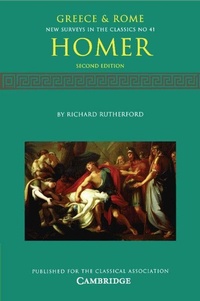
Homer
2nd Edition
Published on 9. May 2013
Book
Paperback/Softback
174 pages
978-1-107-67016-7 (ISBN)
Description
This is a revised and updated version of the survey on Homer which the author originally published in 1996. It provides a wide variety of readers with a clear and detailed introduction to the Iliad and the Odyssey, and to the problems which arise in dating, contextualising and interpreting these two epics, which are among the earliest poetic texts to come down to us from the ancient Greek world. A substantial introductory chapter discusses the so-called Homeric Question, the question of the identity and origins of 'Homer'. Among the important topics considered are the debate over oral composition, the structure, plot and themes of the two epics, and the religious and ethical ideas which figure in the poems; also discussed are characterisation, speeches, similes, symbolism and irony. An extensive bibliography gives expert guidance on these and many other aspects of these extraordinary poems.
More details
Series
Edition
2nd Revised edition
Language
English
Place of publication
Cambridge
United Kingdom
Target group
College/higher education
Edition type
Revised edition
Product notice
Paperback (trade)
Illustrations
Worked examples or Exercises
Dimensions
Height: 229 mm
Width: 152 mm
Thickness: 10 mm
Weight
270 gr
ISBN-13
978-1-107-67016-7 (9781107670167)
Copyright in bibliographic data and cover images is held by Nielsen Book Services Limited or by the publishers or by their respective licensors: all rights reserved.
Schweitzer Classification
Other editions
Previous edition
Richard Rutherford
Homer
Book
05/1996
Oxford University Press
€21.03
Article exhausted; check for reprint
Person
Richard Rutherford was educated at Robert Gordon's College, Aberdeen and Worcester College, Oxford. Since 1982 he has been Tutor in Greek and Latin Literature at Christ Church, Oxford, and has written books and articles on a wide variety of authors. Among his publications are The Meditations of Marcus Aurelius: A Study (1989), Homer: Odyssey 19 and 20 (Cambridge University Press, 1992), The Art of Plato (1995), Classical Literature: A Concise History (2005) and Greek Tragic Style: Form, Language and Interpretation (Cambridge University Press, 2012).
Content
Preface; Part I. Introduction: Background and Problems: 1. History, myth, poetry; 2. Poems behind poems; 3. Poetic language; 4. Light from the East?; 5. Early Greek hexameter poetry; 6. Dating the poems; 7. The debate on the oral epic tradition: Milman Parry and his followers; 8. But could Homer write?; 9. Sixth-century Athens; 10. Text and scholars; 11. Reception and interpretation; Part II. The Iliad: 12. Structure, characterisation, themes; 13. War and the hero; 14. Gods and men; 15. Choices and consequences; Part III. The Odyssey: 16. Must a sequel be inferior?; 17. Themes, structure, ethos; 18. Men, women and goddesses; 19. Endings; Part IV. Some Memorable Scenes: 20. Paris's bedchamber (Iliad 3. 424-47); 21. Phoenix's memories (Iliad 9. 478-97); 22. Patroclus brought low (Iliad 16. 777-800); 23. The horses of Achilles, gifts of the gods (Iliad 17.426-53); 24. News comes to Achilles (Iliad 18. 15-37, 50-1); 25. The pride of Ajax (Odyssey 11. 543-67); 26. Monster and man (Odyssey 12. 243-59); 27. Travel and adventure (Odyssey 14. 196ff. (extracts)); Bibliographical note; Bibliography; About the author; Index.