

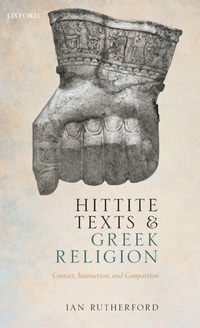
Hittite Texts and Greek Religion
Contact, Interaction, and Comparison
Published on 22. September 2020
Book
Hardback
404 pages
978-0-19-959327-9 (ISBN)
Description
Our knowledge of ancient Greece has been transformed in the last century by an increased understanding of the cultures of the Ancient Near East. This is particularly true of ancient religion. This book looks at the relationship between the religious systems of Ancient Greece and the Hittites, who controlled Turkey in the Late Bronze Age (1400-1200 BC).
The cuneiform texts preserved in the Hittite archives provide a particularly rich source for religious practice, detailing festivals, purification rituals, oracle-consultations, prayers, and myths of the Hittite state, as well as documenting the religious practice of neighbouring Anatolian states in which the Hittites took an interest. Hittite religion is thus more comprehensively documented than any other ancient religious tradition in the Near East, even Egypt. The Hittites are also known to have been in contact with Mycenaean Greece, known to them as Ahhiyawa. The book first sets out the evidence and provides a methodological paradigm for using comparative data. It then explores cases where there may have been contact or influence, such as in the case of scapegoat rituals or the Kumarbi-Cycle. Finally, it considers key aspects of religious practices shared by both systems, such as the pantheon, rituals of war, festivals, and animal sacrifice. The aim of such a comparison is to discover clues that may further our understanding of the deep history of religious practices and, when used in conjunction with historical data, illuminate the differences between cultures and reveal what is distinctive about each of them.
The cuneiform texts preserved in the Hittite archives provide a particularly rich source for religious practice, detailing festivals, purification rituals, oracle-consultations, prayers, and myths of the Hittite state, as well as documenting the religious practice of neighbouring Anatolian states in which the Hittites took an interest. Hittite religion is thus more comprehensively documented than any other ancient religious tradition in the Near East, even Egypt. The Hittites are also known to have been in contact with Mycenaean Greece, known to them as Ahhiyawa. The book first sets out the evidence and provides a methodological paradigm for using comparative data. It then explores cases where there may have been contact or influence, such as in the case of scapegoat rituals or the Kumarbi-Cycle. Finally, it considers key aspects of religious practices shared by both systems, such as the pantheon, rituals of war, festivals, and animal sacrifice. The aim of such a comparison is to discover clues that may further our understanding of the deep history of religious practices and, when used in conjunction with historical data, illuminate the differences between cultures and reveal what is distinctive about each of them.
Reviews / Votes
Rutherford's book is a clever, sober, and most of all, sobering work that provides a useful introduction to the vexed issue of Anatolian and Greek religious contacts. It should be read by everyone, believers and sceptics alike, and especially by those who want to identify such contacts. * Journal of Indo-European Studies * Rutherford's work is an important and interesting addition for those interested in near eastern religion and its relationship to Greek religion (and other western Mediterranean religious history). * Nickolas P. Roubekas, Religious Studies Review *More details
Language
English
Place of publication
Oxford
United Kingdom
Target group
Professional and scholarly
Dimensions
Height: 222 mm
Width: 145 mm
Thickness: 25 mm
Weight
638 gr
ISBN-13
978-0-19-959327-9 (9780199593279)
Copyright in bibliographic data and cover images is held by Nielsen Book Services Limited or by the publishers or by their respective licensors: all rights reserved.
Schweitzer Classification
Other editions
Additional editions
E-Book
09/2020
1st Edition
OUP eBook
€73.99
Available for download
E-Book
09/2020
1st Edition
OUP eBook
€73.99
Available for download
Person
Ian Rutherford is Professor of Classics at the University of Reading. Educated at Oxford, he has held academic posts in both the UK and USA and beyond, including as a Visiting Fellow at the Institute for the Study of the Ancient World in New York from 2013 to 2014 and at ANAMED (Research Centre for Anatolian Civilisations) in Istanbul in 2017. His research focuses on ancient Greek poetry and religion, cultural contact and comparison between Greece and other ancient cultures, and ancient Anatolia.
Content
1: Introduction
2: Hittite Religion and its Reception in Anatolia
3: Greek Religion in the LBA and EIA
4: Working with Comparative Data: Historical and Typological Approaches
5: Anatolian-Greek Religious Interaction in the LBA. Modes of Contact
6: The West Anatolian Contact Zone: Arzawa and Scapegoat Rituals
7: Generations of Gods and the South East
8: Becoming Cybele: Phrygia as an Intermediate Culture
9: Comparing pantheons
10: War-Rituals
11: Amphictiones and the Calendar
12: Animal Sacrifice: Understanding Differences
Epilogue
2: Hittite Religion and its Reception in Anatolia
3: Greek Religion in the LBA and EIA
4: Working with Comparative Data: Historical and Typological Approaches
5: Anatolian-Greek Religious Interaction in the LBA. Modes of Contact
6: The West Anatolian Contact Zone: Arzawa and Scapegoat Rituals
7: Generations of Gods and the South East
8: Becoming Cybele: Phrygia as an Intermediate Culture
9: Comparing pantheons
10: War-Rituals
11: Amphictiones and the Calendar
12: Animal Sacrifice: Understanding Differences
Epilogue