

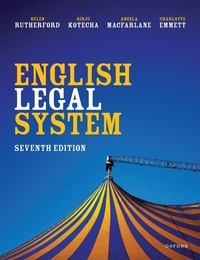
English Legal System 7e
7th Edition
Will be published approx. on 20. September 2026
Book
Paperback/Softback
688 pages
978-0-19-895497-2 (ISBN)
Description
Straightforward explanations of key topics are paired with learning features showcasing the law in its everyday context to give students a firm grasp of the fundamentals of the legal system.
- Covers a wide range of topics without overwhelming students with detail, allowing students to feel confident in their understanding of the essentials
- An introductory chapter provides valuable advice on studying the English legal system and making the transition from school to university, helping students to adapt quickly to their new studies
- Carefully designed learning features encourage students to consider thought-provoking or controversial topics, and form their own views on potential areas of reform, giving them a good grounding for the rest of their course
- Examples throughout the text put the law in its everyday context and show students the practical implications of the concepts discussed
- Also available as an e-book enhanced with self-test questions and video content to offer a fully immersive experience and extra learning support
New to this edition
- Major Legislative Updates: Coverage of the Terminally Ill Adults (End of Life) Bill, Sentencing Bill, and Post Office (Horizon System) Offences Act-key developments shaping UK law and justice.
- Criminal Justice Reform: Insight into the Leveson Review of the UK Criminal Courts, updated Criminal Procedure Rules, and new PACE Code I, reflecting evolving standards in criminal practice.
- Legal Profession & Diversity: Latest data on judicial appointments, legal profession composition, and Solicitors Qualifying Examination outcomes, with a focus on equality, diversity, and inclusion.
- Technology & Law: Exploration of the impact of AI on legal practice, including analysis of recent contempt cases and broader implications for legal ethics and procedure.
- Human Rights & Statutory Interpretation: Case studies on climate change and human rights (Verein KlimaSeniorinnen Schweiz v Switzerland) and gender recognition (For Women Scotland Ltd v The Scottish Ministers), offering critical perspectives on statutory interpretation.
The seventh edition is available for students and institutions to purchase in a variety of formats, and is supported by online resources.
- The enhanced e-book offers a mobile experience and convenient access along with self-test questions, author videos and links that offer extra learning support: www.oxfordtextbooks.co.uk/ebooks
The online resources, accessible via Law Trove and the e-book, include:
- Self-test multiple-choice question with instant feedback
- Author and third-party videos to illustrate the English legal system in action
- Guidance on reading cases
- Links to useful websites
- Covers a wide range of topics without overwhelming students with detail, allowing students to feel confident in their understanding of the essentials
- An introductory chapter provides valuable advice on studying the English legal system and making the transition from school to university, helping students to adapt quickly to their new studies
- Carefully designed learning features encourage students to consider thought-provoking or controversial topics, and form their own views on potential areas of reform, giving them a good grounding for the rest of their course
- Examples throughout the text put the law in its everyday context and show students the practical implications of the concepts discussed
- Also available as an e-book enhanced with self-test questions and video content to offer a fully immersive experience and extra learning support
New to this edition
- Major Legislative Updates: Coverage of the Terminally Ill Adults (End of Life) Bill, Sentencing Bill, and Post Office (Horizon System) Offences Act-key developments shaping UK law and justice.
- Criminal Justice Reform: Insight into the Leveson Review of the UK Criminal Courts, updated Criminal Procedure Rules, and new PACE Code I, reflecting evolving standards in criminal practice.
- Legal Profession & Diversity: Latest data on judicial appointments, legal profession composition, and Solicitors Qualifying Examination outcomes, with a focus on equality, diversity, and inclusion.
- Technology & Law: Exploration of the impact of AI on legal practice, including analysis of recent contempt cases and broader implications for legal ethics and procedure.
- Human Rights & Statutory Interpretation: Case studies on climate change and human rights (Verein KlimaSeniorinnen Schweiz v Switzerland) and gender recognition (For Women Scotland Ltd v The Scottish Ministers), offering critical perspectives on statutory interpretation.
The seventh edition is available for students and institutions to purchase in a variety of formats, and is supported by online resources.
- The enhanced e-book offers a mobile experience and convenient access along with self-test questions, author videos and links that offer extra learning support: www.oxfordtextbooks.co.uk/ebooks
The online resources, accessible via Law Trove and the e-book, include:
- Self-test multiple-choice question with instant feedback
- Author and third-party videos to illustrate the English legal system in action
- Guidance on reading cases
- Links to useful websites
More details
Edition
7th Revised edition
Language
English
Place of publication
Oxford
United Kingdom
Target group
College/higher education
Edition type
Revised edition
Dimensions
Height: 246 mm
Width: 189 mm
ISBN-13
978-0-19-895497-2 (9780198954972)
Copyright in bibliographic data and cover images is held by Nielsen Book Services Limited or by the publishers or by their respective licensors: all rights reserved.
Schweitzer Classification
Persons
Dr Helen Rutherford is an Associate Professor in Law at Northumbria University. She practised as a solicitor for several years and is a Qualified Teacher and Fellow of the HEA. Helen is Programme Leader for the Law Foundation Year and teaches civil litigation, legal history, and inquests on the MLaw and LLB degrees. She has managed civil firms in the pro-bono Student Law Office and has taught English legal system, tort, civil rights in practice, and trials of dissenters at undergraduate level and civil litigation on the Legal Practice Course.
Birju Kotecha is an Assistant Professor in Law at Northumbria University. He was called to the Bar by the Honourable Society of the Middle Temple in July 2021. He has taught English Legal System, Tort and Public International Law to undergraduates. He has also taught Professional Ethics to postgraduate students on the Bar Training Course. He has acted as admissions tutor for Bar programmes and chaired the Law School's Bar Scholarship committee.
Angela Macfarlane is a practising Solicitor, formerly an Assistant Professor in Law at Northumbria University and a Fellow of the HEA. Angela has practising experience in civil and criminal law including civil actions against the police, commercial, public and employment law. Angela has managed employment law firms in her former university's pro-bono Student Law Office, as Programme Leader of postgraduate law programmes and has taught commercial contracts, employment law, key skills for employability, information rights in employment, and equality and diversity at undergraduate and postgraduate level.
Dr Charlotte Emmett is an Associate Professor of Law at Northumbria University. Before entering academia, she worked as a solicitor in private practice, both in the UK and overseas. Charlotte has over 25 years' experience in Higher Education, having served as Director of Education in the Law School for over four years and currently serving as the School's Equality, Diversity and Inclusion Lead. A Senior Fellow of the Higher Education Academy, Charlotte has designed and taught a wide range of academic and skills-based programmes on the LPC, Bar Course, MLaw and LLB degrees, including property law and conveyancing, civil dispute resolution, tort law, and advanced personal injury law.
Birju Kotecha is an Assistant Professor in Law at Northumbria University. He was called to the Bar by the Honourable Society of the Middle Temple in July 2021. He has taught English Legal System, Tort and Public International Law to undergraduates. He has also taught Professional Ethics to postgraduate students on the Bar Training Course. He has acted as admissions tutor for Bar programmes and chaired the Law School's Bar Scholarship committee.
Angela Macfarlane is a practising Solicitor, formerly an Assistant Professor in Law at Northumbria University and a Fellow of the HEA. Angela has practising experience in civil and criminal law including civil actions against the police, commercial, public and employment law. Angela has managed employment law firms in her former university's pro-bono Student Law Office, as Programme Leader of postgraduate law programmes and has taught commercial contracts, employment law, key skills for employability, information rights in employment, and equality and diversity at undergraduate and postgraduate level.
Dr Charlotte Emmett is an Associate Professor of Law at Northumbria University. Before entering academia, she worked as a solicitor in private practice, both in the UK and overseas. Charlotte has over 25 years' experience in Higher Education, having served as Director of Education in the Law School for over four years and currently serving as the School's Equality, Diversity and Inclusion Lead. A Senior Fellow of the Higher Education Academy, Charlotte has designed and taught a wide range of academic and skills-based programmes on the LPC, Bar Course, MLaw and LLB degrees, including property law and conveyancing, civil dispute resolution, tort law, and advanced personal injury law.
Content
1: Studying the English legal system 2: An overview of the English legal system 3: Legislation and the law-making process 4: The interpretation of statutes 5: The doctrine of judicial precedent 6: The law and the institutions of the European Union 7: Human rights in the United Kingdom 8: The judiciary 9: The legal profession 10: Access to justice 11: The criminal process: the suspect and the police 12: The criminal process: pre-trial and trial 13: The jury 14: Sentencing 15: The civil process 16: Alternative dispute resolution 17: Tribunals 18: Criminal and civil appeals