

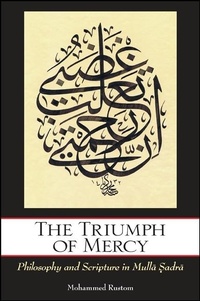
The Triumph of Mercy
Philosophy and Scripture in Mulla ?adra
Published on 2. July 2013
Book
Paperback/Softback
255 pages
978-1-4384-4340-9 (ISBN)
Description
Discusses philosopher Mulla ?adra's commentary on the opening chapter of the Qur'an.
Winner of the 21st International Book of the Year Prize in Iran
This book investigates the convergence of philosophy, scriptural exegesis, and mysticism in the thought of the celebrated Islamic philosopher Mulla ?adra (d. 1050/1640). Through a careful presentation of the theoretical and practical dimensions of ?adra's Qur'anic hermeneutics, Mohammed Rustom highlights the manner in which ?adra offers a penetrating metaphysical commentary upon the Fati?a, the chapter of the Qur'an that occupies central importance in Muslim daily life. Engaging such medieval intellectual giants as Fakhr al-Din al-Razi (d. 606/1210) and Ibn 'Arabi (d. 638/1240) on the one hand, and the wider disciplines of philosophy, theology, Sufism, and Qur'anic exegesis on the other, ?adra's commentary upon the Fati?a provides him with the opportunity to modify and recast many of his philosophical positions within a scripture-based framework. He thereby reveals himself to be a profound religious thinker who, among other things, argues for the salvation of all human beings in the afterlife.
Winner of the 21st International Book of the Year Prize in Iran
This book investigates the convergence of philosophy, scriptural exegesis, and mysticism in the thought of the celebrated Islamic philosopher Mulla ?adra (d. 1050/1640). Through a careful presentation of the theoretical and practical dimensions of ?adra's Qur'anic hermeneutics, Mohammed Rustom highlights the manner in which ?adra offers a penetrating metaphysical commentary upon the Fati?a, the chapter of the Qur'an that occupies central importance in Muslim daily life. Engaging such medieval intellectual giants as Fakhr al-Din al-Razi (d. 606/1210) and Ibn 'Arabi (d. 638/1240) on the one hand, and the wider disciplines of philosophy, theology, Sufism, and Qur'anic exegesis on the other, ?adra's commentary upon the Fati?a provides him with the opportunity to modify and recast many of his philosophical positions within a scripture-based framework. He thereby reveals himself to be a profound religious thinker who, among other things, argues for the salvation of all human beings in the afterlife.
Reviews / Votes
"Written with eminent clarity ... [The Triumph of Mercy] fuses the best of scholarship in Islamic studies with a refined textual approach that is simultaneously historical, analytical, and phenomenological." - Studia Islamica"...[a] systematic study ... Student and specialist will find it supremely useful in a field that has too long been stuck in the 'interdisciplinary' boondocks." - Journal of the Royal Asiatic Society
"...a beautifully written study on the celebrated Islamic philosopher Mulla ?adra ... The translations are flawless and the discussions, rich with intellectual history, are lucid and meaningful." - American Journal of Islamic Social Sciences
"...a path-breaking study which will usher in new ways of envisioning the relationship between philosophy, mysticism, and the Qur'an ... it is an excellent contribution to the burgeoning fields of post-Avicennian Islamic intellectual history, Sufi and non-Sufi tafsir, and Mulla ?adra studies." - Journal of Sufi Studies
"...the book enjoys both academic rigor and an accessible narrative ... The Triumph of Mercy is both a contribution to Mulla ?adra scholarship and a worthwhile addition to exegetical literature." - Iranian Studies
"...Rustom's masterful study ... is an original and valuable asset to both academics and lay readers who have some background and interest in Islamic philosophy, Sufism and qur'anic exegesis ... [the] work is a valuable addition to the fields of philosophy and Islamic studies, and will be a source of inspiration and discussion for years to come." - Islam and Christian-Muslim Relations
"...this book is an excellent introduction to Mulla ?adra's mystic thought as it appears in his commentary of al-Fati?ah. Above all, the author explains clearly Mulla ?adra's concept of being in relation to scripture ... this book is a fine philological work." - Journal of Shi?a Islamic Studies
"...Rustom's study will both generate and provide the ground for increased scholarly attention to ?adra's religious writings." - Journal of Islamic Studies
"...Rustom reminds us how ?adra 'is able to successfully recast his sophisticated ontology of the fundamentality of being into a theological and scripture-based framework' (p. 118), thereby recommending his work to anyone seeking articulate access to Islamic theology." - Modern Theology
"Informed, informative, and a superb example of seminal scholarship, The Triumph of Mercy is a highly recommended and core addition to academic library Islamic Studies and Philosophy Studies reference collections and supplemental reading lists." - Midwest Book Review
"By focusing on ?adra's commentary on the Qur'an's opening chapter, Rustom shows how the great Iranian thinker created an original Qur'anic hermeneutics as well as a new ontology of the Qur'an. Rustom's book is a groundbreaking and richly detailed study of the way that ?adra both appropriated and transcended the Islamic traditions of theology, mysticism, philosophy, and scriptural exegesis." - Robert Wisnovsky, author of Avicenna's Metaphysics in Context
"Mohammed Rustom has opened the door to a remarkable philosophical exegesis of the Qur'an in this pathbreaking study of the outstanding Iranian thinker of the seventeenth century, Mulla ?adra. In the process, he clarifies the profound connections between philosophy, Sufism, and Islamic theology in ?adra's work. This absorbing study will be welcomed by anyone interested in the fundamental question of how reason interacts with revelation." - Carl W. Ernst, author of How to Read the Qur'an: A New Guide, with Select Translations
"This first book-length survey of Mulla ?adra's Qur'anic commentaries is a major contribution to the study of this seventeenth-century Muslim philosopher and to the field of philosophical exegesis in Islam. Mohammed Rustom presents ?adra's vision for the unity of the 'intellectual' and 'transmitted' sciences and gives us a complete picture of a first-rate thinker contemplating upon the Qur'an. He does an excellent job of contextualizing ?adra's Qur'anic hermeneutics within the framework of his 'Transcendent Wisdom' and shows how scriptural reasoning complements philosophical vision. Based on an in-depth reading and translation of ?adra's key texts on Qur'anic exegesis, the book examines a much-neglected aspect of ?adra's thought and introduces the reader to the rich philosophical tapestry of the Islamic intellectual tradition." - Ibrahim Kalin, author of Knowledge in Later Islamic Philosophy: Mulla ?adra on Existence, Intellect, and Intuition
More details
Language
English
Place of publication
Albany, NY
United States
Target group
Professional and scholarly
US School Grade: College Graduate Student and over
Product notice
Paperback (trade)
Dimensions
Height: 229 mm
Width: 156 mm
Thickness: 20 mm
Weight
385 gr
ISBN-13
978-1-4384-4340-9 (9781438443409)
Copyright in bibliographic data and cover images is held by Nielsen Book Services Limited or by the publishers or by their respective licensors: all rights reserved.
Schweitzer Classification
Other editions
Additional editions
E-Book
09/2012
1st Edition
State University of New York Press
from
€84.99
Available for download
Person
Mohammed Rustom is Assistant Professor of Islamic Studies at Carleton University. He is the coeditor (with Atif Khalil and Kazuyo Murata) of In Search of the Lost Heart: Explorations in Islamic Thought by William C. Chittick, also published by SUNY Press.
Content
Acknowledgments
Transliterations and Abbreviations
Introduction
1. Qur'anic Hermeneutics
Lord of the Heart
Etiquette and Understanding
Concept and Reality
The Command's Decent
The Soul's Ascent
2. Formal Considerations
Texts and Sources
Structure and Content
3. Metaphysics
The Essence
Names and their Loci
4. Cosmology
The Act of Praise
The Muhammadan Reality
5. Theology
From Outer to Inner
Idols of Belief
The Religion of the Perfect Man
6. Soteriology I
The Nature of Things
The Essential and the Accidental
7. Soteriology II
Paths to Mercy
Divine Hands and Feet
Intellectual and Scriptural Fidelity
Revealing and Concealing
Chastisement's Sweetness
Conclusion
Appendix 1: Some Key Texts from the Mafati? al-Ghayb
Appendix 2: Key Texts from the Tafsir Surat al-Fati?a
Appendix 3: Passages from the Futu?at Reworked into the Tafsir Surat al-Fati?a
Notes
Bibliography
Index of Qur'anic Passages
Index of ?adiths and Sayings
Index of Names and Terms
Transliterations and Abbreviations
Introduction
1. Qur'anic Hermeneutics
Lord of the Heart
Etiquette and Understanding
Concept and Reality
The Command's Decent
The Soul's Ascent
2. Formal Considerations
Texts and Sources
Structure and Content
3. Metaphysics
The Essence
Names and their Loci
4. Cosmology
The Act of Praise
The Muhammadan Reality
5. Theology
From Outer to Inner
Idols of Belief
The Religion of the Perfect Man
6. Soteriology I
The Nature of Things
The Essential and the Accidental
7. Soteriology II
Paths to Mercy
Divine Hands and Feet
Intellectual and Scriptural Fidelity
Revealing and Concealing
Chastisement's Sweetness
Conclusion
Appendix 1: Some Key Texts from the Mafati? al-Ghayb
Appendix 2: Key Texts from the Tafsir Surat al-Fati?a
Appendix 3: Passages from the Futu?at Reworked into the Tafsir Surat al-Fati?a
Notes
Bibliography
Index of Qur'anic Passages
Index of ?adiths and Sayings
Index of Names and Terms