

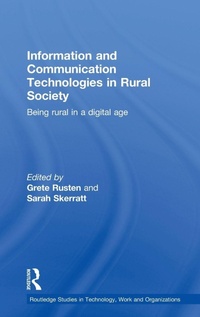
Information and Communication Technologies in Rural Society
1st Edition
Published on 11. October 2007
Book
Hardback
200 pages
978-0-415-41116-5 (ISBN)
Description
Drawing together the experiences of individuals, households and businesses, this book offers an international perspective on the on how and the extent to which the experiential nature of being rural, whether as an business manager in an SME (or micro-enterprise), a non-business person, a retired inhabitant or a housewife is changing as Information and Communication Technologies become applied more widely and allow people to be connected across geographies.
The contributors investigate ways in which these ICTs are being variously experienced in rural areas of Europe, providing a commentary on changing ruralities and their implications for European, national and regional Information Society policies. These changing ruralities are presented here as the lived experiences of individuals, businesses and communities, and the ways in which their experiences are being enhanced, undermined and variously modified through application of ICTs within business, home, leisure and social relations. The book examines the space and place implications of these changes, as reported in a range of rural settings within Scandinavia and Western Europe.
An essential read for economists interested in the area, Information and Communication Technologies in Rural Society will benefit postgraduate students in areas of research such as rural development, regional development and new technology management among others.
The contributors investigate ways in which these ICTs are being variously experienced in rural areas of Europe, providing a commentary on changing ruralities and their implications for European, national and regional Information Society policies. These changing ruralities are presented here as the lived experiences of individuals, businesses and communities, and the ways in which their experiences are being enhanced, undermined and variously modified through application of ICTs within business, home, leisure and social relations. The book examines the space and place implications of these changes, as reported in a range of rural settings within Scandinavia and Western Europe.
An essential read for economists interested in the area, Information and Communication Technologies in Rural Society will benefit postgraduate students in areas of research such as rural development, regional development and new technology management among others.
More details
Series
Language
English
Place of publication
London
United Kingdom
Publishing group
Taylor & Francis Ltd
Target group
College/higher education
Illustrations
14 s/w Abbildungen, 8 s/w Photographien bzw. Rasterbilder, 6 s/w Zeichnungen, 16 s/w Tabellen
16 Tables, black and white; 6 Line drawings, black and white; 8 Halftones, black and white; 14 Illustrations, black and white
Dimensions
Height: 240 mm
Width: 161 mm
Thickness: 16 mm
Weight
482 gr
ISBN-13
978-0-415-41116-5 (9780415411165)
Copyright in bibliographic data and cover images is held by Nielsen Book Services Limited or by the publishers or by their respective licensors: all rights reserved.
Schweitzer Classification
Other editions
Additional editions
Grete Rusten | Sarah Skerratt
Information and Communication Technologies in Rural Society
E-Book
10/2007
Routledge
€60.49
Available for download
Grete Rusten | Sarah Skerratt
Information and Communication Technologies in Rural Society
E-Book
10/2007
Routledge
€60.49
Available for download
Persons
Grete Rusten is Senior Researcher at the Institute for Research in Economics and Business Administration in Bergen, Norway
Sarah Skerratt is Senior Researcher and Team Leader in Rural Development and Society Research at the Scottish Agricultural College in Edinburgh
Sarah Skerratt is Senior Researcher and Team Leader in Rural Development and Society Research at the Scottish Agricultural College in Edinburgh
Content
1. Being Rural in a Digital Age 2. Lost in Cyberspace?: Website Performance Among Firms Located in Rural Areas of Norway: The Niche Food Sector 3. Lone Eagles and High Flyers: Rural-based Business and Professional Service Firms and Information Communication Technology 4. Connecting Local Food to Global Consumers via the Internet 5. The Persistence of Place: The Importance of Shared Participation Environments When Deploying Icts in Rural Areas 6. Digital Divides Within Households 7. Revitalising Rural Europe's Indigengous Languages: 'Technologisation' and the Gaelic Language 8. Policy and the Rural Information Society