

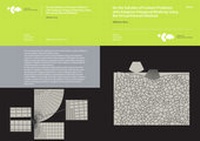
On the Solution of Contact Problems with Adaptive Polygonal Meshing Using the Virtual Element Method
Published on 9. July 2019
Book
160 pages
978-3-941302-32-7 (ISBN)
Unfortunately, price unknown
Available (delivery time upon request)
Not available
Description
This work describes the application of the virtual element method (VEM) to
contact problems between elastic bodies.
The easiest approach to solve contact problems using a discretisation
scheme is a node-to-node method where degrees of freedom from both
bodies are directly linked by constraints that are enforced by a penalty or
Lagrange multiplier method. This direct link, however, is only possible for
matching meshes on both surfaces.
For the case of non-matching meshes at the contact surfaces this work
presents an adaptive meshing scheme that includes node insertion and
remeshing with polygonal elements to create nodal pairs. Basis is the
virtual element method (VEM) as a generalisation of the finite element
method (FEM). It can handle arbitrarily shaped elements with an arbitrary
number of nodes. The work shows advantages of this new discretisation
scheme for treating contact in comparison to classical finite element
approaches.
contact problems between elastic bodies.
The easiest approach to solve contact problems using a discretisation
scheme is a node-to-node method where degrees of freedom from both
bodies are directly linked by constraints that are enforced by a penalty or
Lagrange multiplier method. This direct link, however, is only possible for
matching meshes on both surfaces.
For the case of non-matching meshes at the contact surfaces this work
presents an adaptive meshing scheme that includes node insertion and
remeshing with polygonal elements to create nodal pairs. Basis is the
virtual element method (VEM) as a generalisation of the finite element
method (FEM). It can handle arbitrarily shaped elements with an arbitrary
number of nodes. The work shows advantages of this new discretisation
scheme for treating contact in comparison to classical finite element
approaches.