

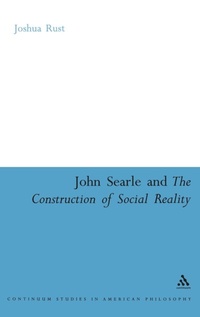
John Searle and the Construction of Social Reality
Published on 15. December 2005
Book
Hardback
224 pages
978-0-8264-8586-1 (ISBN)
Description
John Searle (1932-) is one of the most famous living American philosophers. A pupil of J. L. Austin at Oxford in the 1950s, he is currently Mills Professor of the Philosophy of Mind and Language at the University of California, Berkeley. In 1995 John Searle published "The Construction of Social Reality", a text which not only promises to disclose the institutional backdrop against which speech takes place, but initiate a new 'philosophy of society'. Since then "The Construction of Social Reality" has been subject to a flurry of criticism. While many of Searle's interlocutors share the sense that the text marks an important breakthrough, he has time and again accused critics of misunderstanding his claims. Despite Searle's characteristic crispness and clarity there remains some confusion, among both philosophers and sociologists, regarding the significance of his proposals. This book traces some of the high points of this dialogue, leveraging Searle's own clarifications to propose a new way of understanding the text. In particular, Joshua Rust looks to Max Weber in suggesting that Searle has articulated an ideal type.
In locating The Construction of Social Reality under the umbrella of one of sociology's founding fathers, this book not only makes Searle's text more accessible to the readers in the social sciences, but presents Max Weber as a thinker worthy of philosophical reconsideration. Moreover, the recharacterization of Searle's claims in terms of the ideal type helps facilitate a comparison between Searle and other social theorists such as Talcott Parsons.
In locating The Construction of Social Reality under the umbrella of one of sociology's founding fathers, this book not only makes Searle's text more accessible to the readers in the social sciences, but presents Max Weber as a thinker worthy of philosophical reconsideration. Moreover, the recharacterization of Searle's claims in terms of the ideal type helps facilitate a comparison between Searle and other social theorists such as Talcott Parsons.
Reviews / Votes
"'... among the best work I have read in social philosophy... Anyone interested in the nature and function of philosophy in the social sciences could take some valuable lessons from this book. The reader may discover that what she hoped or thought social philosophy could do is not what it does at all.' Eric Schwitzgebel, University of California, Riverside, CA"More details
Series
Language
English
Place of publication
London
United Kingdom
Publishing group
Bloomsbury Publishing PLC
Target group
College/higher education
Professional and scholarly
Dimensions
Height: 240 mm
Width: 161 mm
Thickness: 16 mm
Weight
496 gr
ISBN-13
978-0-8264-8586-1 (9780826485861)
Copyright in bibliographic data and cover images is held by Nielsen Book Services Limited or by the publishers or by their respective licensors: all rights reserved.
Schweitzer Classification
Other editions
Additional editions
E-Book
12/2005
1st Edition
Continuum International Publishing Group Ltd.
€189.99
Available for download
Person
Joshua Rust was a student of John Searle's at Berkeley in the mid-1990s. He is currently at the University of California, Riverside, CA.
Content
Introduction; 1. Creating Institutional Reality: Dreyfus on Searle; 2. Institutional Atomism: Hacking on Searle; 3. Two criticisms of Institutional Atomism. 4. The Structure of Social Scientific Revolutions: Kuhn and Weber; 5. Searle and Weber: applications of the constitutive formula; 6. Searle and Weber: the constitutive formula; Bibliography; Index.